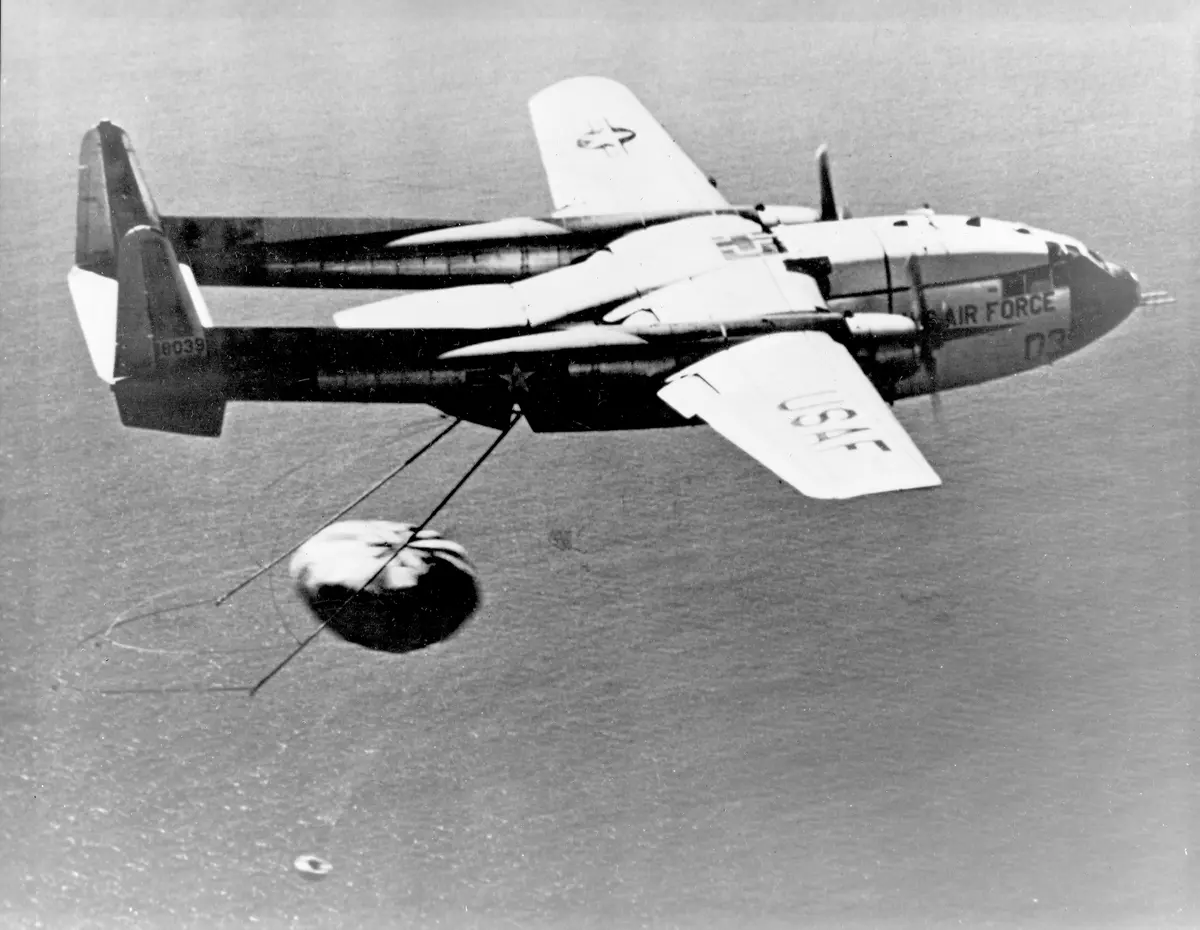
Corona, the first spy satellite, returns film from orbit
“On 19 August 1960 an Air Force C-119 caught a falling capsule of film from the secret satellite Discoverer 14 in mid-air near Hawaii: the first photographs returned from orbit, taken over the Soviet Union.”
On 19 August 1960 a US Air Force cargo plane flew low over the Pacific, some 360 miles (580 km) south-west of Honolulu, trailing a loop of nylon line from two long poles lowered out of its open tail. Ahead of it a gold capsule, the size and shape of a kettle drum, was falling under an orange and silver parachute. The pilot, Captain Harold Mitchell, missed twice. On the third pass he felt a small tug: the loop had caught the parachute and the crew could winch the capsule aboard. Inside was a roll of exposed film from the satellite Discoverer 14, the first film ever brought back from orbit.
The public was told that Discoverer was a science programme, with mice and monkeys on board. In truth it was Corona, a secret satellite camera run by the CIA and the Air Force. The idea was put to President Eisenhower on 7 February 1958 by James Killian and Edwin Land: a satellite would circle the Earth a few times and drop its film in a capsule. America had a pressing need. The U-2 spy plane had flown over the Soviet Union only 24 times in four years, and on 1 May 1960 the Soviets shot one down. Nobody in Washington knew how many missiles and bombers the Soviets really had.
Corona nearly died on the way. The first thirteen Discoverer flights brought back no usable picture. Rockets failed, capsules came down in the wrong place, and the film itself snapped in the vacuum of space until Kodak found a tougher polyester base. Discoverer 13, launched on 10 August 1960, carried no camera, only a flag; its capsule was fished out of the sea the next day, the first object ever recovered from orbit. So 'first film' belongs to Discoverer 14, which was launched on 18 August, made 17 orbits, ejected its capsule over Alaska and was caught in mid-air the next day.
The pictures were rough, but one mission covered more of the Soviet Union than all the U-2 flights together. Eisenhower and the CIA director studied them on 25 August 1960. Analysts counted new airfields and 26 new anti-aircraft missile sites, and within months the fear of a Soviet 'missile gap' began to fade. Corona went on for 145 launches until May 1972 and made it possible to check arms-control treaties from space. Its pictures were declassified on 22 February 1995, and more than 800,000 of them are now open to anyone in the US National Archives and the US Geological Survey.
What happened
- 1960
A Soviet missile brings down Francis Gary Powers's U-2 near Sverdlovsk. In four years 24 U-2 flights had crossed the Soviet Union; now President Eisenhower stops them all, and the CIA has no way to look inside the country except a satellite that has not yet worked.
Discoverer 13 lifts off from Vandenberg at 20:37 UTC on a Thor-Agena. It is a test flight with no camera and no film, carrying instruments and an American flag.
Vandenberg Space Launch Complex 1 West (Pad 75-3-4), California: where the Thor-Agena carrying Discoverer 14 lifted off on 18 August 1960The Discoverer 13 capsule comes down in the Pacific north-west of Hawaii. The planes sent to catch it chase the wrong signal and miss it, so the ship Haiti Victory fishes it from the sea: the first object ever recovered from orbit.
National Air and Space Museum, Washington: the Discoverer XIII capsule, the first object recovered from orbit, is on display hereGeneral Thomas White presents President Eisenhower with the Discoverer 13 flag and capsule, and Eisenhower congratulates the builders. The press is told it is a science success; the real purpose is secret.
The White House, Washington: where Eisenhower received the Discoverer XIII capsule and flag on 15 August 1960Discoverer 14 is launched from Vandenberg at 19:55 UTC. The Agena upper stage starts badly, almost tumbling and burning too much control gas, but steadies by mid-flight, and the camera works. The first target it photographs is the airfield at Mys Shmidta.
Vandenberg Space Launch Complex 1 West (Pad 75-3-4), California: where the Thor-Agena carrying Discoverer 14 lifted off on 18 August 1960On eight passes over the Soviet Union, with strips reaching China and south-east Europe, the camera exposes its film; roughly a quarter of the coverage is free of cloud.
Captain Harold Mitchell's C-119J, call sign Pelican 9, sights the orange and silver parachute 4,000 feet above and slows to 120 knots. He misses it twice and hooks it on the third pass, at about 8,500 feet, about 360 miles south-west of Honolulu. His crew winches the capsule in and he reports it on board. The planes to the north are still chasing a false radar echo.
Capsule catch area in the Pacific, about 360 miles south-west of Honolulu: where Pelican 9 hooked the parachute on 19 August 1960Pelican 9 lands at Hickam to a crowd of families and reporters. Captain Mitchell is given the Distinguished Flying Cross on the spot and each crew member an Air Medal; they fly to the US mainland that night for a television tour.
Hickam Air Force Base, Honolulu: home of the 6593d Test Squadron (Special) and the C-119J recovery aircraft; the crew landed here on the evening of 19 August 1960- 12:46 p.m.
The film capsule is ejected over Alaska at the end of the satellite's 17th orbit; the command post at Hickam reports it at 12:46 local time. A retro-rocket slows it and the parachute opens.
Hickam Air Force Base, Honolulu: home of the 6593d Test Squadron (Special) and the C-119J recovery aircraft; the crew landed here on the evening of 19 August 1960 The Soviet Union recovers the capsule of Korabl-Sputnik 2, with the dogs Belka and Strelka alive. The Americans had brought back Discoverer 13's capsule nine days earlier.
Six days after the catch, Eisenhower and the Director of Central Intelligence, Allen Dulles, inspect the photographs, rated 'good to very good'. Analysts find 64 airfields and 26 new anti-aircraft missile sites in territory the U-2 never reached.
The Photographic Intelligence Center issues the Joint Mission Coverage Index for Mission 9009. It lists the Kapustin Yar missile range, the Sarov nuclear weapons laboratory, new SA-2 missile sites and several new airfields; in a few weeks of analysis the fear of a Soviet 'missile gap' starts to fall apart.