Hülsmeyer's Telemobiloskop detects ships by radio
“In May 1904 Christian Hülsmeyer made a bell ring in Cologne when radio waves bounced back from a metal object: the first patented use of radio echoes, and nobody bought it.”
In May 1904 a 22-year-old inventor from Düsseldorf, Christian Hülsmeyer, showed in Cologne a wooden box that could tell when a metal object was near. A spark transmitter sent out radio waves in a narrow beam. A receiver with a curved reflector listened for the echo, and when one came back it rang an electric bell. He called the box the Telemobiloskop. He had read that Heinrich Hertz proved metal reflects radio waves, and he wanted a warning for ships in fog and darkness.
He filed the German patent on 30 April 1904. On the morning of 17 May, in the courtyard of the Dom Hotel, he showed it to engineers of two Bremen shipping companies. The box rang when its waves bounced off the metal gate about ten metres away, even with a curtain in between. A trial on the Rhine bank under the railway bridge followed, with the bell ringing as barges passed at a few hundred metres. On 9 June he repeated it on the harbour tender Columbus in Rotterdam, during a conference of shipping lines at Scheveningen. The conference minutes say the set was unfinished, but it reacted every time a vessel passed.
Nobody bought it. The German navy said a ship's steam whistle could be heard farther than the box could sense. Telefunken wrote in August 1905 that it saw no use for it. Marconi's company already supplied ship radio, and the Telemobiloskop had no tuning, so any other radio spark could set it off. A new trial near the Hook of Holland in autumn 1904 failed, and the shipping lines' meeting in London in June 1905 gave up on the idea. Hülsmeyer closed his firm in October 1905 and went on to make boilers and filters, with about 180 patents in all.
Was it radar? It found an object and showed its direction with a pointer he called the Kompass, but it could not time the echo to measure distance. A second patent proposed estimating range from angles instead. Radar proper came in the 1930s: Rudolf Kühnhold showed a naval set in Germany in 1934, and Robert Watson-Watt's Daventry test followed in 1935. At a radar conference in 1953 Watson-Watt is said to have told Hülsmeyer that he was the father of radar and Hülsmeyer its grandfather. In 2019 the IEEE put a plaque on the Rhine bank in Cologne to mark the 1904 demonstration.
What happened
- 1903
Hülsmeyer, working in Düsseldorf, files his first application for a 'Telemobiloskop', a device to warn of metal objects by radio waves. It is refused soon after.
Düsseldorf: Hülsmeyer's home and workshop from 1902, and the address on his patents- 1904
He files a US application for a wireless remote-control apparatus with a coherer and a clockwork selector. It is granted as US 810150 in January 1906 and has nothing to do with ships, but the receiver is of the kind Bauer thinks he used to excite his audience in Cologne.
Heinrich Mannheim, a Cologne merchant, agrees before a notary to put 2,000 marks into the venture for 20 per cent of future profits.
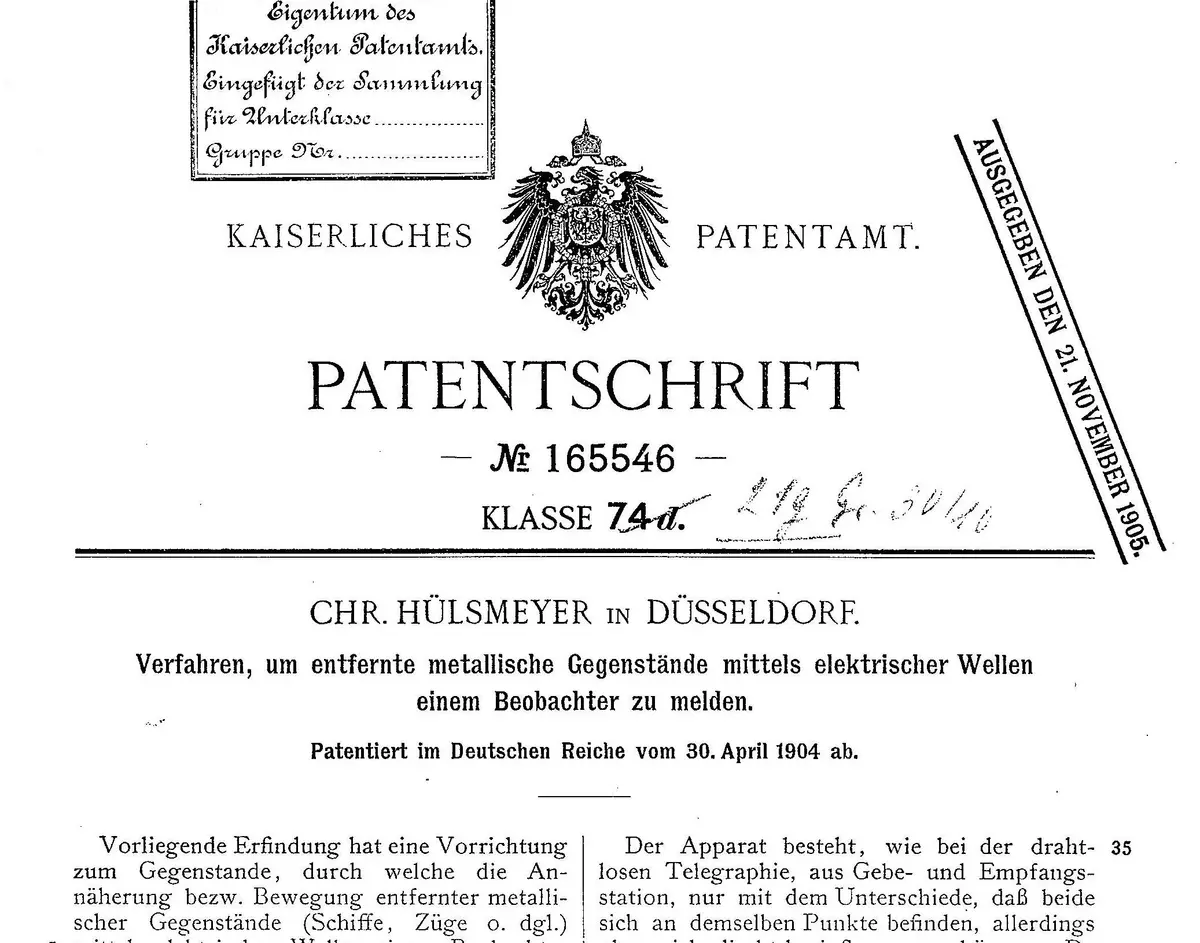
Hülsmeyer files the second, accepted application: a method for reporting distant metal objects such as ships or trains to an observer by electric waves. It becomes German patent 165546.
The firm 'Telemobiloskop-Gesellschaft Hülsmeyer & Mannheim' begins. It is entered in the Cologne register on 7 July.
- 11:00 a.m.
At 11:00, in the courtyard of the Dom Hotel, Hülsmeyer shows a small model to senior engineers of Norddeutscher Lloyd and the Argo line, both of Bremen. The box reacts to the metal courtyard gate about ten metres away, still works behind a curtain and behind a low brick wall, and sets off a few cartridges.
The Dom Hotel at Domkloster, Cologne: the courtyard where Hülsmeyer gave the first public showing on 17 May 1904 The Cologne papers report the demonstration, and the news reaches the New York Times on 19 May. A trial on the Rhine bank under the railway bridge is dated 17 or 18 May: the bell rings as barges pass at a few hundred metres. His own memory, in a 1954 radio interview, was of showing the apparatus under the Rhine bridge.
The Rhine bank by the old Cathedral Bridge in Cologne: the site of the trial on the river, where the IEEE plaque now standsHülsmeyer & Mannheim answer a letter from J. V. Wierdsma, director of the Holland America Line in Rotterdam, who had read of the Cologne show and invited the firm to demonstrate an experimental set at a shipping conference in the Netherlands.
The nautical conference of the big shipping lines opens at Scheveningen and sits for three days.
Scheveningen: the seaside district of The Hague where the shipping lines' conference sat on 8-10 June 1904On the harbour tender Columbus, during the delegates' tour of Rotterdam harbour, the Telemobiloskop is tried 'on a very limited scale' and with an unfinished set. The minutes record that it reacted every time a vessel passed, even at some distance. The set could not yet give distance.
Rotterdam harbour: the demonstration on the tender Columbus, 9 June 1904A British application, no. 13170, is filed the day after Rotterdam, under the title 'Hertzian-wave projecting and receiving apparatus adapted to indicate or give warning of the presence of a metallic body, such as a ship or a train'.
The firm sells its rights to the Gumpel trading company of Hanover, which promises Hülsmeyer up to 5,000 marks for further work and 45 per cent of future net profit.
The British patent is granted in ten weeks.
A trial on a larger scale near the Hook of Holland, with the Columbus as the ship, fails. Hülsmeyer later remembered an autumn day; the date is not recorded.
Hook of Holland: where a trial in autumn 1904 failedHe files the additional patent for range: measuring the elevation angle from the ship's mast to the target and working out the distance by trigonometry. It is granted on 2 April 1906 as DE 169154.
- 1905
The shipping lines meet again in London. The minutes say the new trial at the Hook of Holland failed, and a delegate reported that the principle of the Telemobiloskop was shown to be in error, so that 'probably nothing more will be heard of it'.
Telefunken writes back that it sees no use for the invention.
Hülsmeyer has his firm deleted from the Cologne register and ends his attempt to sell the Telemobiloskop.
The Imperial Patent Office issues German patent specification 165546.