Jansky hears radio waves from the Milky Way
“From August 1931 to 1933 Bell Labs engineer Karl Jansky traced a faint radio hiss to a fixed point among the stars, near the centre of the Milky Way: the first radio waves from space and the start of radio astronomy.”
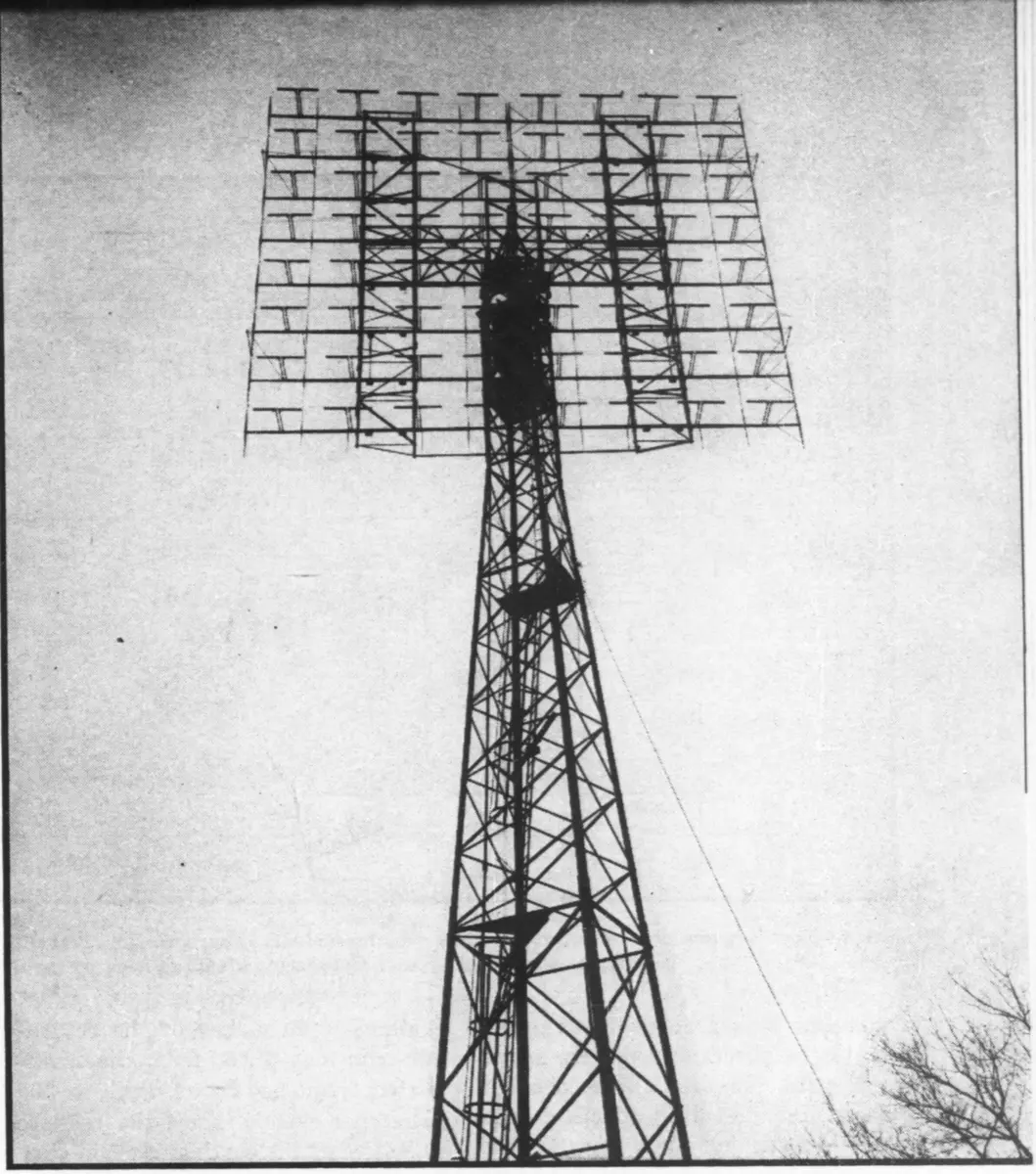
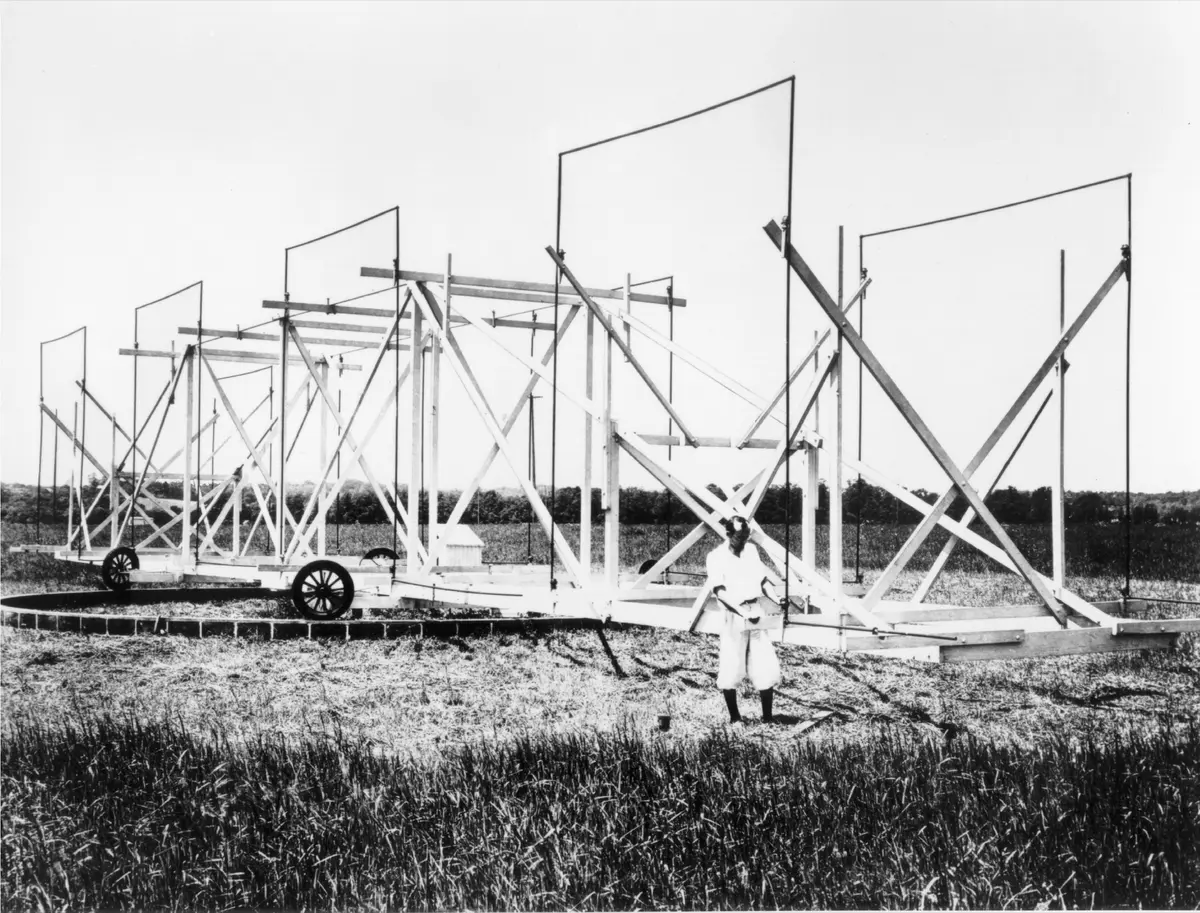
In 1931 Bell Telephone Laboratories wanted to know what spoiled radio calls on short waves, the kind it hoped to use for telephone calls across the Atlantic. A young engineer, Karl Jansky, who had joined the company in 1928 and worked at its field station at Holmdel, New Jersey, was told to study the static. He built a long rotating aerial: a Bruce-type array of brass pipe, two wavelengths long, on a wooden frame and four Ford wheels, turned by a motor once every 20 minutes, with a receiver tuned to 14.6 metres and a pen recorder. From the middle of August 1931 it wrote down the direction and strength of the static all day.
Jansky sorted what he heard into three kinds: static from storms near Holmdel, static from storms far away, and a third, very steady hiss, so faint that it was hard to tell from the set's own noise. He first picked it out in January 1932. At first it swept round the compass once a day and pointed at the Sun, and his first paper, in December 1932, said that its source was somehow tied to the Sun. But month by month the peak drifted away from the Sun's direction. It came about four minutes earlier each day, which is exactly the gap between a solar day and a sidereal day, 23 hours and 56 minutes, the time the Earth takes to turn once against the stars. By February 1933 he told his father that the hiss came from a direction fixed in space.
He announced it on 27 April 1933 at a meeting of the American section of the International Scientific Radio Union in Washington, in a paper called 'A Note on Hiss Type Atmospheric Noise', limited to 12 minutes; his boss had asked him not to make a bold claim. The New York Times put the story on its front page on 5 May, and on 15 May an evening radio programme on the Blue Network let listeners hear the hiss. His paper in the Proceedings of the Institute of Radio Engineers, in October 1933, gave the direction as right ascension 18 hours and declination minus 10 degrees. It said this was close to the direction of the centre of the Milky Way, and also to the point the solar system is heading for, and it left the choice open; the declination could be wrong by as much as 30 degrees.
The great discovery fell between two trades. Astronomers did not know what to do with radio engineers' hiss, and Bell Labs, in the Depression, had no reason to follow it; Jansky's time went to other work. In 1937 a young engineer, Grote Reber, built a dish in his Illinois back garden and mapped the Milky Way's radio glow, and after the Second World War radio astronomy grew fast. The bright spot Jansky found lies in Sagittarius, where the galactic centre is. Jansky died in 1950, aged 44. His name is now the unit of radio brightness (since 1973), a replica of his antenna stands at Green Bank, West Virginia, and the Holmdel site where he worked is where Penzias and Wilson found the cosmic microwave background in 1964-65, with a horn antenna a short way from the spot.
What happened
- 1931
Records begin. From the middle of August 1931 Jansky's rotating array at Holmdel records the direction and strength of short-wave static on 14.6 metres on a pen recorder. The antenna is a brass-pipe array two wavelengths long on a wooden frame and four wheels, turned once every 20 minutes by a motor. Traces of a steady hiss appear on the records from the summer and autumn, but he takes it for an unmodulated carrier.
Holmdel, New Jersey: Bell Telephone Laboratories' field station, where the rotating antenna stood just southeast of the new laboratory building from 1930 until it was taken down in 1944; a stainless-steel model of it was dedicated near the site on 8 June 1998 (the Holmdel horn of 1964-65 is nearby)- 1932
The hiss is recognised. Jansky says in print that this third kind of static was 'first definitely recognized' only in January 1932, after he went back over the old records. His comprehensive study of it begins. In December and January its direction follows the Sun across the day.
Holmdel, New Jersey: Bell Telephone Laboratories' field station, where the rotating antenna stood just southeast of the new laboratory building from 1930 until it was taken down in 1944; a stainless-steel model of it was dedicated near the site on 8 June 1998 (the Holmdel horn of 1964-65 is nearby)Jansky writes to his parents that this static always comes from the same direction as the Sun, or very nearly: in his words, 'the peculiar thing about this static' is that its direction changes gradually.
Holmdel, New Jersey: Bell Telephone Laboratories' field station, where the rotating antenna stood just southeast of the new laboratory building from 1930 until it was taken down in 1944; a stainless-steel model of it was dedicated near the site on 8 June 1998 (the Holmdel horn of 1964-65 is nearby)The first paper. Jansky's account of the three kinds of static is read at the meeting of the American section of the International Scientific Radio Union (URSI) in Washington.
National Academy of Sciences building, 2101 Constitution Avenue, Washington, D.C.: where the American section of URSI met on 27 April 1933, and where Jansky read his twelve-minute paper (the same group met in Washington on 29 April 1932)A day's record kept: the chart that Jansky prints as Fig. 1 of his 1933 paper, made on 16 September 1932. The hiss peaks every 20 minutes as the aerial turns, and the record runs from midnight to midnight.
Holmdel, New Jersey: Bell Telephone Laboratories' field station, where the rotating antenna stood just southeast of the new laboratory building from 1930 until it was taken down in 1944; a stainless-steel model of it was dedicated near the site on 8 June 1998 (the Holmdel horn of 1964-65 is nearby)Jansky's first full paper appears in the Proceedings of the Institute of Radio Engineers. It describes the antenna, the three groups of static (local storms, distant storms, a steady hiss of unknown origin) and concludes that the hiss's source is 'somehow associated with the sun'. Few notice it; he later tells his father its title 'meant nothing to anybody'.
Holmdel, New Jersey: Bell Telephone Laboratories' field station, where the rotating antenna stood just southeast of the new laboratory building from 1930 until it was taken down in 1944; a stainless-steel model of it was dedicated near the site on 8 June 1998 (the Holmdel horn of 1964-65 is nearby)The last curve of the year. The eleventh and final average of 1932 is for 4 December. Across the eleven dates (from 21 January) the curve of the hiss's direction has slid steadily earlier, about two hours a month, until it has nearly come back to where it began: the pattern of a source fixed among the stars, not of the Sun.
Holmdel, New Jersey: Bell Telephone Laboratories' field station, where the rotating antenna stood just southeast of the new laboratory building from 1930 until it was taken down in 1944; a stainless-steel model of it was dedicated near the site on 8 June 1998 (the Holmdel horn of 1964-65 is nearby)- 1933
Jansky tells his father that the hiss comes 'not from the sun as I suggested in that paper, but from a direction fixed in space', and that the evidence is 'very conclusive and, I think, very startling'.
The announcement. At the URSI meeting at the National Academy of Sciences in Washington, Jansky reads a paper limited to 12 minutes, 'A Note on Hiss Type Atmospheric Noise'. The programme lists it between papers on audio-frequency atmospherics and a compact direction finder. His boss, Harald Friis, had urged him not to make a bold claim, and the title says nothing of the stars.
National Academy of Sciences building, 2101 Constitution Avenue, Washington, D.C.: where the American section of URSI met on 27 April 1933, and where Jansky read his twelve-minute paper (the same group met in Washington on 29 April 1932)The story reaches the front page of the New York Times, which describes radio waves traced to the centre of the Milky Way. This is the first time most of the world hears of it.
New York City: Bell Telephone Laboratories' headquarters on West Street, the address Jansky gave on both papers, and the home of the press release; the New York Times printed the story on its front page on 5 May 1933Listeners hear the hiss. At 8:30 p.m. the NBC Blue Network, through WJZ, broadcasts 'Hearing the Radio of the Stars': through the courtesy of AT&T's Long Lines department, the audience listens in to the receiver at Holmdel, 50 miles southwest of New York, while the static, with the faint star noise mixed into it, is played ten seconds at a time (the Archives call it a recording of the hiss); Jansky tells the host, named Caldwell in the typescript, that it comes from a point near the 18-hour meridian, about 10 degrees south of the equator, in Sagittarius.
Holmdel, New Jersey: Bell Telephone Laboratories' field station, where the rotating antenna stood just southeast of the new laboratory building from 1930 until it was taken down in 1944; a stainless-steel model of it was dedicated near the site on 8 June 1998 (the Holmdel horn of 1964-65 is nearby)The revised paper is presented at the Institute of Radio Engineers' Eighth Annual Convention in Chicago; the manuscript had reached the Institute on 22 June.
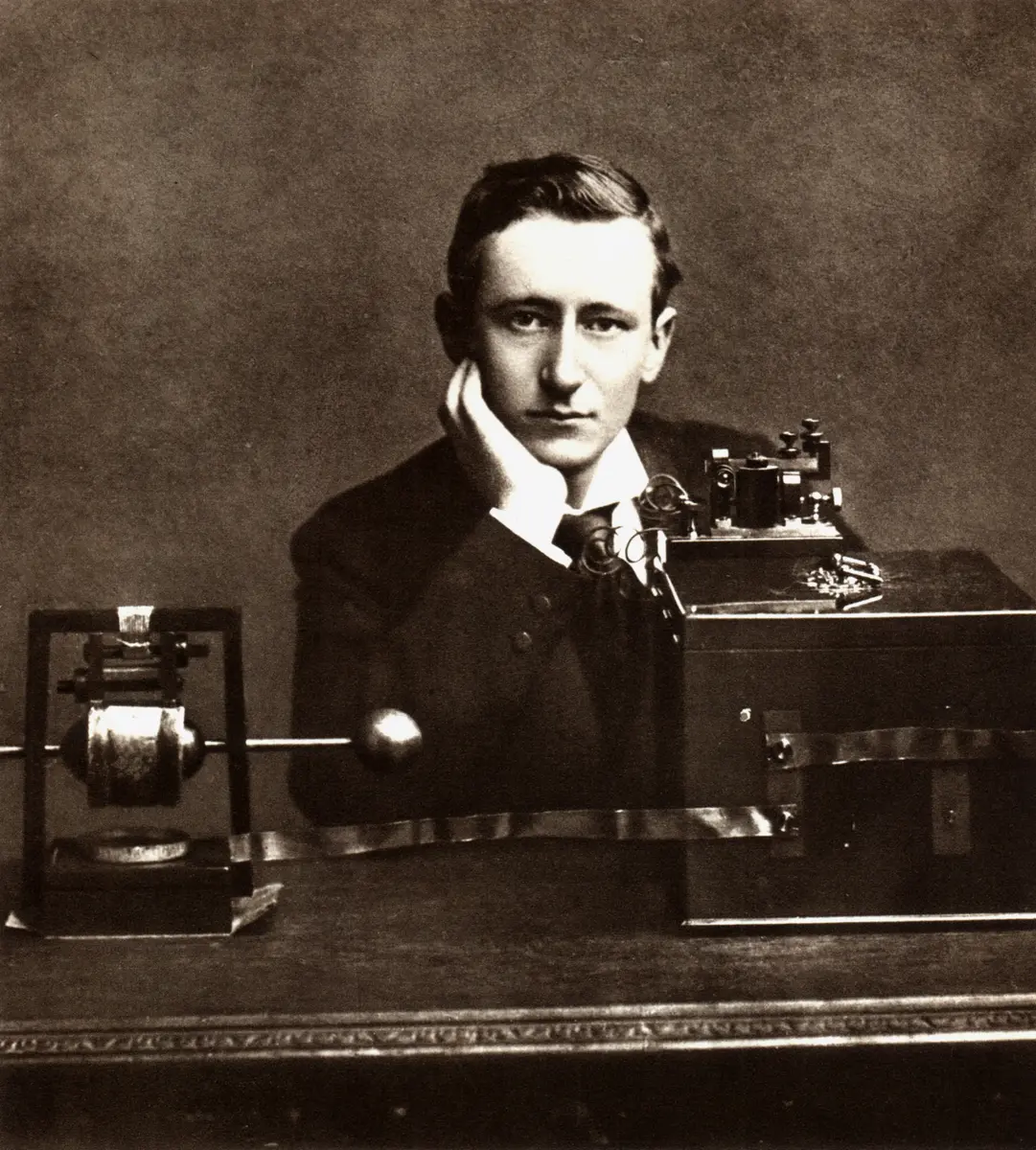
Chicago, Illinois: the Institute of Radio Engineers' Eighth Annual Convention, where Jansky presented his revised paper on 27 June 1933The popular radio press takes it up. Short Wave Craft magazine runs an article, 'Short-Wave Signals from Interstellar Space', with a portrait of Jansky.
The paper that settles it is published: 'Electrical disturbances apparently of extraterrestrial origin'. It gives the direction as right ascension 18 hours and declination minus 10 degrees, with the declination uncertain by as much as 30 degrees. It notes that this is very near the direction of the galactic centre, and also near the point the solar system is moving toward, and leaves the choice open. The cycle is 23 hours 56.06 minutes. Jansky thanks A. M. Skellett of Bell Labs for the astronomical interpretation.