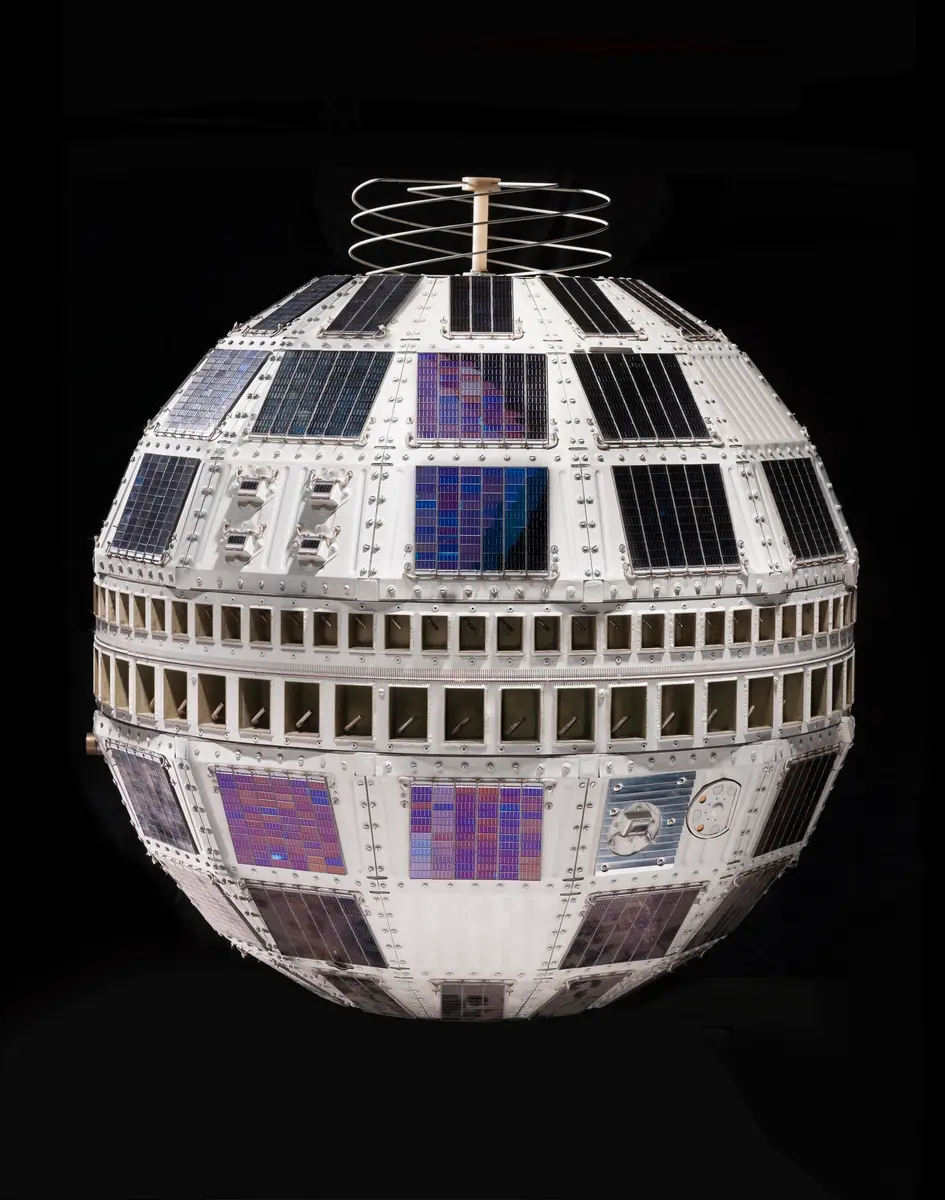
Telstar relays the first live transatlantic television
“Telstar 1, launched 10 July 1962, let America and Europe swap live television for the first time; the big public programme was on 23 July.”
Telstar 1 was a faceted metal ball about 34 inches (86 cm) across and about 171 pounds (77 kg), covered with 3,600 solar cells and ringed by small microwave antennas. Bell Telephone Laboratories built it for AT&T, and NASA launched it from Cape Canaveral on a Thor-Delta rocket at 08:35 UTC (4:35 in the morning, Florida time) on 10 July 1962. AT&T paid for the satellite and also repaid NASA for the launch. It was the first satellite that did more than bounce radio waves back: it received a signal, made it stronger, and sent it on. Bell Labs gave it a single repeater that could carry one television picture or many telephone calls.
Nothing like this had been possible before. The first transatlantic telephone cable with repeaters, laid in 1956, carried only 36 calls and could not carry television, so programmes crossed the ocean as recordings flown by aeroplane. Radio could not go over the horizon with enough quality. NASA's Echo 1, a 100-foot (30 m) balloon launched on 12 August 1960, showed that a signal could be bounced off an object in orbit, but Bell Labs worked out that bouncing a television picture would need an impossibly large balloon, so it chose an active repeater. The idea went back to Arthur C. Clarke's 1945 article and John R. Pierce's calculations of 1955. In April 1961 AT&T, Bell Labs, NASA, Britain's General Post Office and the French telecoms ministry agreed to build ground stations: Andover in Maine, Pleumeur-Bodou in Brittany and Goonhilly Downs in Cornwall.
The first signals went out on the evening of 10 July, Maine time. At 7:17 pm Andover found the satellite, at 7:31 pm a flag outside the station appeared on screen, and at 7:47 pm the French station reported a perfect picture. Goonhilly could not use the signal that night because of a polarisation fault, but the next day it received pictures from Andover and sent its own live pictures back, the first live television from Europe to America. The grand public programme came on Monday 23 July 1962, a little after 3 pm in New York: Walter Cronkite and Chet Huntley in New York, Richard Dimbleby in Brussels, an 18-minute Eurovision programme from Europe, and President Kennedy's press conference partway through. Which picture came first that day is told differently by different sources, and the baseball game often named as the opening was shown while the studios waited for Kennedy.
Telstar could only be used for about 20 minutes each time its oval orbit, from roughly 600 to 3,500 miles up, carried it over the Atlantic. It also met bad luck. The day before the launch the United States exploded a nuclear bomb high above the Pacific (Starfish Prime), and the electrons it released filled the Van Allen belt where Telstar flew; Russian tests in October added more. Telstar still managed some 400 demonstrations, with transatlantic television shown 47 times, five of them in colour. Its command circuit failed on 23 November 1962, was brought back by special codes on 20 December, and failed for good on 21 February 1963. It is still in orbit.
Telstar showed that live pictures could cross an ocean, and it changed what people expected from news. Soon after came NASA's Relay 1 (13 December 1962), Telstar 2 (7 May 1963) and Syncom 2 (26 July 1963), the first satellite to hover at a steady spot high above the equator. The first of the practical commercial satellites, Early Bird, followed in 1965. Telstar's ground stations also left monuments: Pleumeur-Bodou's radome is now a museum, and Goonhilly's first dish, nicknamed Arthur, still stands.
What happened
- 1960
NASA launches Echo 1, a 100-foot balloon of aluminium-coated plastic, into orbit. Bell Labs' horn antenna at Holmdel and NASA's Jet Propulsion Laboratory station in California use it as a mirror for the first two-way telephone talks by satellite. It reflects signals but cannot amplify them, and Bell Labs concludes that television would need an impossibly large balloon.
Holmdel, New Jersey: Bell Labs' horn antenna for Echo and the Telstar frequenciesAT&T picks a site near Andover, Maine, for the American ground station. The reasons are a short great-circle path to western Europe, hills round the site that block radio noise, flat ground, and a position near the existing microwave routes. Land is bought in January 1961.
Andover Earth Station, Maine: AT&T's ground station with the horn antenna in its radome- 1961
AT&T, Bell Labs, NASA, the British Post Office and the French telecoms ministry sign an agreement to build two active satellites, Telstar and Relay, and ground stations to work with them. AT&T is to pay for Telstar and repay NASA for the launch. The exact day is not given in the sources read.
Building work begins at Andover on the station, with its 3,600-square-foot horn antenna and an air-inflated radome that keeps out snow and wind; Maine could expect 90 inches of snow a year. The building is finished and the equipment installed in February 1962.
Andover Earth Station, Maine: AT&T's ground station with the horn antenna in its radome- 1962
The Andover building is finished and its equipment installed. The station is ready in the spring. Its horn weighs 340 tons and stands seven storeys high.
Andover Earth Station, Maine: AT&T's ground station with the horn antenna in its radome- 9:00 a.m.
The United States explodes the Starfish Prime nuclear bomb high above the Pacific (09:00 UTC; Hawaii time 11 pm on 8 July). The electrons it creates fill the Van Allen belt at the height where Telstar is to fly, a day later.
That evening a telephone call between AT&T's chairman Frederick Kappel in Andover and Vice President Lyndon Johnson in Washington is carried through Telstar, called the first telephone call through space.
- 4:35 a.m.
Thor-Delta 11 lifts off from Cape Canaveral at 08:35 UTC with Telstar 1; the satellite is in orbit at 4:46. The model launched weighs 170.94 pounds. Bell Labs' account says only 'early morning'; the IEEE Milestone gives 4:35 and 4:46 am Florida time.
Cape Canaveral Space Launch Complex 17B, Florida: the pad of Thor-Delta 11, 10 July 1962 - 7:17 p.m.
Andover finds the satellite on its first usable pass after a fifteen-hour wait. Eugene O'Neill, the project director, announces 'We've acquired Telstar!' at 7:17 pm Maine time.
Andover Earth Station, Maine: AT&T's ground station with the horn antenna in its radome - 7:31 p.m.
An American flag at Andover appears on a television screen, the first picture sent by the satellite. Speech and television are exchanged between distinguished guests in Washington and Andover, a telephoto picture is sent for the first time, and the networks televise the event.
Andover Earth Station, Maine: AT&T's ground station with the horn antenna in its radome - 7:47 p.m.
At 7:47 pm Andover is told that Pleumeur-Bodou in France has received the picture. The British station at Goonhilly is also receiving the signal but cannot use it because the antenna's polarisation is turned round. A French-side source gives the reception as 00:47 GMT on 11 July, an hour later than 7:47 pm in Maine would convert to.
Pleumeur-Bodou, Brittany: the French station, now the Cite des telecoms At Goonhilly, the Post Office's first dish, Arthur, receives excellent pictures from Andover on pass 15. On pass 16 it sends the first live television from Europe to America, shown across the United States: still captions and test cards, then BBC cameras in the control room, with commentary by Raymond Baxter and a talk by Capt C. F. Booth of the Post Office. A Washington monitor photograph reads 'FIRST PICTURES FROM ENGLAND VIA TELSTAR'.
Goonhilly Downs, Cornwall: the Post Office's station with the first dish, ArthurEurope sends America an 18-minute Eurovision programme through Goonhilly, with scenes from many European countries. It is received at Andover and carried across the United States. Goonhilly's monitors show no noticeable difference between the incoming Eurovision picture and the one that went round through Telstar.
Goonhilly Downs, Cornwall: the Post Office's station with the first dish, ArthurLater accounts say Kennedy was not yet ready when the signal arrived, so the American side filled the gap with a live shot of the Phillies and the Cubs at Wrigley Field in Chicago. Sources disagree on who was at bat (Tony Taylor in one, Johnny Callison in another), and Cronkite's own account does not mention a baseball game.
- 3:00 p.m.
The first scheduled programme, shared by the three American networks, Canada and Eurovision. In New York Walter Cronkite, at NBC's 30 Rockefeller Plaza next to Chet Huntley, has asked Europe to put the Eiffel Tower on the monitors beside the Statue of Liberty. Telstar rises over the horizon slightly early. Richard Dimbleby of the BBC, in Brussels, says both sides are clear: 'go America, go'. Cronkite opens with a greeting at 3 pm Eastern time, noon in San Francisco.
Andover Earth Station, Maine: AT&T's ground station with the horn antenna in its radome - 3:00 p.m.
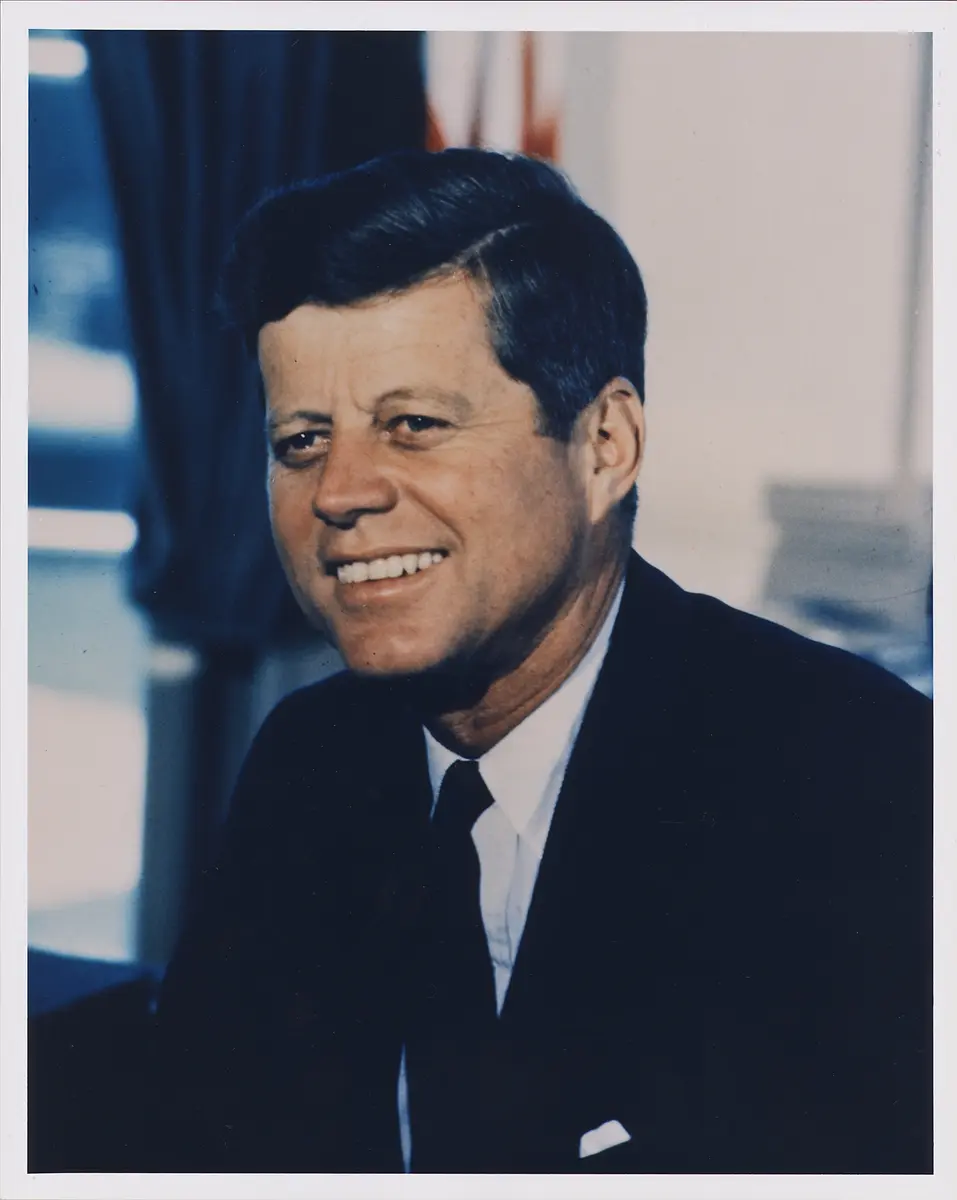
President Kennedy opens his news conference in the State Department Auditorium by announcing that part of it is going to Europe by Telstar. He says the dollar is 'as good as gold' and rules out devaluing it. The Telstar relay begins partway through and ends before the conference does.
State Department Auditorium, Washington: where Kennedy's news conference of 23 July 1962 was held The Soviet Union carries out the first of two high-altitude nuclear tests that add still more electrons to the radiation belts round Telstar's orbit.
After orbit 1,242, the satellite's command channel stops answering. The command circuit had begun to act erratically in the fourth week of November, and Bell Labs suspects radiation damage to its transistors: one of the two command decoders had already failed in August.
NASA launches Relay 1, another experimental communications satellite. The American, British and French stations had been equipped to work with Project Relay as well as Telstar.
A specially modified command code gets through to Telstar. Removing voltage from the command decoders lets the damaged transistors recover, and in the following weeks the satellite answers normal commands again.
- 1963
On orbit 1,628 the last public demonstrations of live television to and from Europe end. Between launch and then there were more than 250 technical tests and about 400 demonstrations; transatlantic television was shown 47 times, five times in colour.
After days of slower and slower replies, Telstar misreads a command and switches off most of its electronics. It does not answer again, even to the special codes, up to Bell Labs' note of 18 March. Telstar 1 stays in orbit, the Smithsonian's backup in a museum.