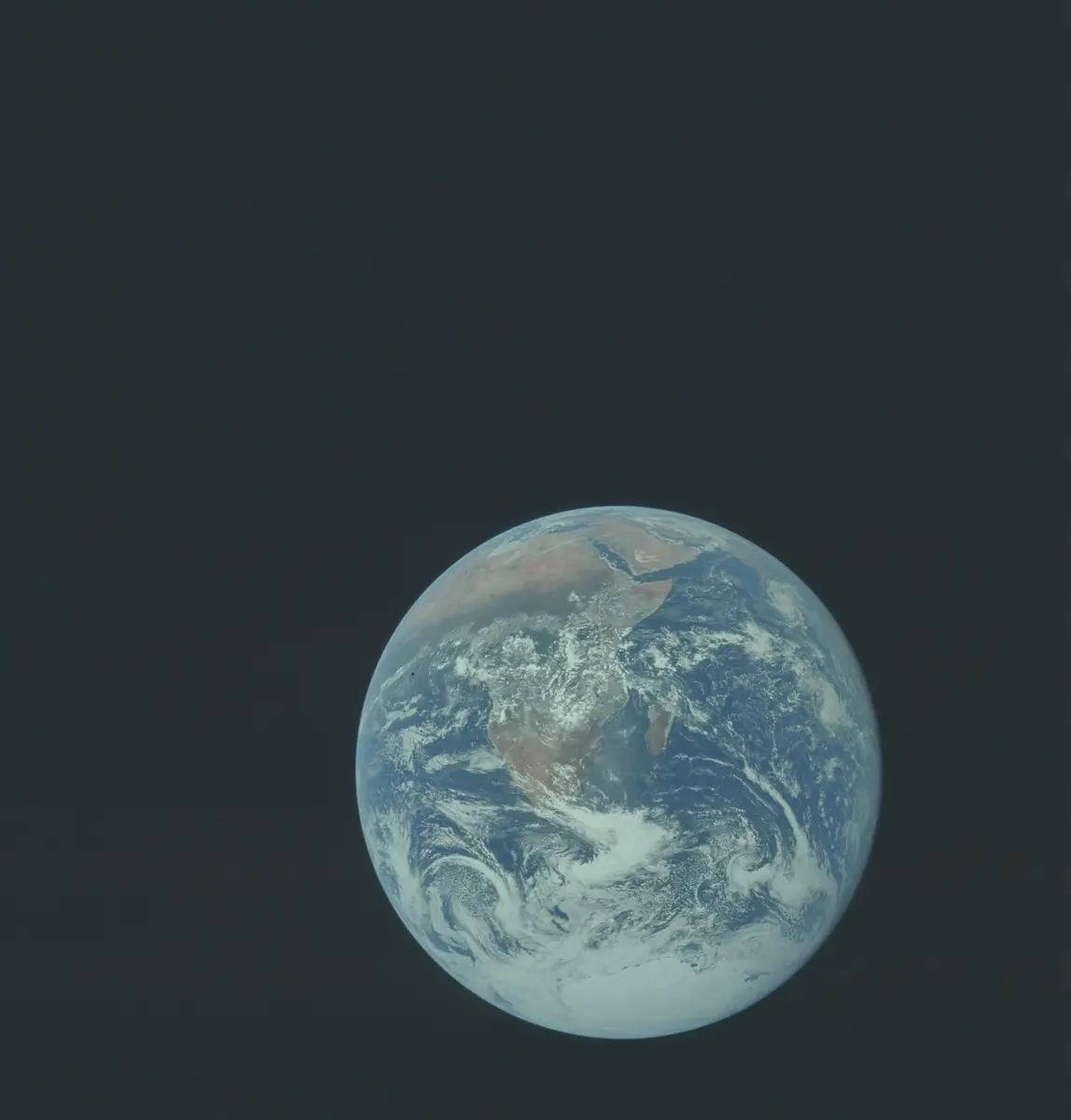
The Blue Marble photograph of the Earth
“On 7 December 1972 the Apollo 17 crew, about 29,000 km out on their way to the Moon, photographed the whole sunlit Earth, and it became the best-known picture of our planet.”
Apollo 17 was the last time people flew to the Moon. It left Cape Canaveral at 12:33 in the morning, Florida time, on 7 December 1972 (05:33 UTC), after a delay of 2 hours and 40 minutes caused by a fault in a launch sequencer. It was the only Saturn V rocket that ever flew at night. About three hours later the rocket's last stage fired for just under six minutes and pushed the ship out of Earth orbit towards the Moon. At about 5 hours 6 minutes after liftoff, near 10:39 UTC, with the Sun behind them, the three astronauts looked back and saw the whole Earth lit up like a full moon. They were roughly 29,000 kilometres away, a distance that the Apollo Flight Journal's authors worked out from the size of the Earth on the film (NASA's own record says roughly 29,400 km).
The picture is frame 22727 on a roll of colour film (magazine 148/NN) shot with a 70 mm Hasselblad camera and an 80 mm lens. It is one of four whole-Earth frames taken in a row, numbered 22725 to 22728, and the third is generally reckoned the best of them. Africa fills the middle, the Arabian Peninsula sits at the top right, Madagascar floats off the east coast, and a great swirl of cloud lies over the southern oceans. Antarctica's ice is visible at the bottom, the first time an Apollo route had gone far enough south to photograph the polar cap. One detail is often forgotten: on the film the south pole is at the top. In space there is no up, and the picture was turned half a circle before it was published, so that the Earth looks the way we expect.
Nobody can say for certain who pressed the shutter. NASA credits the whole crew, Eugene Cernan, Ronald Evans and Harrison Schmitt, because the film has no time stamps and the tape of their talk shows the camera being handed around. The Apollo Flight Journal notes that Evans read the frame count to Houston just afterwards, which hints that he held the camera. Schmitt has said that he is proud to have taken it, and later analyses have leaned towards him. A NASA review could neither confirm nor deny any of the three claims. The picture is therefore a team's picture, and that fits its meaning.
It also arrived at a ready moment. In 1966 the writer Stewart Brand had begun selling buttons that asked why we had not yet seen a photograph of the whole Earth. In November 1967 a satellite 36,000 km up, ATS-3, sent back the first colour disc, a picture built up line by line as the satellite spun. In December 1968 Apollo 8 showed the Earth as a small blue thing above a grey Moon. The 1972 photograph was different: a clear, sharp, sunlit Earth, taken by people with a normal camera, with nothing else in the frame. By Christmas it was on newspapers' front pages. The Smithsonian's Air and Space Museum calls it one of the most widely distributed images in existence, and says it became a rallying picture for Earth Day and the environmental movement.
Its name, the Blue Marble, was later given to a whole family of pictures. NASA released a flat world map of the same name in 2002, stitched from months of satellite data by Reto Stockli and Robert Simmon, and a new Blue Marble made by Norman Kuring from the Suomi NPP satellite on 25 January 2012, which more than three million people viewed on one website in a week. On 7 December 2022, exactly fifty years later, NASA published pictures of Earth from a satellite a million miles out that echo the 1972 view. Anyone who has seen a photograph of the planet as a single round object has seen a descendant of frame 22727.
What happened
- 1972
- 5:33 a.m.
Apollo 17 lifts off from Pad 39A at Kennedy Space Center at 12:33 a.m. Eastern time (05:33 UTC), after a delay of 2 hours 40 minutes caused by a fault in a launch sequencer, the only night launch of a Saturn V. The crew are Eugene Cernan, Ronald Evans and Harrison Schmitt. Times here are UTC.
Launch Complex 39A at Kennedy Space Center, Florida, where Apollo 17 lifted off at 12:33 a.m. on 7 December 1972 - 8:45 a.m.
After a little more than two orbits of the Earth the rocket's third stage fires for 5 minutes 52 seconds (translunar injection) and sends the ship towards the Moon. Soon afterwards the crew photograph the Earth, with Africa and Madagascar in view.
- 9:29 a.m.
The command and service module has separated from the third stage (09:15), turned round and docked with the Lunar Module Challenger (09:29), and the Lunar Module is pulled out of its housing. The spent stage is let go at about 10:18 and heads for the Moon on its own.
- 10:39 a.m.
About 5 hours 6 minutes after liftoff, roughly 29,000 km from Earth and with the Sun behind them, the crew photograph the whole Earth four times in a row on one roll of colour film. The third frame, AS17-148-22727, becomes the Blue Marble. Evans reads the frame count to Houston a couple of minutes later. The time of 10:39 UTC follows the Flight Journal's 005:06:24, taken as the moment of the third frame.
- 7:24 p.m.
Apollo 17 splashes down in the South Pacific at 19:24:59 UTC, about 350 nautical miles south-east of Samoa and 6.5 km from the carrier USS Ticonderoga, bringing the film home.
Splashdown point of Apollo 17 in the South Pacific on 19 December 1972, about 350 nautical miles south-east of Samoa NASA's picture of the whole Earth reaches the public and is printed on the front pages of newspapers over the Christmas weekend. The date comes from two news articles and not from a NASA record.
- 2002
NASA publishes 'The Blue Marble', a true-colour map of the whole Earth at 1 km pixels made by Reto Stockli and Robert Simmon from months of satellite data, the first of the Blue Marbles made not by a camera but by data.
NASA Goddard Space Flight Center, Greenbelt, Maryland, where the 2002 and 2012 Blue Marble images were made - 2012
NASA Goddard publishes a new Blue Marble made by Norman Kuring from the VIIRS instrument on the Suomi NPP satellite. More than three million people look at it on one picture site in a week.
NASA Goddard Space Flight Center, Greenbelt, Maryland, where the 2002 and 2012 Blue Marble images were made- 2022
Fifty years to the day, NASA shows pictures of the Earth taken by the EPIC camera on the DSCOVR satellite a million miles away, a series that ran from 7:39 to 10:39 UTC and ended at the hour of the original.