The first aerial photograph, from a balloon near Paris
“Nadar took the first aerial photograph in 1858, over Petit-Bicêtre near Paris, but it is lost; the oldest one that survives is James Wallace Black's view of Boston from a balloon on 13 October 1860.”
In 1858 a Paris portrait photographer who called himself Nadar went up in a tethered balloon and tried to take a picture of the ground. His real name was Gaspard-Félix Tournachon. Photography was still a messy chemical craft: every glass plate had to be coated, exposed and developed within minutes. So Nadar had to work a small darkroom inside the balloon basket. By his later account, he succeeded at about 80 metres over Petit-Bicêtre, a village outside Paris that is now part of Clamart. Nadar's own memory is the main evidence, because the picture does not survive. It is the first aerial photograph on record, but nobody today can look at it.
Nadar saw a use for it at once. On 23 October 1858 he filed a patent for a system of 'aerostatic photography' (patent no. 38509), to make topographic and property maps and to serve military reconnaissance. The idea was to hang a camera under a tethered balloon and photograph the ground straight down. He never made it pay. Nadar fought with leaking gas and fogged plates for years. The earliest surviving Nadar photographs of Paris from the air date from 1868, when he showed views of the Arc de Triomphe and the star of avenues around it. He presented one as the 'first result'.
The oldest aerial photograph that you can still see is American. On 13 October 1860, the Boston photographer James Wallace Black went up with the balloonist Samuel Archer King in King's balloon, the Queen of the Air. Held on a rope at about 1,200 feet, Black exposed eight glass plates over the city. One gave a good print, which he called 'Boston, as the Eagle and the Wild Goose See It'. It is the first clear aerial view of a city, and the Metropolitan Museum of Art owns a print. The Great Fire of 1872 later destroyed much of what it shows.
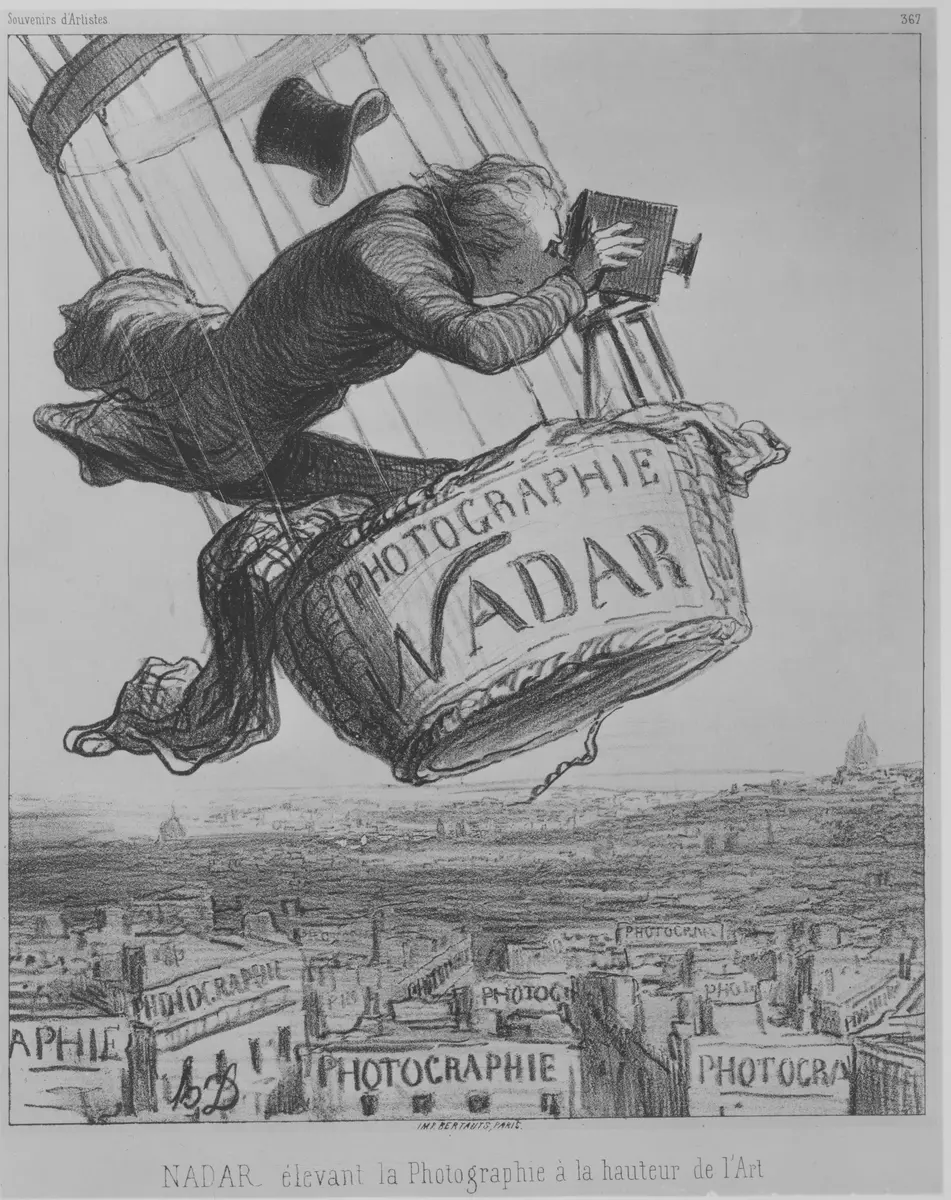
Nadar made the balloon famous. In May 1862 the artist Honoré Daumier drew him in a basket above Paris, lifting photography 'to the height of art', and in 1863 Nadar built a giant balloon, Le Géant, with a darkroom of its own. The idea of seeing and recording the ground from above went on to survey maps, to war reconnaissance, and in time to satellites. The first picture is lost, but the habit it started is everywhere.
What happened
- 1858
Nadar goes up in a tethered balloon at Petit-Bicêtre, about 80 metres, and says he makes the first photograph from the air. The picture is lost.
Petit-Bicêtre, now Le Petit-Clamart, Hauts-de-Seine: where Nadar said he made the first aerial photograph in 1858Nadar files a French patent for 'aerostatic photography', to make maps and for military use. It becomes patent no. 38509.
- 1860
James Wallace Black and Samuel Archer King take eight plates over Boston from the Queen of the Air. One print survives as 'Boston, as the Eagle and the Wild Goose See It'.
Boston, Massachusetts: the city in Black's 1860 aerial photograph- 1862
Daumier's lithograph shows Nadar photographing Paris from his balloon basket, 'raising photography to the height of art'.
- 1863
- 5:00 p.m.
Nadar's giant balloon Le Géant makes its first ascent from the Champ de Mars, with its small photographic department on board.
Champ de Mars, Paris: where Le Géant rose in October 1863 Le Géant leaves the Champ de Mars on its second flight and comes down badly in Hanover, wrecking the gondola.
Champ de Mars, Paris: where Le Géant rose in October 1863- 1868
Nadar makes the aerial views of Paris that survive, from a tethered balloon over the Étoile, and later presents one as the 'first result' of his 1858 patent.
Arc de Triomphe and Place de l'Étoile, Paris: the subject of Nadar's 1868 aerial views