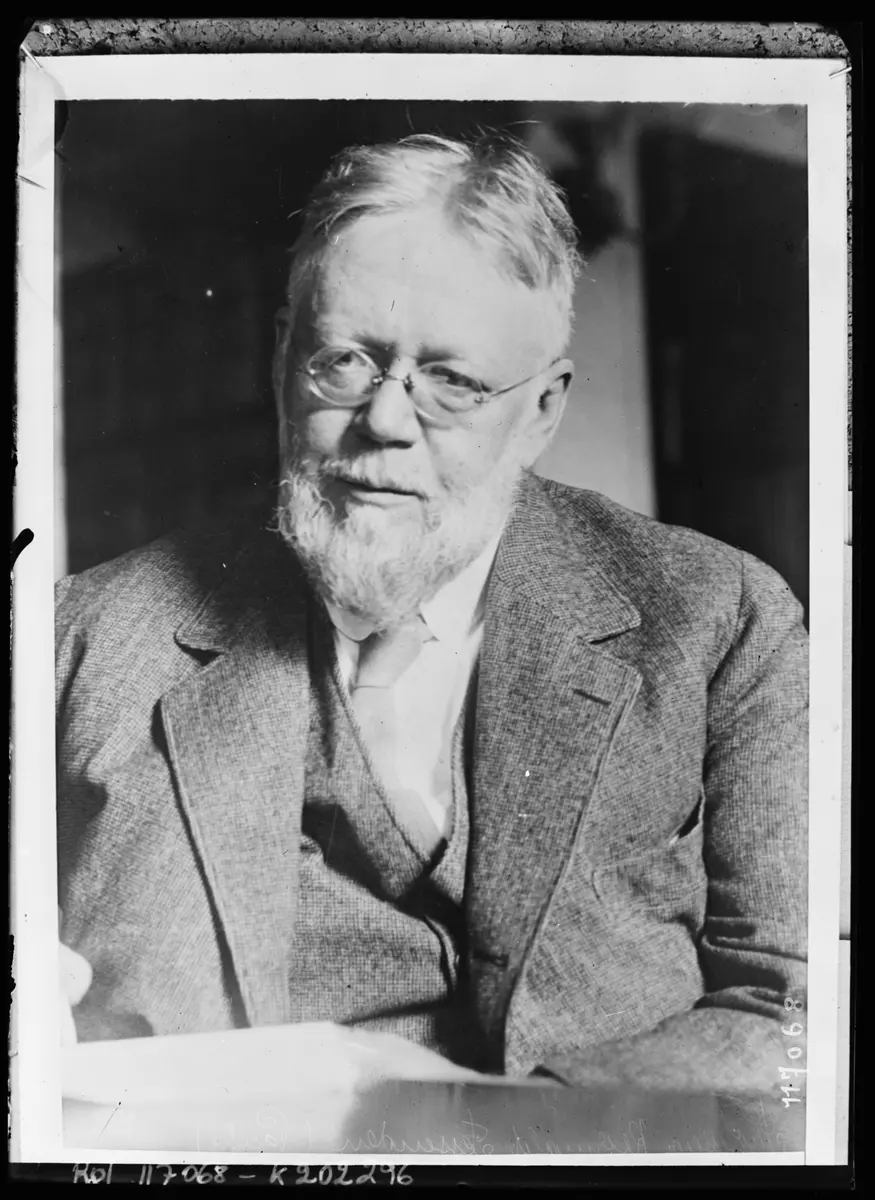
The first voice radio broadcast
“Fessenden's Christmas Eve 1906 broadcast rests on his own 1932 letter, with no report from 1906; sure things are his voice on radio in 1900 and his demonstration of 21 December 1906.”
On Christmas Eve 1906, the story goes, the Canadian-born engineer Reginald Fessenden spoke, played the violin and sang into a microphone at his radio station at Brant Rock, on the Massachusetts coast south of Boston. Ships of the US Navy and the United Fruit Company, which had been told to listen, are said to have heard a short speech, a phonograph record of Handel's 'Largo', 'O Holy Night' on the violin and a Bible verse, and a repeat on New Year's Eve. It is told as the first radio broadcast, the first time a voice and music went out over the air to anyone who had a receiver. This entry tells the story as a disputed one, because the evidence for that evening is thin.
What is well documented comes before it. On 23 December 1900 Fessenden, then working for the US Weather Bureau, spoke over a distance of about a mile between two 50-foot masts on Cobb Island in the Potomac, Maryland. It is usually called the first voice sent by radio, and the words are given as 'One, two, three, four. Is it snowing where you are, Mr. Thiessen?' The speech was hard to follow and drowned in noise. By 1906 he had a much better machine: a high-frequency alternator built by General Electric that made a smooth continuous wave, which a microphone could vary to carry sound. On 21 December 1906, three days before Christmas Eve, he showed it at Brant Rock to invited guests, among them the electrical inventor Elihu Thomson and men from the telephone companies. Speech was sent over more than ten miles, and The American Telephone Journal described the test on 26 January 1907.
For Christmas Eve itself there is only one first-hand account. It is a letter Fessenden wrote from Bermuda on 29 January 1932, answering a question from the Westinghouse vice-president Samuel Kintner, about six months before he died. He said that three days beforehand operators had told Navy and United Fruit ships to listen, that the programme was his speech, the Handel record, his violin and one sung verse, and a Bible text, and that word came back from as far south as Norfolk, Virginia; New Year's Eve was heard in the West Indies. His widow Helen printed the same words in her biography 'Fessenden: Builder of Tomorrows' in 1940, and she and their son are said to have been there. No newspaper, magazine, ship's log or letter from a listener from 1906 or 1907 is known. Fessenden's own list of inventions in Radio News in 1925 does not mention it, and the first printed references seem to be a Westinghouse lecture of 1928 and a newspaper column of 1930.
Historians divide on what that silence means. In 2006 Donna Halper and Christopher Sterling, and separately James O'Neal, argued that it cannot be proved the broadcast happened, and O'Neal thought the evidence pointed against it; Halper's view is that it may well have happened but cannot be called certain. John Belrose, a radio scientist who studied Fessenden for decades, replied that there is no doubt, because the 1932 letter is detailed, Helen and Kenneth Fessenden were there, local amateurs remembered it, and the press of the day ignored or mocked Fessenden's work. The IEEE puts the broadcast on its 2008 milestone plaque as a fact. What nobody disputes is that Fessenden sent speech by radio in 1900, that his alternator carried voice and music in December 1906, and that he saw it as a telephone for two points, not as a service for the public.
The date matters because 'the first broadcast' is a title with a prize: the usual rival is KDKA in Pittsburgh, which began regular broadcasting on 2 November 1920. Fessenden's own 1932 letter is careful about the word. He says that if a broadcast must reach stations owned by someone else, and be announced beforehand, then Christmas Eve was the first; but if sending to stations of the same company counts, his demonstration on 21 December was one. Either way, the Brant Rock alternator showed that radio could carry a human voice and music, an idea the rest of the century built on.
What happened
- 1900
On Cobb Island in the Potomac, Fessenden, working for the Weather Bureau, speaks over radio between two 50-foot masts a mile apart; his assistant Thiessen hears him. The words given are 'One, two, three, four. Is it snowing where you are, Mr. Thiessen?' The speech is heard but noisy.
Cobb Island, Charles County, Maryland: the Potomac island where Fessenden sent his voice about a mile on 23 December 1900 (the Journal of 1907 says 'Rock Point')- 1902
A one-kilowatt, 10,000-cycle alternator built by General Electric is delivered to Fessenden. It is too slow to send radio waves directly, so he uses it with a spark gap; it is the first step toward the machine of 1906.
- 1906
From Brant Rock Fessenden exchanges Morse messages across the Atlantic with a sister station at Machrihanish in Scotland, the first two-way transatlantic radio link; it works only at night and in winter.
Brant Rock, Marshfield, Massachusetts: Fessenden's station of the National Electric Signaling Company, where the alternator demonstration of 21 December 1906 took place and the Christmas Eve broadcast is said to have been sent; the base of its antenna survives at Blackman's PointBy the summer Fessenden is sending speech from Brant Rock to a receiver at Plymouth, about ten miles away, with the alternator and a microphone.
Plymouth, Massachusetts: the receiving station about ten miles from Brant Rock for the 1906 voice tests and the demonstration of 21 December 1906A storm brings down the tower at Machrihanish, ending the transatlantic work. Fessenden decides to show his machine to a wider audience.
Invitations go out to engineers and company men to see the alternator at Brant Rock.
At Brant Rock Fessenden shows his alternator transmitter to invited guests, among them Elihu Thomson and Greenleaf Pickard, and representatives of the telephone companies. Speech is sent more than ten miles, including through the Bell telephone lines at both ends; John Grant of The American Telephone Journal is present and describes it.
Brant Rock, Marshfield, Massachusetts: Fessenden's station of the National Electric Signaling Company, where the alternator demonstration of 21 December 1906 took place and the Christmas Eve broadcast is said to have been sent; the base of its antenna survives at Blackman's PointThree days before Christmas Eve, according to Helen Fessenden's book and the 1932 letter, Fessenden's operators telegraph the ships of the US Navy and of the United Fruit Company that carry his apparatus, telling them that speech, music and singing will be sent from Brant Rock on Christmas Eve and New Year's Eve. No copy of such a message has been found.
Brant Rock, Marshfield, Massachusetts: Fessenden's station of the National Electric Signaling Company, where the alternator demonstration of 21 December 1906 took place and the Christmas Eve broadcast is said to have been sent; the base of its antenna survives at Blackman's PointChristmas Eve. In the only account, Fessenden speaks to say what he will do, plays Handel's 'Largo' from a phonograph record, plays Gounod's 'O Holy Night' on the violin and sings a verse, reads the text 'Glory to God in the highest and on earth peace to men of good will', and wishes his listeners a Merry Christmas. He says word of reception came from as far south as Norfolk, Virginia. No report from the time is known.
Brant Rock, Marshfield, Massachusetts: Fessenden's station of the National Electric Signaling Company, where the alternator demonstration of 21 December 1906 took place and the Christmas Eve broadcast is said to have been sent; the base of its antenna survives at Blackman's PointNew Year's Eve. By the same account the programme is repeated with different music and a man, he thinks Adam Stein, singing; word comes from places in the West Indies. Again nothing from the time survives.
Brant Rock, Marshfield, Massachusetts: Fessenden's station of the National Electric Signaling Company, where the alternator demonstration of 21 December 1906 took place and the Christmas Eve broadcast is said to have been sent; the base of its antenna survives at Blackman's Point- 1907
The American Telephone Journal prints John Grant's front-page report on the demonstration of 21 December, with the picture of the alternator transmitter. It says wireless telephony is 'admirably adapted' to news and music for many listeners at once; it does not describe a broadcast on Christmas Eve, and none is known from any source of the time.
Brant Rock, Marshfield, Massachusetts: Fessenden's station of the National Electric Signaling Company, where the alternator demonstration of 21 December 1906 took place and the Christmas Eve broadcast is said to have been sent; the base of its antenna survives at Blackman's Point- 1910
The Boston Globe prints a favourable piece on Brant Rock, 'Wireless Station at Brant Rock Has Been in Touch with Egypt'. It does not mention a Christmas Eve broadcast, nor, Halper finds, do the Electrical Experimenter's profile of January 1917 or the Radio News series of 1925.
Brant Rock, Marshfield, Massachusetts: Fessenden's station of the National Electric Signaling Company, where the alternator demonstration of 21 December 1906 took place and the Christmas Eve broadcast is said to have been sent; the base of its antenna survives at Blackman's Point- 1925
In a series in Radio News, with a list of his inventions, Fessenden does not mention a Christmas Eve broadcast. The series stops at the end of the year and the autobiography is never finished.
- 1928
In a lecture at Harvard, the Westinghouse vice-president H. P. Davis says Fessenden 'broadcast a program on Christmas Eve 1906'. Halper and Sterling count it as the first published reference.
- 1930
A column by Robert Mack, 'Broadcasting by Radio Came into Being Decade Ago', in the Appleton Post-Crescent, Wisconsin, is among the earliest newspaper items to give Christmas Eve 1906 as the first broadcast.
- 1932
Samuel Kintner, a Westinghouse vice-president and Fessenden's former assistant, writes to Fessenden in Bermuda asking about the broadcasts he has heard of.
From Bermuda, Fessenden answers Kintner in a typed letter, the only first-hand account of Christmas Eve 1906. He defines 'broadcasting' two ways, says that on the narrower one the Christmas Eve programme was the first and on the wider one the demonstration of 21 December was, and suggests that Navy and United Fruit logs should have a record. The copy in the Clark Radioana Collection at the Smithsonian is a copy, which Sterling has questioned.
St. Mark's Church, Smith's Parish, Bermuda: where Fessenden is buried and from where he wrote his letter of 29 January 1932Kintner repeats Fessenden's account in a talk, 'Pittsburgh's Contribution to Radio', at a joint meeting of the Institute of Radio Engineers and the American Institute of Electrical Engineers in Pittsburgh; it is printed in the Proceedings of the IRE in December and abstracted in QST in July.
Reginald Fessenden dies in Bermuda. The Associated Press and New York Times obituaries praise his many inventions and say nothing of Christmas Eve 1906.
St. Mark's Church, Smith's Parish, Bermuda: where Fessenden is buried and from where he wrote his letter of 29 January 1932- 1936
Alvin Harlow's popular history of broadcasting gives Christmas Eve 1906 as the first broadcast, one of the early printed accounts.
- 1940
Helen Fessenden's 'Fessenden: Builder of Tomorrows' prints the programme in the words of the 1932 letter. Most of the later retellings come from it.
- 1966
A bronze marker for Fessenden's station is dedicated at Marshfield, a gift of the Broadcast Pioneers and the Massachusetts Broadcasters Association; Belrose's source Robert Merriam remembers speaking there about the Christmas Eve broadcast.
Brant Rock, Marshfield, Massachusetts: Fessenden's station of the National Electric Signaling Company, where the alternator demonstration of 21 December 1906 took place and the Christmas Eve broadcast is said to have been sent; the base of its antenna survives at Blackman's Point- 2006
For the centenary Donna Halper and Christopher Sterling (AWA Review) and James O'Neal (Radio World) question whether the broadcast can be shown to have happened; O'Neal notes that the radio amateur Francis Hart, 257 km away at Sayville, New York, logged nothing. John Belrose replies that there is no doubt that it was made.
- 2008
The IEEE dedicates a Milestone at Brant Rock for the 'First Wireless Radio Broadcast by Reginald A. Fessenden, 1906', giving 24 December 1906 as a broadcast for entertainment and music to the general public.
Brant Rock, Marshfield, Massachusetts: Fessenden's station of the National Electric Signaling Company, where the alternator demonstration of 21 December 1906 took place and the Christmas Eve broadcast is said to have been sent; the base of its antenna survives at Blackman's Point- 2025
Halper restates her position: Fessenden was a great inventor who almost certainly broadcast voice and music many times, but without papers from 1906 it cannot be stated as certain that Christmas Eve 1906 was the first, and the question stays open.