The maser
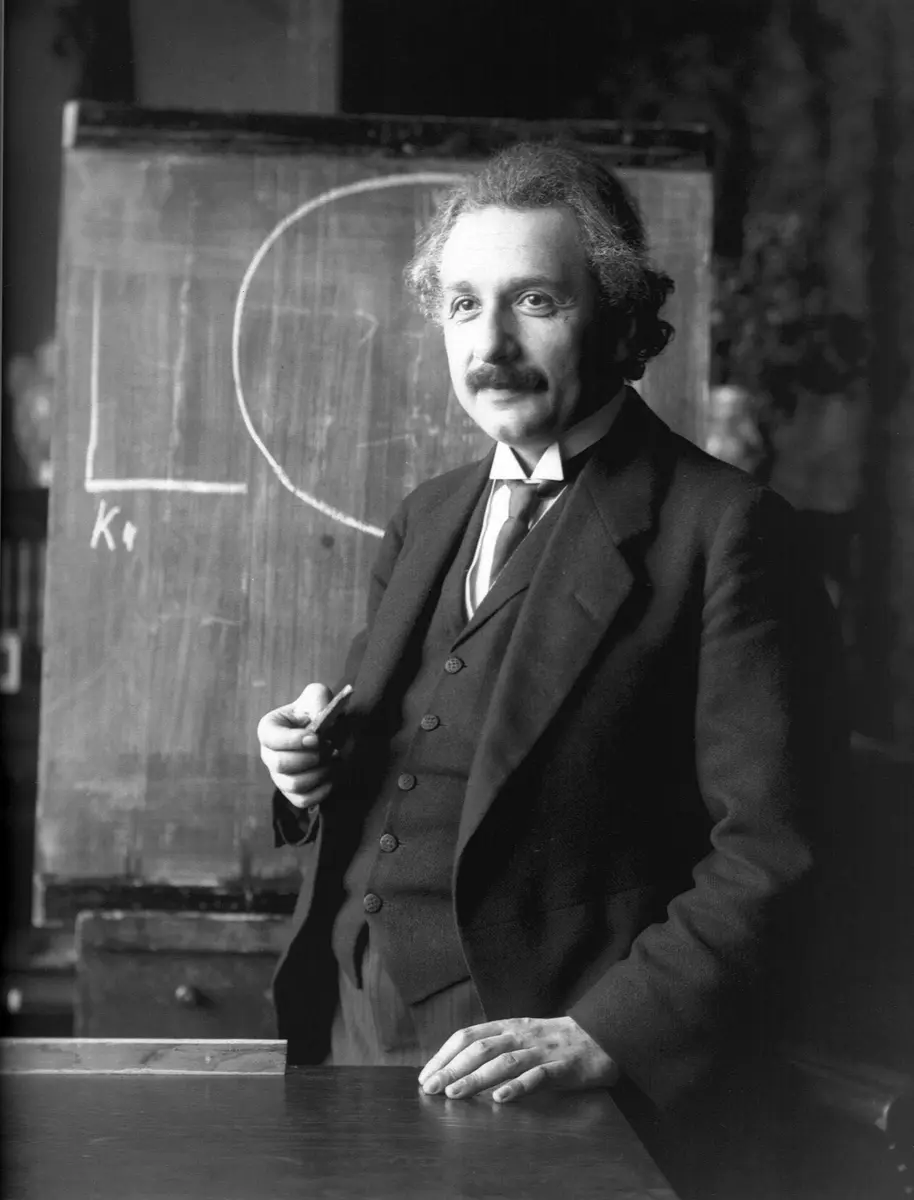
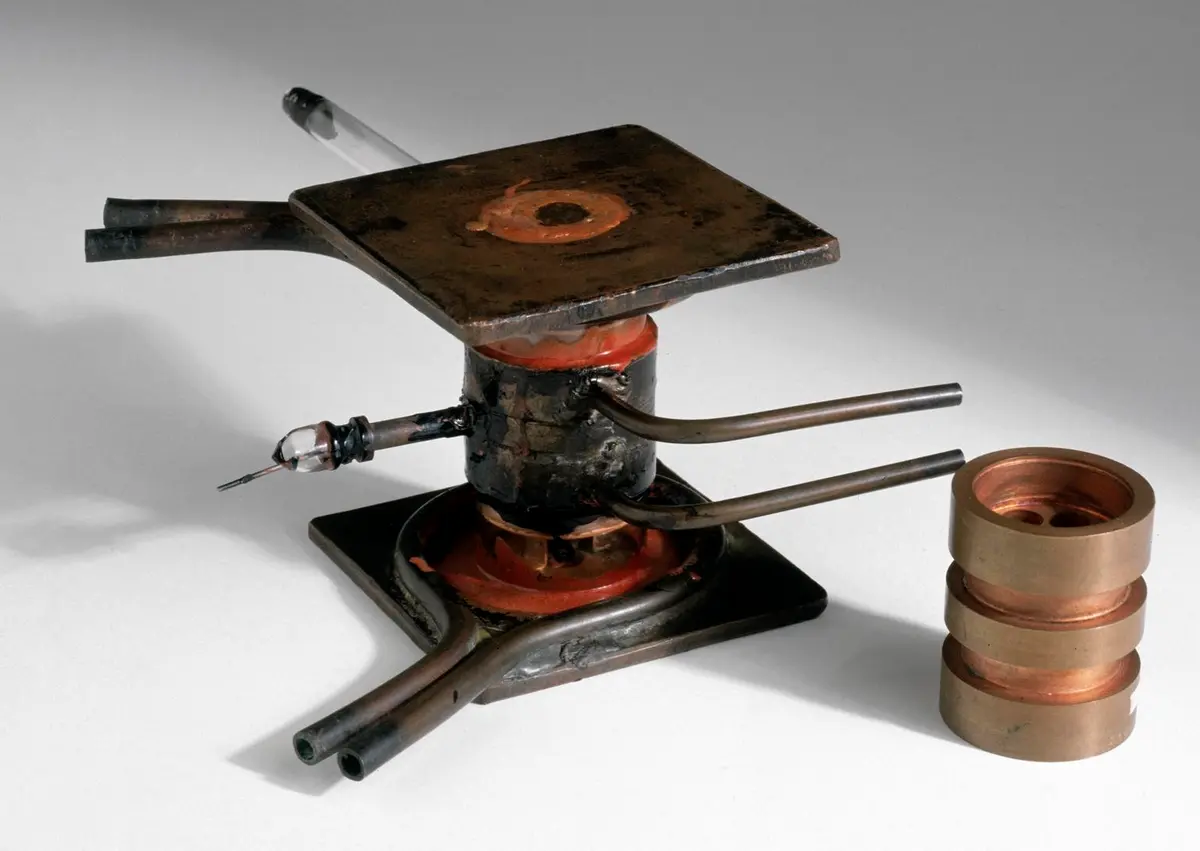
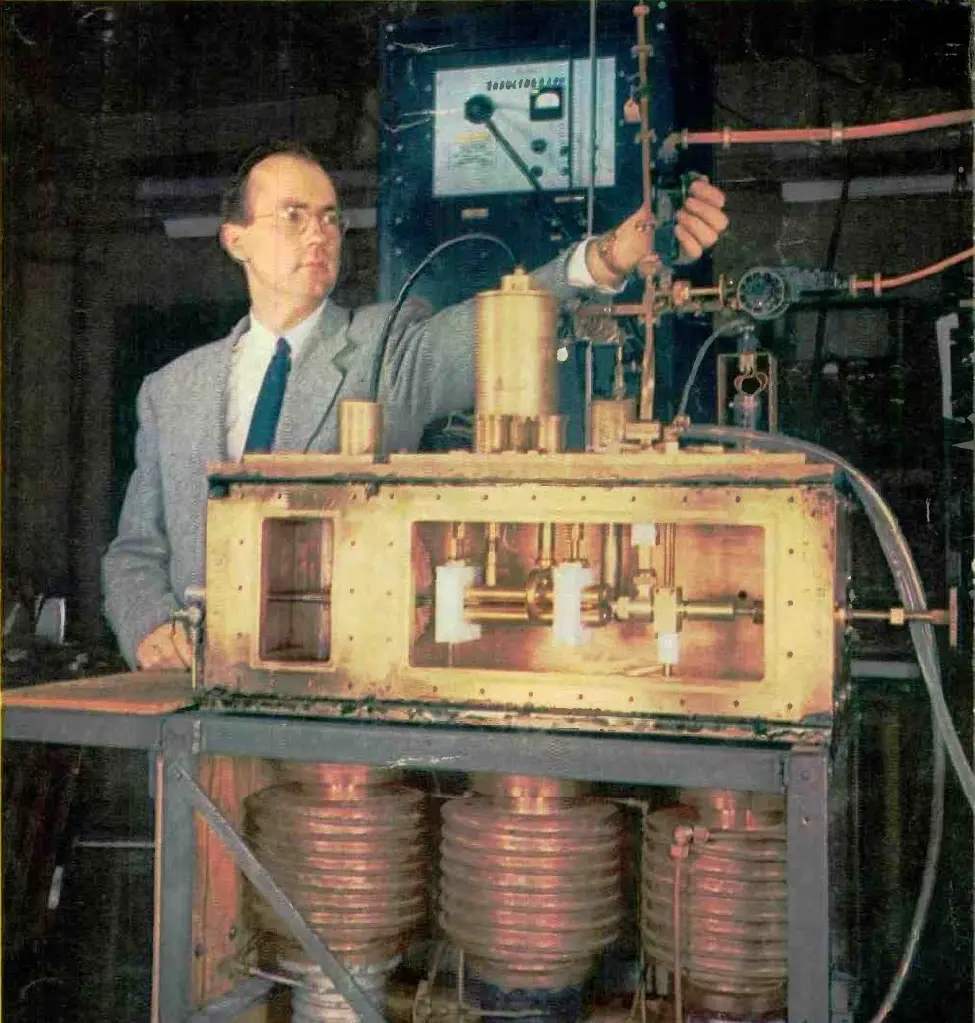
“Townes, Gordon and Zeiger's ammonia maser (Columbia, 1954) was the first oscillator built on stimulated emission; Townes, Basov and Prokhorov shared the 1964 Nobel Prize.”
The maser is a device that makes microwaves by getting molecules to give up their energy together, in step. The name stands for microwave amplification by stimulated emission of radiation. The first one was built in Pupin Hall at Columbia University in New York in the spring of 1954 by the physicist Charles Townes, his graduate student James Gordon and the postdoctoral fellow Herbert Zeiger. It ran on a thin beam of ammonia gas and put out a clean signal at a wavelength of 1.25 centimetres, about 24 gigahertz. It was the first oscillator built on stimulated emission, an effect Albert Einstein had worked out in 1917, and it was the road to the laser. In 1964 Townes shared the Nobel Prize in Physics with two Soviet physicists, Nikolay Basov and Aleksandr Prokhorov, who had reached the same idea on their own in Moscow.
The idea came on the morning of 26 April 1951. Townes, then a Columbia professor, was in Washington for a meeting of a Navy committee on millimetre waves. He was up early, his brother-in-law Arthur Schawlow was asleep in their hotel room, and he went out to sit on a bench in Franklin Park. The problem was old. Radar work in the war had given physicists powerful microwave tubes, but no electronic oscillator could make waves shorter than about a millimetre, because the parts would have to be as small as the wave. Townes saw that nature had already made tiny oscillators: molecules. If a beam of molecules were sorted so that most of them were in the high-energy state, and sent through a metal cavity that kept some of the radiation in, each molecule would add to the wave it passed. Outstanding colleagues told him it would not work. They included Niels Bohr and John von Neumann, in Townes's telling.
He needed a student who would take the risk, and in the autumn of 1951 he found James Gordon. Zeiger, a Carbide and Carbon postdoctoral fellow, joined later. The machine was a long vacuum chamber. At one end a nozzle shot out ammonia molecules. Four brass rods, charged with high voltage, pushed the molecules in the lower-energy state out of the beam and focused the others into a cavity tuned to ammonia's natural frequency at 24 gigahertz. After about two and a half years, Townes recalled, two senior colleagues from the physics department came to tell him he was wasting money and should stop. He did not. In April 1954 it worked, and at a lunch in the Teachers College cafeteria that month he and four others made up the name maser. Gordon, Zeiger and Townes sent a short letter to the Physical Review, which received it on 5 May and printed it on 1 July 1954. The full paper followed on 15 August 1955.
Two other groups were close. Joseph Weber of the University of Maryland gave a talk on amplifying microwaves with molecules that are not in thermal equilibrium at a conference in Ottawa in June 1952, and printed it in 1953. At the Lebedev Physical Institute in Moscow, Basov and Prokhorov worked out a molecular oscillator and presented it at a Soviet conference in May 1952; their paper came out in 1954 and a working ammonia oscillator followed about the turn of 1955. The Nobel committee's presentation speech said the first papers came out of work done 'simultaneously and independently' in New York and Moscow, and gave the prize to Townes (half) and to Basov and Prokhorov (a quarter each). Weber did not share it.
What it changed was less the ammonia machine than the idea. In 1955 Basov and Prokhorov proposed pumping, a way to keep many molecules excited using a third energy level; Nicolaas Bloembergen turned it into a plan for solid-state masers in 1956, and Bell Labs built a ruby maser in 1957. These masers were the quietest microwave amplifiers ever made; Penzias and Wilson used a ruby maser on the Holmdel horn antenna in the work that found the cosmic microwave background. Masers still keep time in atomic clocks. And in 1958 Townes and Schawlow showed the same principle should work for light, which led to the first working laser in 1960. The maser itself was never a big commercial product, and the prize was given for the principle, which came first.
What happened
- 1951
Townes, in Washington for a meeting of a Navy committee on millimetre waves, wakes early and walks out to a bench in Franklin Park while his brother-in-law Arthur Schawlow sleeps in the hotel room. Within some fifteen minutes he has the plan: sort ammonia molecules so that the excited ones go into a cavity, and let them amplify the wave themselves. He writes it on a scrap of paper and puts it in his pocket.
Franklin Square (Franklin Park), Washington: where Townes sat on a bench on the morning of 26 April 1951- 1952
At an All-Union conference on radio-spectroscopy in the USSR, Basov and Prokhorov of the Lebedev Physical Institute present their theory of a molecular oscillator based on stimulated emission, independently of Townes.
Lebedev Physical Institute, Moscow: where Basov and Prokhorov worked on the molecular oscillatorJoseph Weber of the University of Maryland describes how to amplify microwaves with molecules that are not in thermal equilibrium at the Electron Tube Research Conference in Ottawa. It is the earliest public talk on the principle; he builds no device.
- 1953
Weber's summary appears in the Transactions of the IRE Professional Group on Electron Devices, the first printed account of the idea of the maser.
- 1954
Gordon bursts in on a seminar Townes is giving to say that the machine is amplifying and oscillating. A beam of ammonia gas in a vacuum chamber, a four-rod electric focuser and a resonant cavity give a clean signal at 1.25 cm, about 24 GHz, the first maser.
Pupin Hall, Columbia University, New York: where the first maser was built in 1954Five people at lunch in the Columbia Teachers College cafeteria agree they need a name. Townes vetoes anything ending in '-tron', and by the end of the meal they have 'maser', for microwave amplification by stimulated emission of radiation.
Pupin Hall, Columbia University, New York: where the first maser was built in 1954The Physical Review receives the letter 'Molecular microwave oscillator and new hyperfine structure in the microwave spectrum of NH3' from Gordon, Zeiger and Townes. It reports the oscillator and also a new fine detail in ammonia's spectrum, a by-product of the machine.
Pupin Hall, Columbia University, New York: where the first maser was built in 1954The letter is printed in the Physical Review, volume 95, page 282.
Basov and Prokhorov's paper on the molecular generator is printed in the Soviet Journal of Experimental and Theoretical Physics, volume 27, page 431, two years after they described it in public.
Lebedev Physical Institute, Moscow: where Basov and Prokhorov worked on the molecular oscillator- 1955
Basov and Prokhorov propose pumping: using a third energy level to keep many molecules excited. Their Moscow device is working on ammonia about the turn of 1955. Basov defends his doctoral thesis on a molecular oscillator in 1956.
Lebedev Physical Institute, Moscow: where Basov and Prokhorov worked on the molecular oscillatorTownes files his first patent application on the maser, Serial No. 506,533, as an individual inventor; the patent that follows is granted on 24 March 1959.
The full paper, 'The Maser: new type of microwave amplifier, frequency standard and spectrometer', appears in the Physical Review. Gordon is now at Bell Labs; Zeiger is at Project Lincoln at MIT.
- 1956
Nicolaas Bloembergen of Harvard publishes his three-level plan for a solid-state maser, pumped continuously between two levels, which makes masers without molecular beams possible.
- 1957
Scovil, Feher and Seidel of Bell Labs report a working three-level solid-state maser; the ruby version is the quiet receiver later used with radio telescopes and satellites.
- 1958
Schawlow and Townes publish 'Infrared and optical masers' in the Physical Review, showing that the same principle should work for light. It is the paper the Nobel committee later names as the start of the laser.
- 1959
Basov and Prokhorov receive the Soviet Union's Lenin Prize for their work on molecular oscillators and paramagnetic amplifiers.
Lebedev Physical Institute, Moscow: where Basov and Prokhorov worked on the molecular oscillatorThe United States Patent Office grants Townes patent 2,879,439, 'Production of electromagnetic energy', for the ammonia-beam maser and its use as oscillator and amplifier.
Townes chairs the first International Conference on Quantum Electronics at the Sha-Wan-Ga Lodge in the Shawangunk Mountains, New York, on 14-16 September. Basov and Prokhorov are there, and a photograph shows the three together.
- 1964
The Royal Swedish Academy of Sciences announces the 1964 Nobel Prize in Physics: half to Townes, then provost of MIT, and half to Basov and Prokhorov of the Lebedev Institute, 'for fundamental work in the field of quantum electronics, which has led to the construction of oscillators and amplifiers based on the maser-laser principle'.
Lebedev Physical Institute, Moscow: where Basov and Prokhorov worked on the molecular oscillatorAt the Stockholm Concert Hall King Gustaf VI Adolf hands the prize to the three physicists. Professor Bengt Edlen, for the Nobel Committee, explains stimulated emission and says the first maser papers came from New York and Moscow 'simultaneously and independently'.
Stockholm Concert Hall: the Nobel ceremony of 10 December 1964The laureates give their Nobel lectures: Townes on 'Production of coherent radiation by atoms and molecules' and Prokhorov on 'Quantum electronics'.