Gemma Frisius
“The Flemish doctor and mathematician (1508-1555) who first set out triangulation for surveying, suggested finding longitude with a clock, and taught Mercator.”
Gemma Frisius was a doctor, mathematician and instrument maker in Leuven (then Louvain, in the Low Countries) who turned geometry into tools for mapping the earth. In 1533 he set out the method of triangulation for surveying, in 1530 he suggested finding longitude with a travelling clock, and he taught Gerardus Mercator. He was born Jemme Reinerszoon in Dokkum, in Friesland, and 'Frisius' is simply Latin for 'the Frisian'; 'Gemma' is the Latin form of his first name.
His parents died when he was a child and the family was poor. A relative in Groningen paid for his schooling, and in 1526 he enrolled at the University of Louvain, where he took his Master of Arts in 1528. He turned to medicine and was given a public chair in medicine there from 1537, but he never held a chair of mathematics. He taught it privately in his own house, and he treated rich patients, among them the Emperor Charles V. He married Barbara in 1534, and their son Cornelius became a professor too and edited his father's last book.
From 1529 he edited Peter Apian's Cosmographia, a handbook of geography and astronomy, and added so much that it became one of the most reprinted science books of the century. With the goldsmith Gaspar van der Heyden he made a terrestrial globe in 1536 and a celestial globe in 1537, with the young Mercator as engraver. His workshop made brass instruments, among them the astronomer's ring and the cross-staff, and in 1544 he watched an eclipse of the sun in a darkened room through a small hole. The drawing in his book of 1545 is the first published picture of a camera obscura.
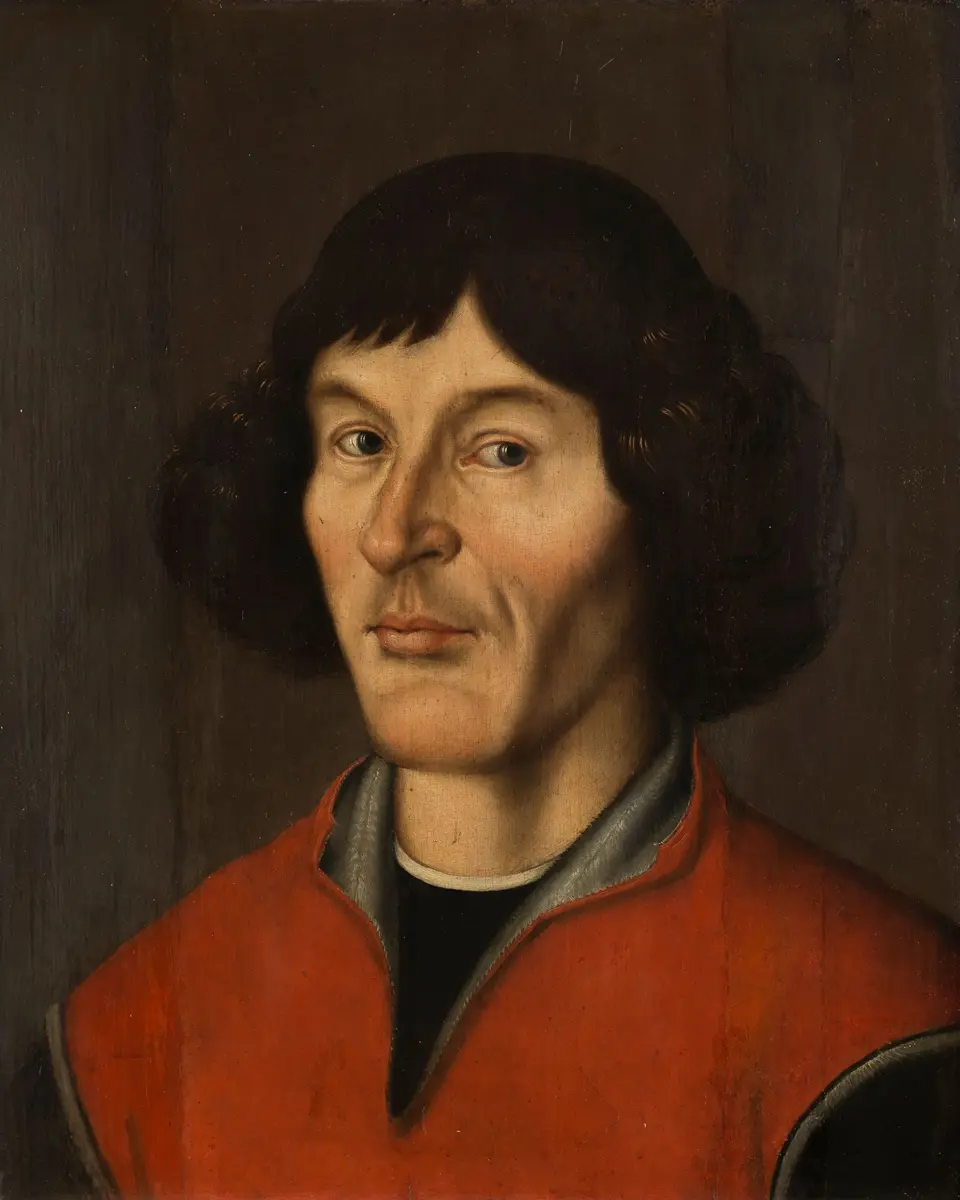
Two ideas made his name. In a short text added to the Cosmographia in 1533 he showed how to fix the places of towns by measuring the angles to them from two ends of a known line, and drawing where the sight lines cross: this is triangulation, still the base of surveying. In his book of 1530 he also wrote that a clock set at home and carried on a journey would show how far east or west the traveller had gone. No clock was good enough for that at sea for another two hundred years. He knew Copernicus's new theory early, through a Polish diplomat, and preferred it.
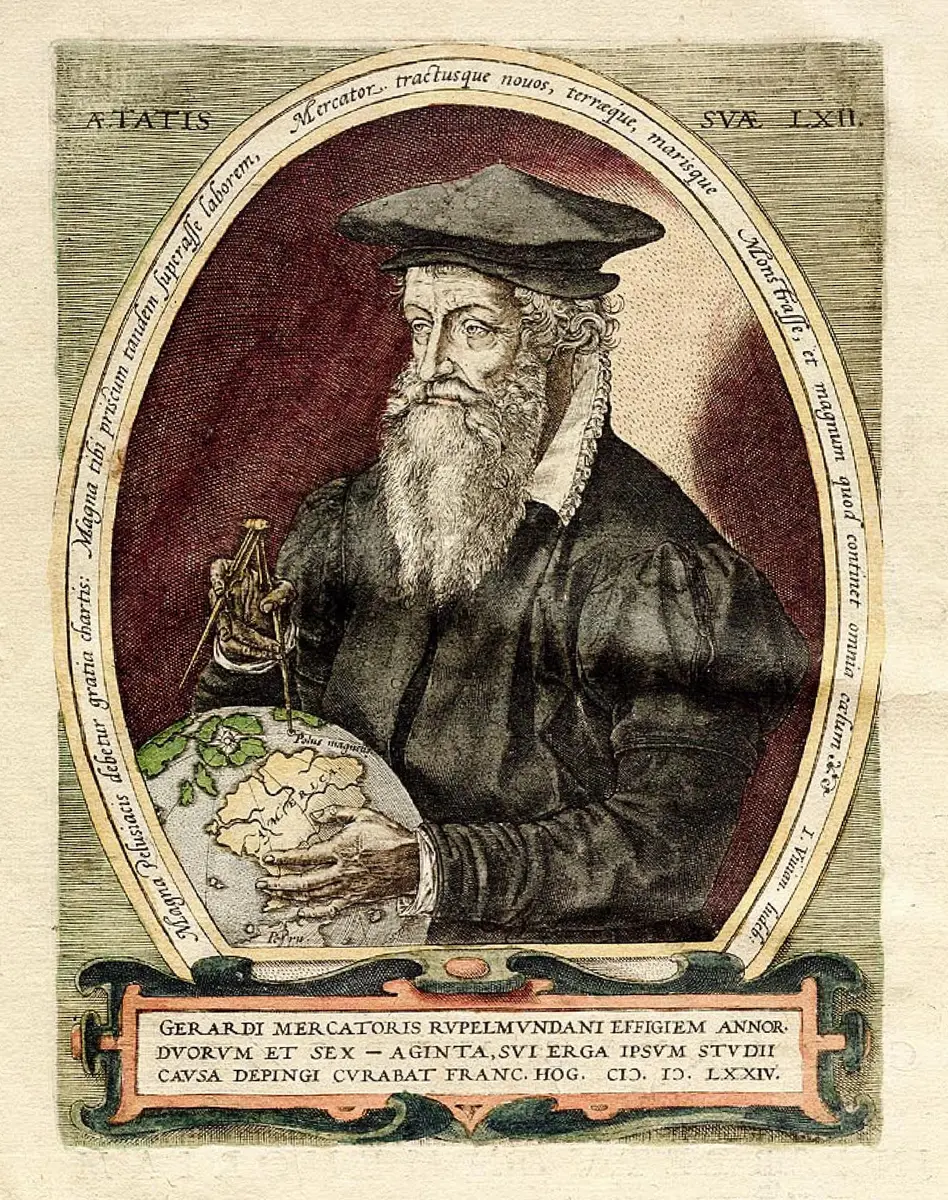
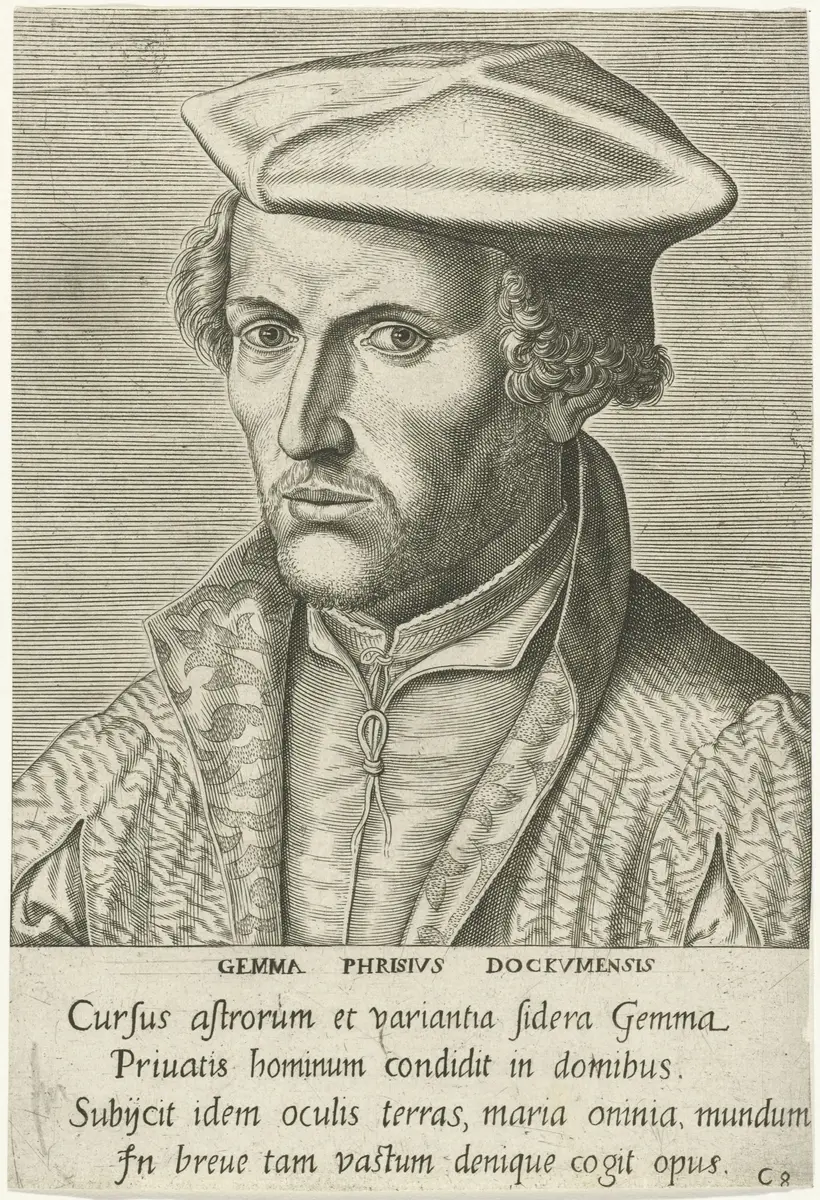
He died in Leuven on 25 May 1555 of kidney stones, aged 46. His book on the astrolabe came out the next year. What he is known for is a way of measuring the world with angles and clocks, and for the pupils who carried it on: Mercator, whose own entry follows, and John Dee, who came to Louvain in 1548 and took his instruments home to England. A famous painting once said to show him is in fact of another man; no portrait made from life is known. The notes below say where sources differ.
What happened
- 1508
Jemme Reinerszoon, later Gemma Frisius, is born in Dokkum in Friesland to poor parents who die while he is a child.
Dokkum, Friesland: where he was born in 1508- 1526
After school in Groningen he matriculates at the Faculty of Arts of the University of Louvain, having been sent there probably in the autumn of 1525.
Leuven (Louvain): his home, workshop and university from 1526 until his death in 1555- 1528
He takes his Master of Arts, then studies medicine and sets up an instrument workshop in Louvain.
Leuven (Louvain): his home, workshop and university from 1526 until his death in 1555 - 1529
His first publication: a corrected edition of Peter Apian's Cosmographia, printed in Antwerp. The picture is the title page of a later, Paris edition of 1553.
Antwerp: where most of his books were printed- 1530
'On the Principles of Astronomy and Cosmography' comes out in Antwerp with his combined terrestrial and celestial globe. A chapter says that a clock set at home and carried on a journey would give the longitude of the traveller's place.
Antwerp: where most of his books were printed - 1532
The Polish ambassador Johannes Dantiscus, who has told him of Copernicus's theory, leaves the imperial court and invites him to come to Poland; after some thought he stays in Louvain.
Brussels: the court of Charles V, where he met the imperial circle and where Vesalius was born- 1533
A new Antwerp edition of the Cosmographia carries his 'Libellus de locorum describendorum ratione', the first proposal, with a diagram, to fix places by triangulation.
Antwerp: where most of his books were printed - 1534
He begins to teach the young Gerardus Mercator, who becomes his collaborator and the engraver of his globes.
Leuven (Louvain): his home, workshop and university from 1526 until his death in 1555At Louvain he dates the letter that opens his 'Usus annuli astronomici', the instructions for the astronomer's ring: a small armillary sphere made to be carried in the pocket.
Leuven (Louvain): his home, workshop and university from 1526 until his death in 1555He marries Barbara; their son Cornelius is born the next year and will edit his father's last works.
Leuven (Louvain): his home, workshop and university from 1526 until his death in 1555- 1535
Charles V grants Frisius and Gaspar van der Heyden an imperial licence to publish an improved terrestrial globe and a celestial globe.
Brussels: the court of Charles V, where he met the imperial circle and where Vesalius was born - 1536
The terrestrial globe appears, naming Frisius as the author, with Van der Heyden's help and Mercator's engraving. The only known copy is in Vienna.
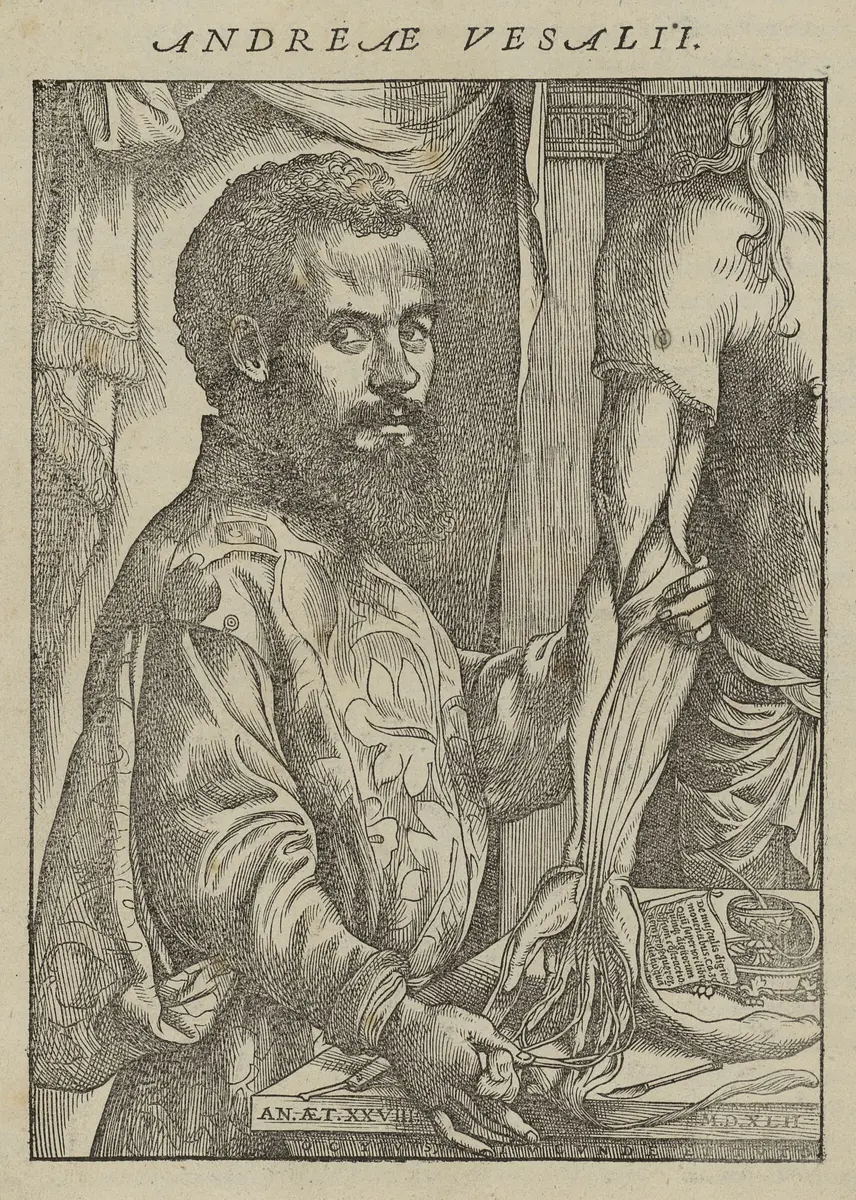
Leuven (Louvain): his home, workshop and university from 1526 until his death in 1555In the autumn the medical student Andreas Vesalius comes from Paris to Louvain; with Frisius he brings a corpse from outside the town and builds a skeleton from it, over several nights.
Leuven (Louvain): his home, workshop and university from 1526 until his death in 1555- 1537
The celestial globe is finished, by Frisius, Van der Heyden and Mercator; in the same year he is given a public chair in medicine at Louvain.
Leuven (Louvain): his home, workshop and university from 1526 until his death in 1555 - 1542
An army comes to besiege Louvain. The students form a defence force, and Frisius spends four days on the walls keeping watch; the siege is lifted.
Leuven (Louvain): his home, workshop and university from 1526 until his death in 1555 - 1544
- 8:53 a.m.
At Louvain he watches an eclipse of the sun by letting its image fall through a hole into a darkened room, and measures it: about ten digits of the sun covered, the middle of the eclipse at about 8 hours 53 minutes before midday by his reckoning.
Leuven (Louvain): his home, workshop and university from 1526 until his death in 1555 - 1545
He dates from Louvain the dedication of 'De radio astronomico et geometrico', the book of his cross-staff. It is printed in Antwerp the same year and carries the first published picture of a camera obscura.
Antwerp: where most of his books were printedIn the book he describes the cross-staff: a rod about a metre and a half long with a sliding cross-piece and sighting vanes, used to measure angles between stars, and distances and heights on the ground.
Antwerp: where most of his books were printed- 1548
John Dee arrives in Louvain and seeks out Frisius and Mercator; he goes home with a brass cross-staff and ring by Frisius and Mercator's two globes.
Leuven (Louvain): his home, workshop and university from 1526 until his death in 1555 - 1555
He dies in Louvain, aged 46, of kidney stones from which he had suffered for years.
Leuven (Louvain): his home, workshop and university from 1526 until his death in 1555