Pietro Coppo
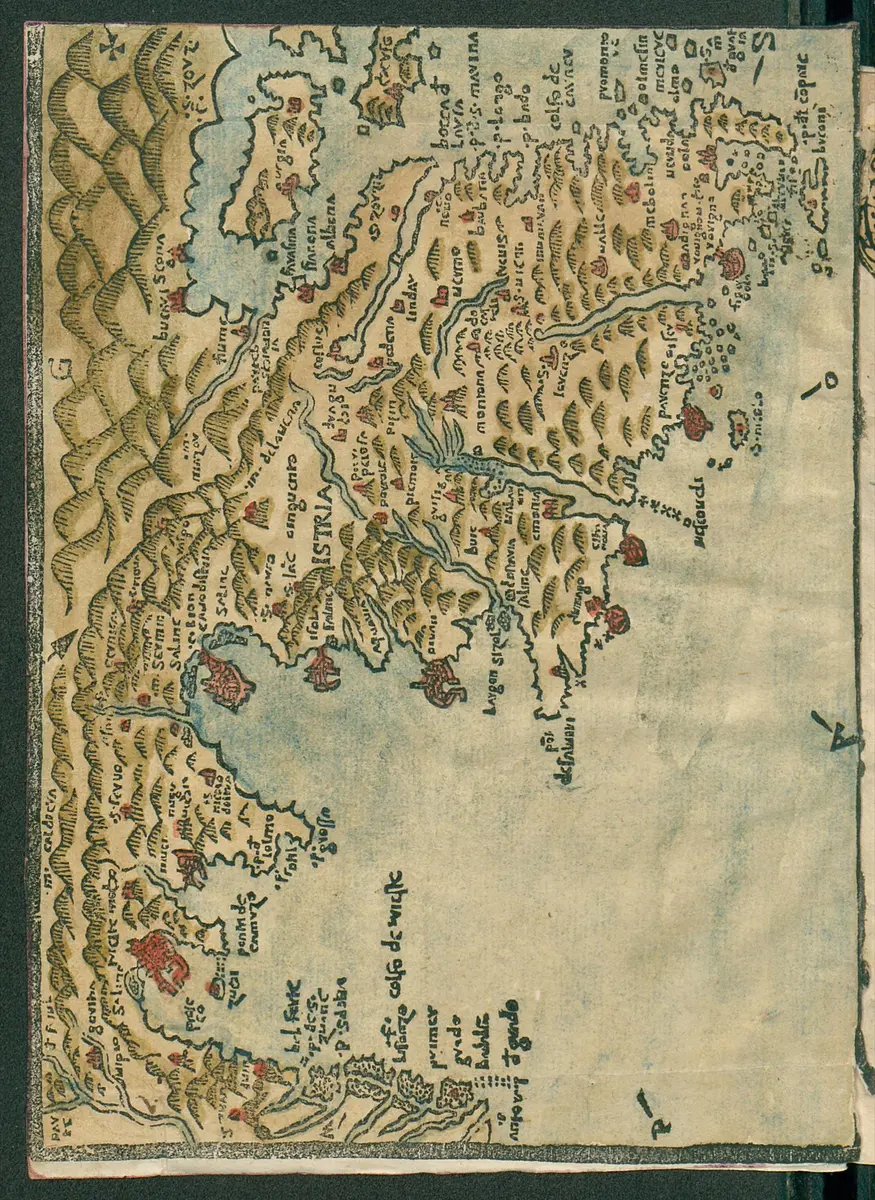
“The Venetian-born notary of Izola (about 1470 to 1555) who drew the first map of Istria and planned a world atlas of fifteen woodcut maps.”
Pietro Coppo was a Venetian-born scribe, judge and mapmaker who spent most of his life in the small Adriatic port of Izola, in what is now Slovenia. In his spare hours he wrote four works on geography. They gave the first regional map of the Istrian peninsula, a sailor's guide to the Mediterranean, and a set of fifteen woodcut maps of the whole known world.
He was born in Venice at the end of 1469 or in the first half of 1470 and studied under the scholar Marcantonio Sabellico. He then travelled in Italy and sailed to Crete, where he lived with an uncle for about six years. Back in Venice he worked as a scribe for a town governor, which took him to Izola. There he married Collotta di Ugo in 1499 and stayed, working as a scribe, a judge and an overseer of the deepening of the harbour and the building of a pier.
His big works came in his fifties. De toto orbe (1518 to 1520) described the world in four volumes with an atlas of 22 maps. De summa totius orbis (1524 to 1526) was a shorter version in Latin with fifteen woodcut maps arranged in a planned order, which is why it is sometimes called the first modern atlas. The Portolano (1528), in Italian, lists the coasts and islands of the Mediterranean with distances, winds and other facts for pilots. His map of Istria (1525) is the oldest surviving map of the peninsula, and a description of Istria that goes with it was printed in Venice in 1540.
Coppo's books were never printed as the atlas he planned, and the pieces that survive are few: the Bologna and Paris copies of De toto orbe, and the Piran Codex, which binds De summa and the Portolano together with the fifteen maps and is kept in the Sergej Masera Maritime Museum in Piran. In 2022 Slovenia listed it among its national monuments of the world. His Istria map reached a wide public when Abraham Ortelius included it in his Theatrum Orbis Terrarum in 1573.
What happened
- 1470
Pietro Coppo is born in Venice, at the end of 1469 or in the first half of 1470; he studies under Marcantonio Sabellico.
Venice: where he was born about 1470 and studied - 1499
Now a scribe for a Venetian official, he settles in Izola and marries Collotta di Ugo, of a wealthy local family.
Izola: his home from 1499, where he wrote his geographies - 1520
He finishes De toto orbe, a description of the world in four volumes with an atlas of 22 maps, begun in 1518; it stays in manuscript.
Bologna: the Archiginnasio Library, which holds a copy of De toto orbe - 1525
He draws the map of Istria, the oldest surviving map of the peninsula, and a map of Britain and Ireland, within De summa totius orbis (written 1524 to 1526).
Izola: his home from 1499, where he wrote his geographies - 1526
De summa totius orbis is complete: fifteen woodcut maps with a Latin text, later bound with the Portolano as the Piran Codex.
Piran: the Maritime Museum that keeps the Piran Codex - 1528
He writes the Portolano, in Italian, a sailors' guide to the coasts and islands of the Mediterranean with distances and winds.
Izola: his home from 1499, where he wrote his geographies - 1540
His description of Istria, Del sito de Listria, written in 1529, is printed in Venice with the first regional map of the peninsula.
Venice: where he was born about 1470 and studied - 1555
Coppo dies, in 1555 or 1556 according to the sources.
Izola: his home from 1499, where he wrote his geographies