Drive to Survive premieres
“Netflix's Drive to Survive, released on 8 March 2019 as part of Liberty Media's plan to open Formula 1 to new fans, helped lift the sport's American audience, while Verstappen said it faked rivalries.”
On 8 March 2019 Netflix released all ten episodes of Formula 1: Drive to Survive, a documentary series about the 2018 season, from the start in Melbourne to the finale in Abu Dhabi. It was made by Box to Box Films, the company behind the films Senna and Amy, with James Gay-Rees and Paul Martin as executive producers and Sophie Todd as showrunner, and with Formula 1's own cooperation. Instead of reporting results, the cameras followed the people: drivers in their motorhomes, team bosses in the garage, the rows and the worry about losing a seat. The story was told like a drama, one team or driver to an episode, and the sport was suddenly easy to enter for someone who had never watched a race.
The series was one move in a bigger plan. On 23 January 2017 Liberty Media, the American company from Englewood, Colorado, completed its purchase of Formula 1, a deal that Liberty put at an equity value of 4.4 billion dollars and an enterprise value of 8.0 billion. Chase Carey became chief executive and Bernie Ecclestone, who had been its chief executive for more than 40 years, became chairman emeritus. Sean Bratches, the new head of commercial operations, said soon after that F1 had been 'left behind' by the digital revolution and that everything had to 'pivot around the fan': teams and drivers were allowed to post short films, a parade of F1 cars drove through central London in July 2017, and in 2019 F1's media-rights director called the Netflix deal a step towards becoming 'a media and entertainment brand'.
Nobody can say exactly how much the show did, but the American numbers moved. ESPN's Formula 1 races averaged 949,000 viewers in 2021 and a record 1.21 million in 2022, and the first Miami Grand Prix, on 8 May 2022, drew 2.6 million on ABC, the biggest live F1 audience ever on US television. Nielsen found that more than 360,000 people who had not watched the last races of 2021 watched F1 in early 2022 after first watching the series, and that these new fans were far younger than the sport's usual audience. F1 added Miami in 2022 and Las Vegas in 2023 beside Austin. But other things probably pushed the same way: the Hamilton and Verstappen title fight of 2021, a pandemic year of streaming, and ESPN's coverage. In 2023 the season average slipped back to 1.12 million.
The show has also been a quarrel. Mercedes and Ferrari stayed out of the first season, and Toto Wolff has said he 'hated' an early episode that played up a rivalry he found made up; both teams joined in season two, which came out on 28 February 2020. The loudest critic was Max Verstappen, who told the Associated Press in October 2021 that the makers 'faked a few rivalries which they don't really exist' and refused to take part in season four. He came back for season five, in February 2023, after talks with the producers about showing him as he is. Fans have long complained of soundbites cut out of context and radio messages moved to other moments, and in 2026 a Box to Box executive admitted mistakes, among them footage from the wrong cool-down room, while saying the show aims at casual viewers and cannot please everyone.
By 2026 there were eight seasons. Season eight, about the 2025 championship, came out on 27 February 2026 with eight episodes, and in the United States it also streamed on Apple TV, which had become the exclusive US home of F1 that year, while Netflix got to carry the Canadian Grand Prix live. Its producers say they are 'not planning for an end'. Whatever its flaws, Drive to Survive showed that a sport could use a streaming drama as its front door, and it is still where many fans, especially in the United States, say they first met Formula 1.
What happened
- 2017
Liberty Media completes its purchase of Formula One from a group of sellers. Liberty gives the equity value as 4.4 billion dollars and the enterprise value as 8.0 billion. Chase Carey becomes chief executive of F1 and remains chairman; Bernie Ecclestone becomes chairman emeritus.
Liberty Media, Englewood, Colorado: the American company's office, from where it bought Formula One (completed 23 January 2017) and commissioned its media strategyIn an interview published by Autosport, Sean Bratches, the new managing director for commercial operations, says F1 was 'left behind' by the digital revolution and that everything must 'pivot around the fan'. Teams and drivers can now post short films on social media, which the old regime had forbidden.
At the Russian Grand Prix in Sochi, President Putin is greeted by Chase Carey, 'newly appointed' Formula One chief executive, and by Bernie Ecclestone, the sport's chief executive for more than 40 years: the old and the new head of F1 side by side, three months after the takeover.
'F1 Live' fills central London: every team and all but one driver (Lewis Hamilton declined) take part in a 90-minute demonstration of cars from Whitehall to Trafalgar Square and Horse Guards Parade, days before the British Grand Prix. Liberty has said fan engagement is its 'number one priority' and wants each race to be a 'Super Bowl-style event'.
Trafalgar Square, London: where the F1 cars of 'F1 Live' ran on 12 July 2017, Liberty's first public show- 2018
The Australian Grand Prix in Melbourne opens the 2018 season. Box to Box Films' cameras follow the season, from Melbourne to the finale at Abu Dhabi on 25 November, for what becomes the first series of Drive to Survive.
- 2019
Formula 1 and Netflix announce the series, released with its first trailer: ten episodes about the 2018 championship, executive-produced by James Gay-Rees and Paul Martin of Box to Box Films, with Sophie Todd as showrunner. F1's director of media rights, Ian Holmes, says the deal puts F1 'at the forefront of becoming a media and entertainment brand'.
All ten episodes of Formula 1: Drive to Survive go online on Netflix worldwide. Mercedes and Ferrari have stayed out of the first season, so the story is told through the midfield teams and their drivers.
Netflix headquarters, Los Gatos, California: the streaming company that released Drive to Survive on 8 March 2019Toto Wolff confirms that Mercedes will take part in the second series after sitting out the first, but will give Netflix access to only one race that year; he says the first series 'didn't reflect what was happening on track' and that the show 'is about the characters'. Ferrari is also expected to appear.
- 2020
Season two, about the 2019 season, is released, with Mercedes and Ferrari joining and the crews now following all ten teams.
- 2021
Season three, about the 2020 season, is released, nine days before the start of the 2021 season in Bahrain.
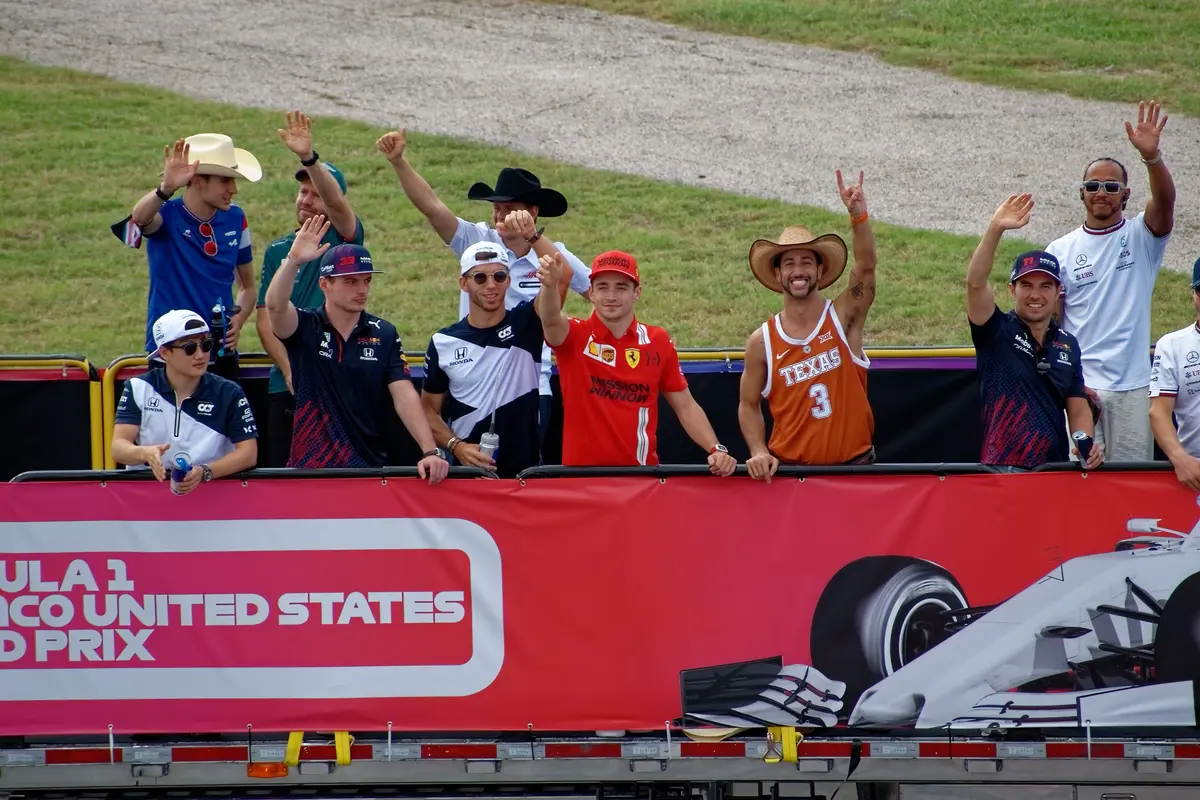
Max Verstappen tells the Associated Press that he will not take part in the next series: 'They faked a few rivalries which they don't really exist.' He adds, 'I understand that it needs to be done to boost the popularity in America. But from my side as a driver, I don't like being part of it.' Three days later the drivers' parade is held at the United States Grand Prix in Austin, with the title fight at its height.
Circuit of the Americas, Austin, Texas: F1's American race since 2012, where Verstappen's 'faked rivalries' remark of October 2021 was followed by the 2021 race weekend- 2022
Season four, about the 2021 title fight between Hamilton and Verstappen, is released without Verstappen's cooperation. Nielsen finds that its premiere week drew 60 per cent more viewers than the season three premiere. Verstappen says the show 'was already ruined after Season 1'.
Netflix and F1 renew the series for a fifth and sixth season, the first time two seasons are confirmed in advance. They say season four reached number one in 33 countries, and that the show's influence in the United States has been 'particularly notable', as F1 heads for a third American race in 2023.
The first Miami Grand Prix, won by Max Verstappen at the Miami International Autodrome, is shown on ABC to a record average audience of 2.6 million (best quarter hour 2.9 million), the largest audience for a live F1 telecast in US television history. The earlier record for a live race was 1.744 million, for the 1995 Brazilian Grand Prix.
Miami International Autodrome, Miami Gardens, Florida: the circuit round Hard Rock Stadium of the first Miami Grand Prix, 8 May 2022, watched by 2.6 million people on US televisionESPN reports that the 2022 season averaged 1.21 million viewers per race, a US record, 28 per cent above the 949,000 of 2021; viewers aged 18 to 34 were up 43 per cent per race and women made up 28 per cent of the audience.
- 2023
Season five, about the 2022 season, is released, with Verstappen taking part again after what he calls an agreement with the makers: he says he has long wanted to be shown 'exactly as he truly is', that as world champion he has to take part, and that fans will get a 'true image' of him.
- 10:00 p.m.
The first Las Vegas Grand Prix is run on the Strip on Saturday night, local time. ESPN's overnight telecast averages 1.31 million viewers, but Las Vegas itself gives it a local rating of 7.4. The 2023 season's US average is 1.12 million per race, below 2022's record but above 2021's.
Las Vegas Strip Circuit, Nevada: the street circuit of the first Las Vegas Grand Prix, 18 November 2023 - 2024
Season six, about the 2023 season, is released on the last day of pre-season testing in Bahrain.
- 2025
Season seven, about the 2024 season, is released a week before the new season opens in Australia; Autosport later reports that it reached more than 10 million viewers.
- 2026
Netflix and Apple announce that season eight will stream on Apple TV in the United States as well as on Netflix, now that Apple is the exclusive US broadcaster of Formula 1; in exchange Netflix will carry the Canadian Grand Prix live in the US. Outside the US the series stays on Netflix alone.
Apple Park, Cupertino, California: Apple's headquarters; Apple became the exclusive US broadcaster of F1 in 2026 and Drive to Survive season eight streamed thereSeason eight, eight episodes about the 2025 championship, is released on Netflix worldwide and on Apple TV in the United States.
In an Autosport interview, Tom Rogers of Box to Box Films admits the show 'has made mistakes', among them footage of Verstappen taken from the wrong cool-down room, now fixed, and says: 'You have to very early accept the fact you're not going to please everybody.' He says the producers are 'not planning for an end'.
Netflix carries the Canadian Grand Prix live to American subscribers, the first live F1 race on the platform, as part of the deal with Apple.