The first Formula One World Championship, at Silverstone
“On 13 May 1950 at Silverstone, in front of the King, Nino Farina won the first race of the first World Championship for drivers; he clinched the title at Monza on 3 September.”
At the end of 1949 the sport's governing body, the FIA, decided to turn its top single-seater racing into a championship. Since 1947 the best drivers had raced under one set of rules, the International Formula, which allowed cars with unsupercharged 4.5-litre engines or supercharged 1.5-litre engines. For 1950 six of the biggest European Grands Prix and the Indianapolis 500 in America would count towards one title, the World Championship of Drivers. A driver's best four results would count, with 8, 6, 4, 3 and 2 points for the first five places and one extra point for the fastest lap. Nobody yet called it Formula One as a brand. It was a title for the drivers alone; a prize for the makers came only in 1958.
The first round was the Grand Prix d'Europe, also the British Grand Prix, at Silverstone on Saturday 13 May 1950. The track was a wartime bomber airfield in Northamptonshire that had shut in the 1940s; racing had begun there in 1948. Cars ran round the airfield's perimeter track, with straw bales marking the corners. The crowd, put at about 150,000 by Motor Sport, was a record for British motor racing, and King George VI, Queen Elizabeth and Princess Margaret watched for much of the afternoon. It is the only time a reigning British monarch has been at a Grand Prix in Britain.
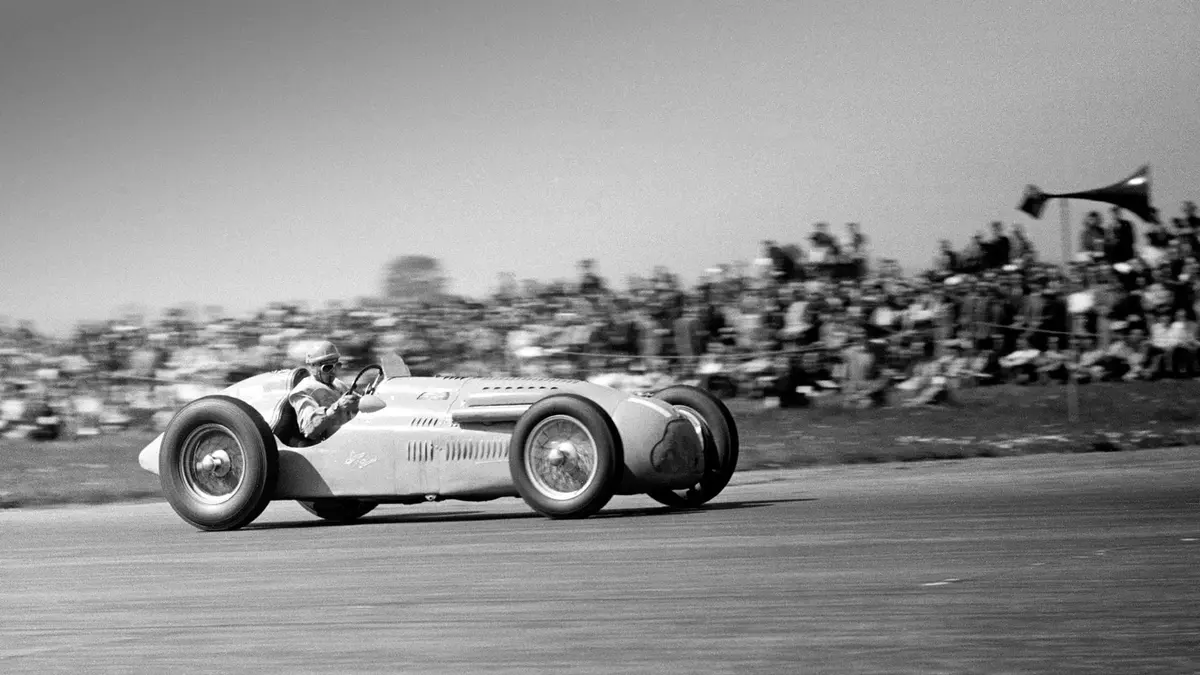
The race belonged to Alfa Romeo. Its 1.5-litre supercharged 158, nicknamed the Alfetta, had first raced in 1938 and was now the quickest car of its day, though it drank fuel at more than twice the rate of its rivals. Alfa Romeo took the first four places on the grid, with Giuseppe 'Nino' Farina on pole, then Luigi Fagioli, Juan Manuel Fangio and the British guest driver Reg Parnell. Farina won after 70 laps from Fagioli, with Parnell third, Alfas 1-2-3. Fangio had been close behind the leader when he hit a straw bale at Stowe and was out with engine trouble, and Parnell finished with his grille smashed by a hare. Farina took the first pole, the first fastest lap and the first win of the championship.
Over the summer the other rounds went by. Fangio won at Monaco, Belgium and France, Farina in Switzerland, and a Kurtis-built roadster with an American driver won the Indianapolis 500, where no European team had gone. The title was settled at Monza on 3 September. Fangio led on points, 26 to Farina's 22, but he lost his engine and then a second car taken over from a team-mate, while Farina led and won. He finished the season on 30 points to Fangio's 27 and Fagioli's 24, and became the first World Champion at the age of 43.
The 1950 season created the template: a yearly list of Grands Prix, one points table, and a champion. The championship ran to Formula Two rules in 1952 and 1953, went back to 2.5-litre Formula One cars in 1954, and has run every year since. Its first season was also close to a one-team show, since the Alfettas led 384 of the 391 laps run in the six European rounds; the sport had to wait for Ferrari to make it a contest. For readers today, Silverstone 1950 is where the idea of a world championship of racing drivers first became real.
What happened
- 1949
At the end of the 1949 season the FIA's sporting commission decides that races of the following year will be joined into a World Championship of Drivers: six European Grands Prix and the Indianapolis 500, with points on the 8-6-4-3-2 scale, best four results to count. The racing rules behind it, set in 1946 for 1947, allow 4.5-litre unsupercharged engines or 1.5-litre supercharged ones. The month and place of the decision are not found in any source seen.
- 1950
Practice at Silverstone begins on the Thursday, two days before the race. Nino Farina's 1 min 50.8 sec (93.85 mph) is the fastest time; Fangio is at 1:51 and the British guest, Reg Parnell, at 1:52.2. Farina's lap is half a mile an hour faster than the old BRDC lap record.
Silverstone: the former RAF Silverstone bomber airfield where the first championship race was run on 13 May 1950, round its perimeter trackSpectators have been arriving since 6 am. About 150,000 people come, a record for British motor racing, and the King, the Queen and Princess Margaret watch for most of the afternoon with Earl and Countess Mountbatten. The King greets the drivers before the start, and Earl Howe presents them. Raymond Mays shows the new BRM before the Grand Prix.
Silverstone: the former RAF Silverstone bomber airfield where the first championship race was run on 13 May 1950, round its perimeter trackThe Grand Prix d'Europe, the first race of the World Championship, is run over 70 laps of the 2.889-mile airfield circuit. Alfa Romeo has the first four places on the grid: Farina, Fagioli, Fangio and Parnell. Farina leads, then Fagioli after ten laps, Fangio by 0.2 sec at fifteen, and Farina again from lap 20; never more than a second separates the leaders. Farina sets the first fastest lap in the championship, 1:50.6.
Silverstone: the former RAF Silverstone bomber airfield where the first championship race was run on 13 May 1950, round its perimeter trackFangio, who had closed to within 0.6 sec of Farina, hits a straw bale at Stowe Corner and soon retires with engine trouble (Motor Sport: a broken connecting rod; Wikipedia and PlanetF1: a broken oil pipe). Reg Parnell hits a hare but keeps going. Maserati, Talbot and ERA entries drop out one by one.
Silverstone: the former RAF Silverstone bomber airfield where the first championship race was run on 13 May 1950, round its perimeter trackFarina wins in 2 h 13 min 23.6 sec, an average of 90.95 mph, 2.6 sec ahead of Fagioli, with Parnell third and Alfa Romeo 1-2-3. Farina takes 9 points: 8 for the win and 1 for the fastest lap. Bob Gerard, sixth, is the first British car home and receives the Fred Craner Memorial Trophy.
Silverstone: the former RAF Silverstone bomber airfield where the first championship race was run on 13 May 1950, round its perimeter trackMonaco: Fangio wins from pole, with Ascari's Ferrari second a lap down. A pile-up on the first lap, caused by a wave over the harbour wall, eliminates nine of the 19 starters, among them Farina and Fagioli.
Monte Carlo, Monaco: round 2, 21 May 1950, won by Fangio after a first-lap pile-upThe Indianapolis 500 counts as round 3 of the championship but is run to American rules, and no European driver goes. Johnnie Parsons wins in a Kurtis Kraft-Offenhauser after rain stops the race at 138 of 200 laps.
Indianapolis Motor Speedway, USA: round 3, the 1950 Indianapolis 500 of 30 May, which counted for the championshipSwiss Grand Prix at Bremgarten: Farina wins, Fagioli second, Rosier's Talbot third. Fangio, on pole, is out with engine trouble.
Bremgarten forest, Bern, Switzerland: the Swiss Grand Prix of 4 June 1950 was run on public roads through itBelgian Grand Prix at Spa: Fangio wins, Fagioli is second and Rosier third. Farina is fourth and scores 4 points.
Spa-Francorchamps, Belgium: round 5, 18 June 1950French Grand Prix at Reims: Fangio wins again. Farina, who has led, is out with a fuel-pump failure. After six rounds Fangio leads with 26 points.
Reims-Gueux, France: the grandstand of the road circuit, where the French Grand Prix of 2 July 1950 started and finishedMonza, the last round, and the title is open. Before the race Fangio has 26 points, Fagioli 24 and Farina 22. Farina can take the title by winning, provided Fangio does not finish above fifth. Fangio is on pole with 1:58.6, with Ascari's new 4.5-litre Ferrari alongside and Farina third.
Monza, Italy: the Autodromo Nazionale, where Farina clinched the title on 3 September 1950Farina takes the lead at the start and holds it, pressed by Fangio and Ascari. Ascari passes him briefly before his Ferrari fails; Motor Sport and Autosport give valve trouble, 8W a broken rear axle, Wikipedia a porous engine block on lap 20.
Monza, Italy: the Autodromo Nazionale, where Farina clinched the title on 3 September 1950Fangio's own Alfa Romeo drops a valve, ending his challenge. He takes over Piero Taruffi's car and it blows up as well. Ascari takes over Dorino Serafini's Ferrari and closes on the leader. The two Ferrari drivers share the points for second place.
Monza, Italy: the Autodromo Nazionale, where Farina clinched the title on 3 September 1950Farina wins in 2 h 51 min 17.4 sec, 80 laps, with the Ferrari of Ascari and Serafini second and Fagioli third. Fangio takes the fastest lap, and a point. Farina's four scoring results come to 30 points, Fangio's to 27, Fagioli's to 24, and Giuseppe Farina becomes the first World Champion of drivers, the only man to take the title at home.
Monza, Italy: the Autodromo Nazionale, where Farina clinched the title on 3 September 1950