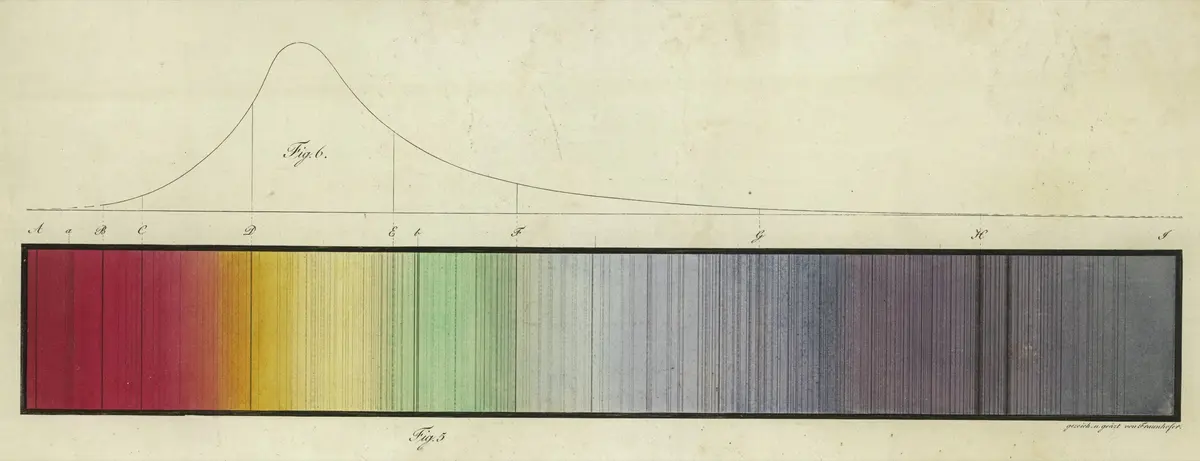
Fraunhofer maps the dark lines in sunlight
“In 1814 Joseph Fraunhofer, a Bavarian glassmaker, counted 574 fixed dark lines in the Sun's rainbow; in 1859 Kirchhoff and Bunsen showed they are the fingerprints of chemical elements.”
A rainbow made by a glass prism is not smooth. In 1814 Joseph Fraunhofer, a 27-year-old glassmaker at the Optical Institute in Benediktbeuern in Bavaria, looked at sunlight spread out by a prism through a surveyor's telescope and saw a great number of thin dark lines crossing the colours, always in the same places. He had not gone looking for them. He was measuring how strongly different kinds of glass bend each colour of light, so that he could build better telescope lenses, and he needed a sharp, fixed mark in the spectrum to measure from. A flame gave him a bright orange line; he then asked whether sunlight had a line at the same place, and found the dark ones instead.
He was not the very first to see one. William Hyde Wollaston, an English chemist, had noted a few dark gaps in sunlight in a paper read at the Royal Society on 24 June 1802, but he had only a half-dozen and did not follow them up. Fraunhofer counted 574 and drew them in position. He gave the strongest ones capital letters, A, B, C, D and on, names that astronomers still use. He checked that the lines did not change when he altered his slit or his apparatus, so they belonged to sunlight itself, and he found different dark lines in the light of Sirius and other bright stars. He published this in a paper on glass and telescopes in the Munich Academy's memoirs, printed in 1817. He later made diffraction gratings and, from 1821, measured the wavelengths of the lines with them.
Fraunhofer could not say what the lines were, and he died in Munich on 7 June 1826, aged 39, without knowing. The answer came in 1859 and 1860 at Heidelberg. Gustav Kirchhoff, a physicist, and Robert Bunsen, a chemist, showed that each chemical element, heated in a flame, gives out bright lines at its own fixed places, and that cooler gas in front of a bright source takes the same lines away as dark ones. Fraunhofer's dark D line sat exactly where sodium's bright line sits, so the Sun's outer layers must contain sodium. A spectrum now worked as a fingerprint that could be read from far away.
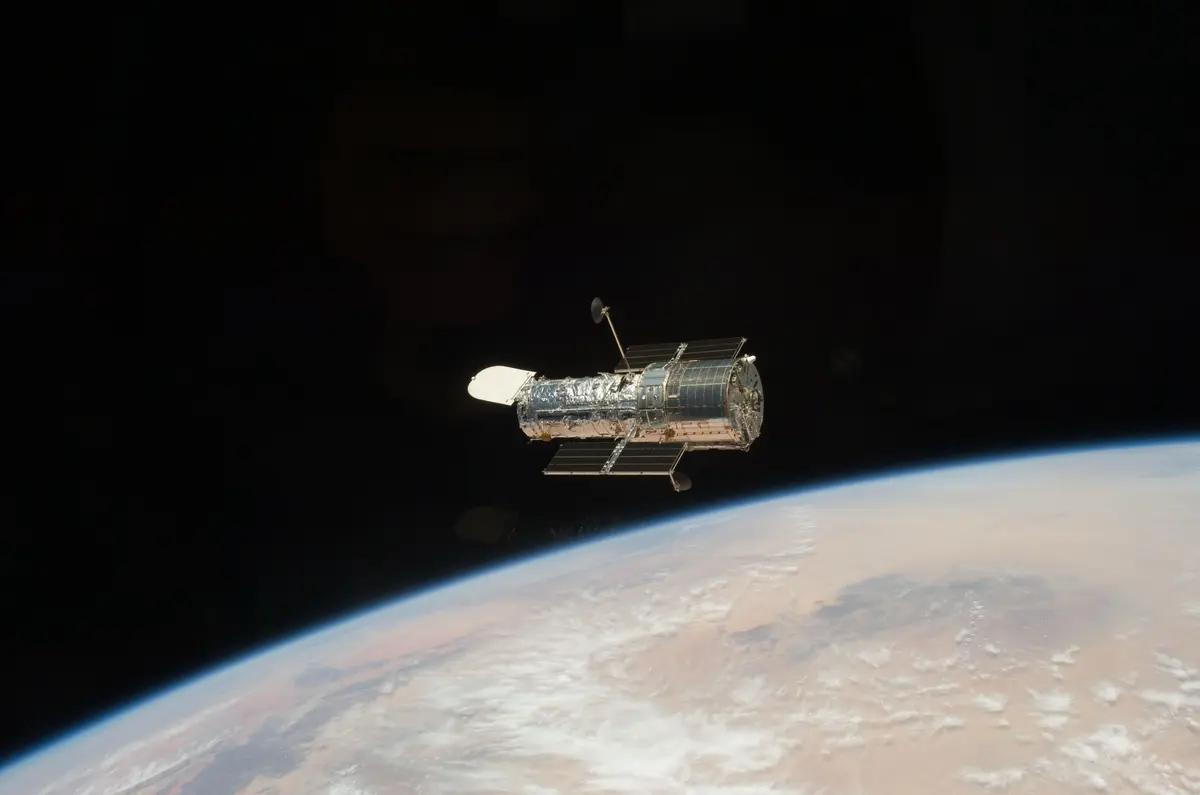
That is why a glassmaker's table of lines matters. Nearly everything we know about what the Sun and the stars are made of comes from reading such lines, from the first measurements in the 1860s to the spectra taken today by the Hubble and James Webb space telescopes. His own bench work also mattered: Fraunhofer's firm, with its precise glass and surveying-grade instruments, made Bavaria the centre of the optical trade in his day.
What happened
- 1802
At the Royal Society in London a paper by William Hyde Wollaston on measuring how glass bends light is read; it notes a handful of dark gaps in sunlight, the first sighting of what Fraunhofer will map.
London, Somerset House: the Royal Society, where Wollaston's paper with the first dark gaps was read on 24 June 1802- 1806
Fraunhofer, aged 19, joins the Optical Institute that Utzschneider, Reichenbach and Liebherr have set up at the secularised abbey of Benediktbeuern.
Benediktbeuern Abbey, Upper Bavaria: the secularised monastery where the Optical Institute worked and where he found the lines in 1814 - 1809
He takes over the mechanical side of the Institute and becomes a partner in the firm.
Benediktbeuern Abbey, Upper Bavaria: the secularised monastery where the Optical Institute worked and where he found the lines in 1814 - 1813
The Institute's prism spectrograph, a theodolite fitted with a prism, is built; Fraunhofer uses it to spread sunlight into a spectrum. He now runs the whole workshop.
Benediktbeuern Abbey, Upper Bavaria: the secularised monastery where the Optical Institute worked and where he found the lines in 1814 - 1814
While measuring the glasses' dispersion he finds a bright orange line in a flame, looks for it in sunlight through a slit and a telescope, and sees instead a great number of fixed dark lines. This is the year of the discovery; no day is recorded in the sources read.
Benediktbeuern Abbey, Upper Bavaria: the secularised monastery where the Optical Institute worked and where he found the lines in 1814Guinand and Reichenbach leave the firm and Fraunhofer becomes a partner, so the business becomes Utzschneider and Fraunhofer.
Benediktbeuern Abbey, Upper Bavaria: the secularised monastery where the Optical Institute worked and where he found the lines in 1814- 1815
He engraves a coloured map of the spectrum with the lettered lines, now in the Deutsches Museum Archive; the date is Commons' and Physics Today dates the printed engraving 1815.
Benediktbeuern Abbey, Upper Bavaria: the secularised monastery where the Optical Institute worked and where he found the lines in 1814 - 1817
His paper on the dispersion of glass, with plates showing the lines and the lettering, comes out; the Munich Academy volume is for 1814-15, and the paper is reprinted the same year in Annalen der Physik, vol. 56. He becomes a corresponding member of the Bavarian Academy.
Munich, Alter Sudfriedhof: the city where the firm returned in 1819, where he died on 7 June 1826 and where he is buried - 1819
The workshop returns from Benediktbeuern to Munich.
Munich, Alter Sudfriedhof: the city where the firm returned in 1819, where he died on 7 June 1826 and where he is buried - 1820
Fraunhofer builds a heliostat, a mirror that holds sunlight steady, for his grating spectrometer.
- 1821
He turns from prisms to diffraction gratings and uses them to measure the wavelengths of the dark lines, the first to do so; the results appear in the Academy's memoirs for 1821-22 and, in 1823, in the Annalen der Physik.
Munich, Alter Sudfriedhof: the city where the firm returned in 1819, where he died on 7 June 1826 and where he is buried - 1824
He receives personal nobility from the King of Bavaria and calls himself 'von' from now on.
Munich, Alter Sudfriedhof: the city where the firm returned in 1819, where he died on 7 June 1826 and where he is buried - 1826
Joseph von Fraunhofer dies in Munich at 39; glassmakers of his time breathed metal vapours, which Wikipedia names as the likely cause. He is buried in the Alter Sudfriedhof.
Munich, Alter Sudfriedhof: the city where the firm returned in 1819, where he died on 7 June 1826 and where he is buried- 1859
At Heidelberg, Kirchhoff tells the Berlin Academy that the dark Fraunhofer lines come from absorption in the Sun's atmosphere; the dark D line matches the bright line of sodium. The month is the Academy's monthly report; the day was not checked.
Heidelberg: where Kirchhoff and Bunsen, both professors at the university, explained the dark lines in 1859-60- 1860
Kirchhoff and Bunsen publish their method of chemical analysis by spectrum in Poggendorff's Annalen, vol. 110, with a drawing of their spectroscope; their work leads straight to the discovery of caesium and rubidium.
Heidelberg: where Kirchhoff and Bunsen, both professors at the university, explained the dark lines in 1859-60