The CCD image sensor
“On 17 October 1969 Willard Boyle and George Smith sketched the charge-coupled device at Bell Labs in about an hour; the chip that turns light into numbers won them the 2009 Nobel Prize in Physics.”
A charge-coupled device, or CCD, is a chip that turns light into numbers. Its surface is a grid of tiny cells. When light hits a cell, it frees electrons from the silicon, and the cell stores them as a small packet of charge: the brighter the light, the bigger the packet. Then the chip passes the packets from cell to cell, like buckets along a line of people, to one corner where they are counted. The count for each cell is one dot of a picture. On 17 October 1969, in an office at Bell Labs in Murray Hill, New Jersey, Willard Boyle and George Smith sketched this idea on a blackboard in a talk of not much more than an hour.
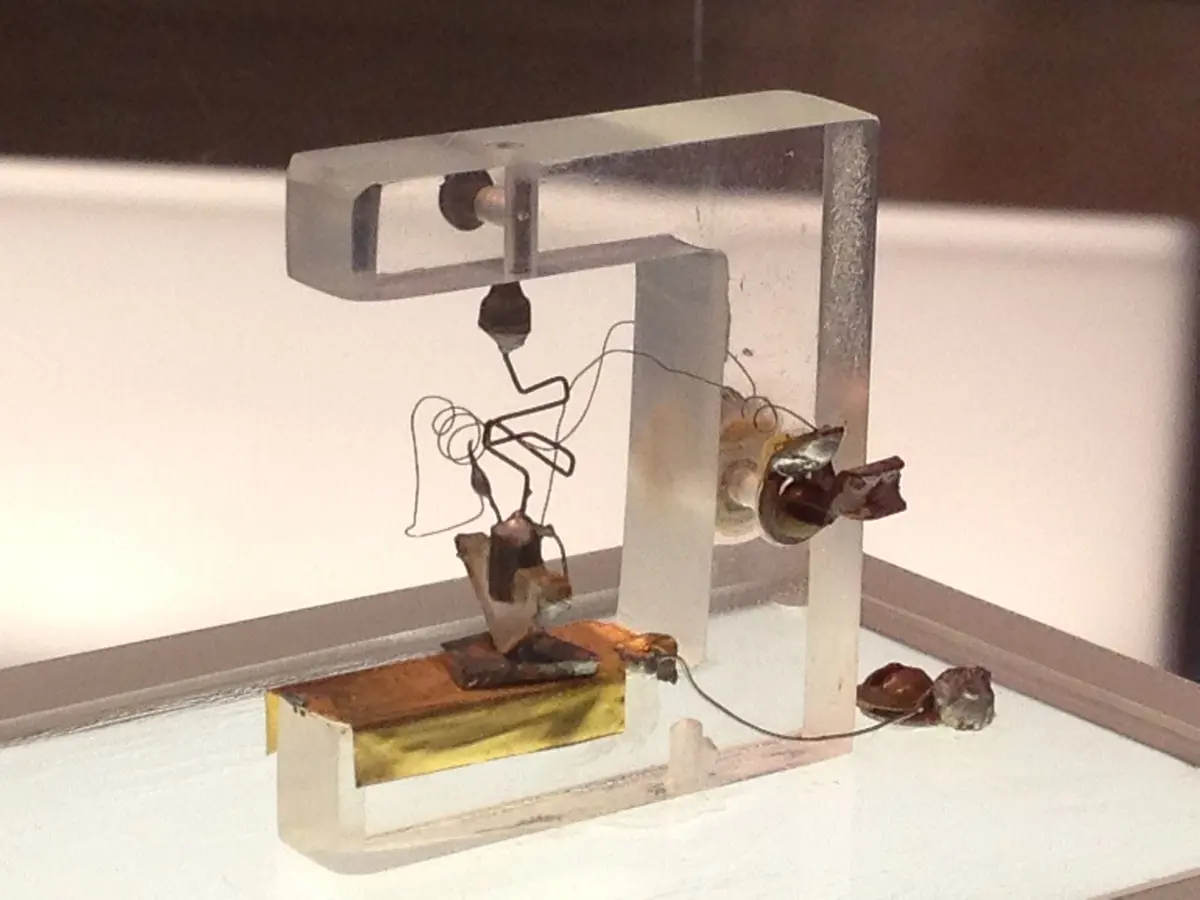
They were not trying to invent a camera. Bell Labs' vice president Jack Morton wanted a semiconductor memory to compete with magnetic bubble memory, and threatened to move money and people away from Boyle's division if it could not produce one. Boyle was the executive director of the semiconductor work and Smith one of his department heads. Smith's own department was also working on a solid-state camera for AT&T's Picturephone, a telephone that showed the face of the caller. Boyle and Smith put the pieces together: a packet of charge was the electrical twin of a magnetic bubble; a metal-oxide-silicon capacitor could hold it; and capacitors placed very close together could hand it along when the voltages were changed. Light could fill the cells with charge just as well as a wire could. Within a week their colleagues had built and tested the first crude device, and in April 1970 the Bell System Technical Journal printed the concept together with an experimental check made by Gil Amelio, Michael Tompsett and Smith.
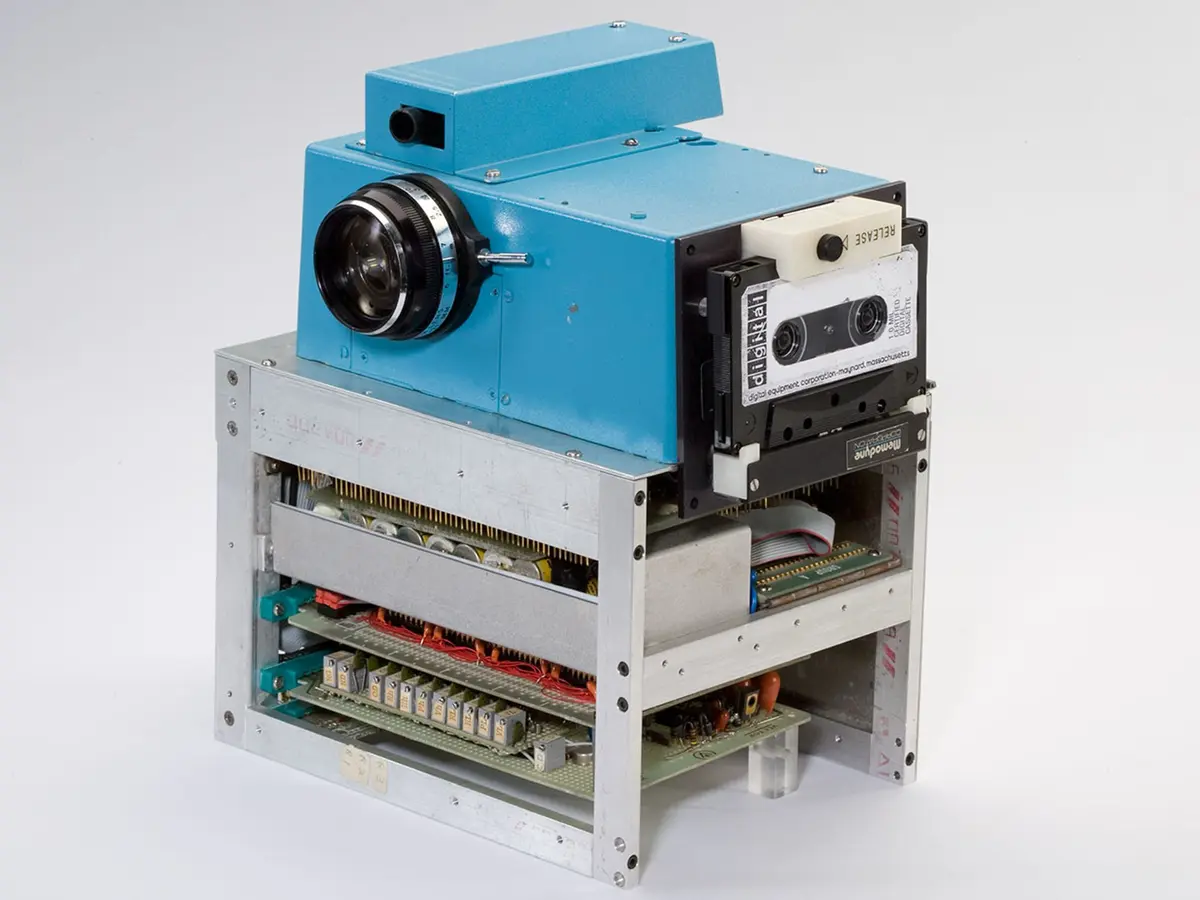
Making it work as a camera took years and many people. Tompsett, who had joined Bell Labs in 1969, led the work on imaging chips and in 1971 filed the first patent for CCD imagers; his team built a colour camera with three CCDs by 1973. Boyle and Smith added the buried-channel CCD, which keeps the charge away from the surface of the silicon and stops images from smearing. Bell Labs itself dropped the project, because the Picturephone failed in the market and cheap memory chips won, but Fairchild Semiconductor, led by the former Bell researcher Amelio, sold CCDs from the early 1970s, including a chip of 100 by 100 pixels. In December 1975 Steven Sasson at Kodak built a battery-powered camera around that chip, which took 23 seconds to record one picture onto tape.
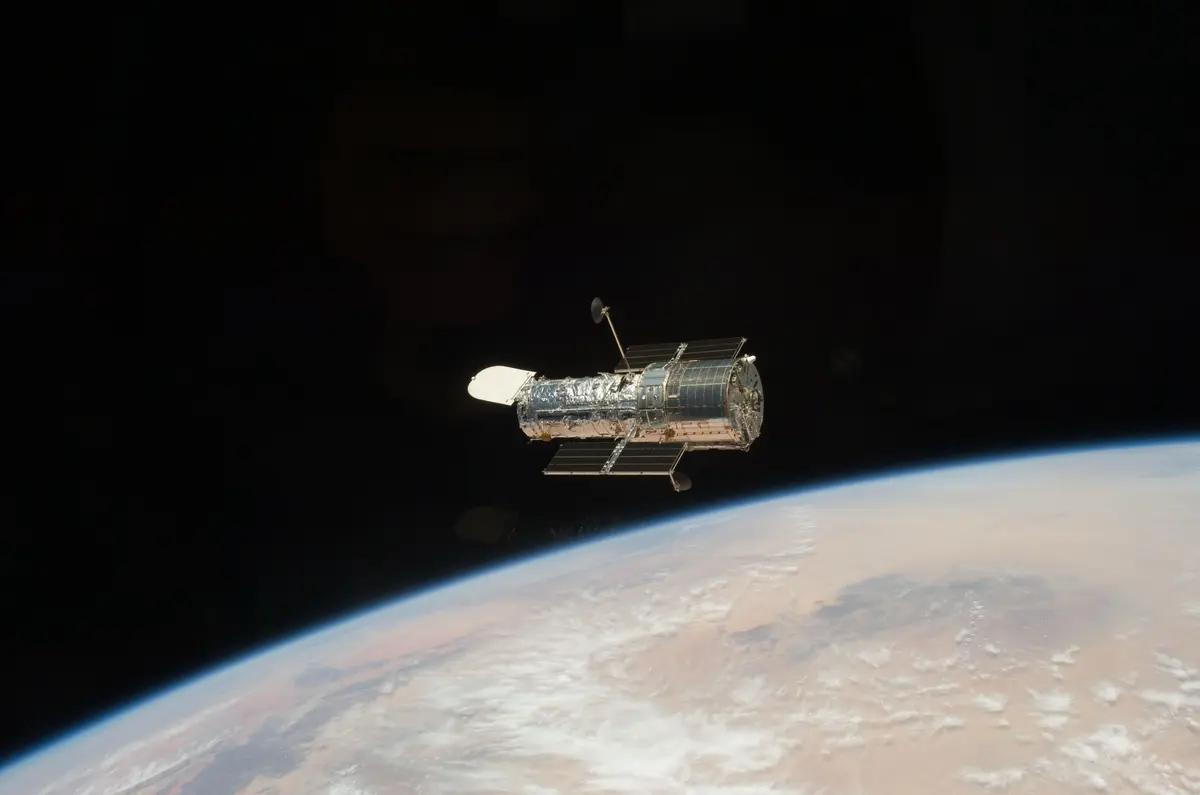
The CCD's great strength was that it caught about nine in ten of the photons that reached it, against a few in a hundred for photographic film. Astronomers took it first: in the mid-1970s a CCD camera on an Arizona telescope showed markings on the planet Uranus for the first time, and in 1993 the Hubble Space Telescope received a new camera, WFPC2, with four CCD chips, which took pictures such as the Pillars of Creation. CCDs went into scanners, fax machines, bar-code readers, endoscopes and spy satellites, and in 2009 the Kepler telescope launched with 42 of them to look for planets. In the 1990s a rival design, the CMOS sensor with its amplifier in each pixel, was developed at NASA's Jet Propulsion Laboratory, and over the next years it took over most cameras.
On 6 October 2009 the Royal Swedish Academy of Sciences gave a quarter of the Nobel Prize in Physics to Boyle and a quarter to Smith, 'for the invention of an imaging semiconductor circuit - the CCD sensor'; the other half went to Charles Kao for optical fibres. They received it from the king of Sweden on 10 December. Not everyone agreed on who deserved the credit: Tompsett said that the invention that made electronic photography possible was his imaging work, and a former Bell Labs manager called the famous 1974 photograph of Boyle and Smith with a CCD camera staged. What nobody disputes is the result: nearly every digital photograph, from a family snapshot to a picture of a distant galaxy, descends from the idea on that blackboard.
What happened
- 1969
In Willard Boyle's office at Bell Labs, Boyle and George Smith get together to answer Jack Morton's demand for a semiconductor device to rival magnetic bubble memory. In an hour or so at the blackboard they sketch the idea: a packet of electric charge, the 'electric twin' of a magnetic bubble, held in a metal-oxide-silicon capacitor and handed from one capacitor to the next, which can also be filled by light. Within a week masks are made and the first crude device is built and tested: a row of closely spaced metal squares on silicon, where charge is made at the first square, passed along by changing the voltages and measured at the end. Charge transfer works.
Bell Telephone Laboratories, Murray Hill, New Jersey: where Boyle and Smith sketched the CCD in Boyle's office on 17 October 1969- 1970
Boyle and Smith's paper 'Charge Coupled Semiconductor Devices' reaches the editors of the Bell System Technical Journal. It names a shift register, an imaging device, a display and logic as uses, but does not describe a camera.
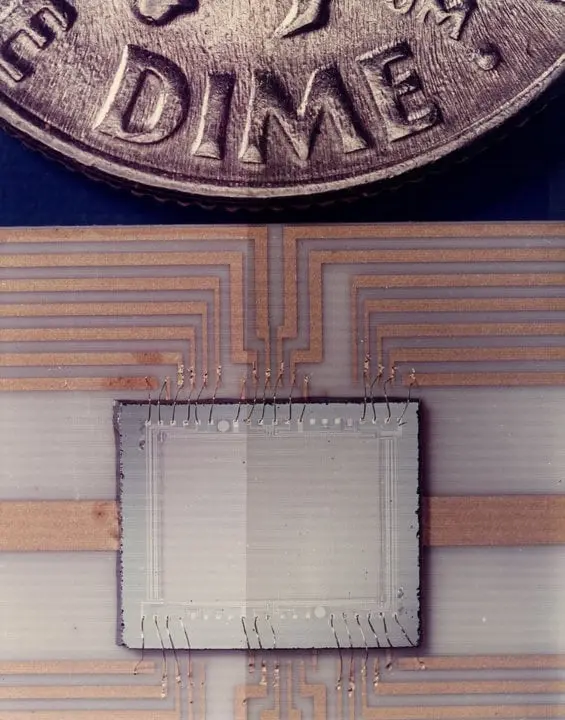
The April issue of the Bell System Technical Journal prints two papers side by side: Boyle and Smith's theory, and an experimental check by Gil Amelio, Michael Tompsett and Smith, whose test device is a line of chromium-and-gold squares 0.1 mm wide, 3 micrometres apart, on a ten-pin header. Other companies begin their own CCD programmes.
Tompsett, Amelio and Smith report the first CCD made with integrated-circuit methods, a simple eight-bit shift register that also works, crudely, as an eight-pixel line sensor. Smith's lecture shows its first 'image' as a trace on an oscilloscope.
- 1971
Michael Tompsett, who runs Bell Labs' imaging work, files his first application for CCD imaging devices, with a sensing array and a separate storage array so the picture can be read out without smearing; it leads to US patent 4,085,456, his alone.
- 1972
At Fairchild Semiconductor, where Gil Amelio left Bell Labs to start a CCD programme, a photograph titled 'CCD 500' records a wafer of linear CCDs. Fairchild is the first to sell the chips, a 500-element line sensor and a 100 by 100-pixel area sensor, by about 1973-74.
- 1973
Tompsett and his colleague Edward Zimany build a colour camera with three CCD arrays of 106 by 128 pixels; pictures of Tompsett's wife, Margaret, appear on the cover of the magazine Electronics, in the first colour photographs made with a solid-state camera.
- 1974
Boyle and Smith's second basic patent, US 3,792,322 for the buried-channel CCD, is issued. It places the charge inside the silicon, away from the surface where it was getting trapped, and so improves the chip enormously.
The U.S. Patent Office grants Boyle and Smith US patent 3,858,232 for 'Information storage devices', the basic CCD patent, first applied for on 16 February 1970. The Bell Labs photograph of the two men with a CCD camera is taken the same year.
- 1975
Steven Sasson at Kodak in Rochester takes the first picture with his battery-powered camera: a 100 by 100-pixel Fairchild CCD, 50 milliseconds to take the picture and 23 seconds to record it on a cassette tape. His first subject is a Kodak lab technician, Joy Marshall. The camera weighs 3.6 kg.
- 1976
A CCD camera built by NASA's Jet Propulsion Laboratory and used on the University of Arizona's 154 cm telescope shows, for the first time, markings on the disk of the planet Uranus, in a band of infrared light where methane absorbs. It is one of the first scientific uses of the CCD in astronomy.
- 1993
On the first Hubble servicing mission, astronauts Jeffrey Hoffman and Story Musgrave take out Hubble's first wide-field camera and put in WFPC2, whose four 800 by 800-pixel CCDs will take most of the telescope's best-known pictures.
- 1995
NASA releases 'Pillars of Creation', a WFPC2 picture of columns of gas in the Eagle Nebula taken on 1 April 1995. It becomes one of the most famous images of the century.
- 2006
The U.S. National Academy of Engineering gives Boyle and Smith its Charles Stark Draper Prize 'for the invention of the Charge-Coupled Device (CCD), a light-sensitive component at the heart of digital cameras and other widely used imaging technologies'.
- 2009
NASA's Kepler space telescope is launched to look for planets like Earth. Its camera is 42 CCDs, nearly 95 million pixels in all, the largest camera sent into space at that time.
On Hubble's last servicing mission, STS-125, astronauts replace WFPC2 with Wide Field Camera 3, whose ultraviolet and visible channel is a 16-megapixel CCD.
The Royal Swedish Academy of Sciences announces that half of the 2009 Nobel Prize in Physics goes to Charles Kao for optical fibres and the other half jointly to Willard Boyle and George Smith 'for the invention of an imaging semiconductor circuit - the CCD sensor'.
Royal Swedish Academy of Sciences, Frescati, Stockholm: the Nobel Prize in Physics announced here on 6 October 2009 and the laureates' press conference on 7 DecemberAt the press conference of the laureates in Stockholm, Boyle, 85, and Smith, 79, answer questions; Smith takes pictures of the audience with a digital camera.
Royal Swedish Academy of Sciences, Frescati, Stockholm: the Nobel Prize in Physics announced here on 6 October 2009 and the laureates' press conference on 7 DecemberKao, Boyle and Smith give their Nobel Lectures at Stockholm University. Smith's, 'The Invention and Early History of the CCD', tells the story of the blackboard hour of 17 October 1969.
Aula Magna, Stockholm University: the Nobel Lectures of Kao, Boyle and Smith on 8 December 2009At the Stockholm Concert Hall, King Carl XVI Gustaf hands Boyle and Smith their Nobel Prizes. Each takes a quarter of the prize; Kao takes the other half.
Stockholm Concert Hall (Konserthuset): the Nobel Prize ceremony of 10 December 2009