The first Grand Prix, at Le Mans
“On 26 and 27 June 1906 the Automobile Club de France ran the first international Grand Prix on a triangle of roads near Le Mans, and Ferenc Szisz won in a Renault, helped by Michelin's detachable rims.”
On Tuesday 26 and Wednesday 27 June 1906 the Automobile Club de France (ACF) ran the race it called its Grand Prix on a triangle of public roads east of the city of Le Mans, in the heat of a French summer. Thirty-two cars were sent away one at a time, every 90 seconds from six in the morning, to drive twelve laps of a circuit of 103 kilometres, six laps on each day, 1,238 kilometres in all, much longer than any earlier circuit race. The winner, after twelve hours of driving, was Ferenc Szisz, a Hungarian who had come to France as a mechanic, in a red Renault; Felice Nazzaro's Fiat was second, about half an hour behind, and Albert Clement's Clement-Bayard third. Only 11 cars finished.
The race grew out of a quarrel. Since 1900 the great international race had been the Gordon Bennett Cup, in which each country could enter only three cars, so that France, which had the largest car industry in Europe, was held level with a country with one maker. The French makers complained, and the ACF answered by running a race of its own with no limit on entries from a country and with a rule on weight (1,000 kilograms) instead. No British or American maker entered a team; Italy sent two teams (Fiat and Itala), Germany one (Mercedes), and ten French makes entered. The earlier great races, from town to town on open roads, had ended in the disaster of the 1903 Paris to Madrid race, in which Marcel Renault died; a closed circuit with fences and boards, bypasses of wooden planks round Saint-Calais and Vibraye, and 2,000 seats at the start was meant to make the new race safer and more orderly.
It was also a race of tyres. For the first time only the driver and his riding mechanic could work on the car during the race, so that a puncture, which came every lap or two on the hot, stony and tarred roads, could cost a quarter of an hour. Michelin brought the jante amovible, a detachable rim with a tyre already fitted, which could be changed in about four minutes. It weighed 9 kilograms more than an ordinary wheel, so that only cars far enough below the weight limit could carry it: Fiat used it on all four wheels, Renault and Clement-Bayard on the rear wheels only. Szisz took the lead on the third lap and kept it to the end, and Clement, who had refused the rims, was beaten by Nazzaro, who had them.
The ACF ran the Grand Prix again in 1907 at Dieppe, now with a limit on fuel instead of weight, Renault, the winner, sold about twice as many cars in 1907 as it had in 1906. Albert Clement was killed in practice for the second race. The 1906 race has come to be called the first Grand Prix: it was the first international race with that name, though an earlier French race, at Pau in February 1901, awarded a prize called the 'Grand Prix de Pau', and whether to count that is a matter of definition (see the QA).
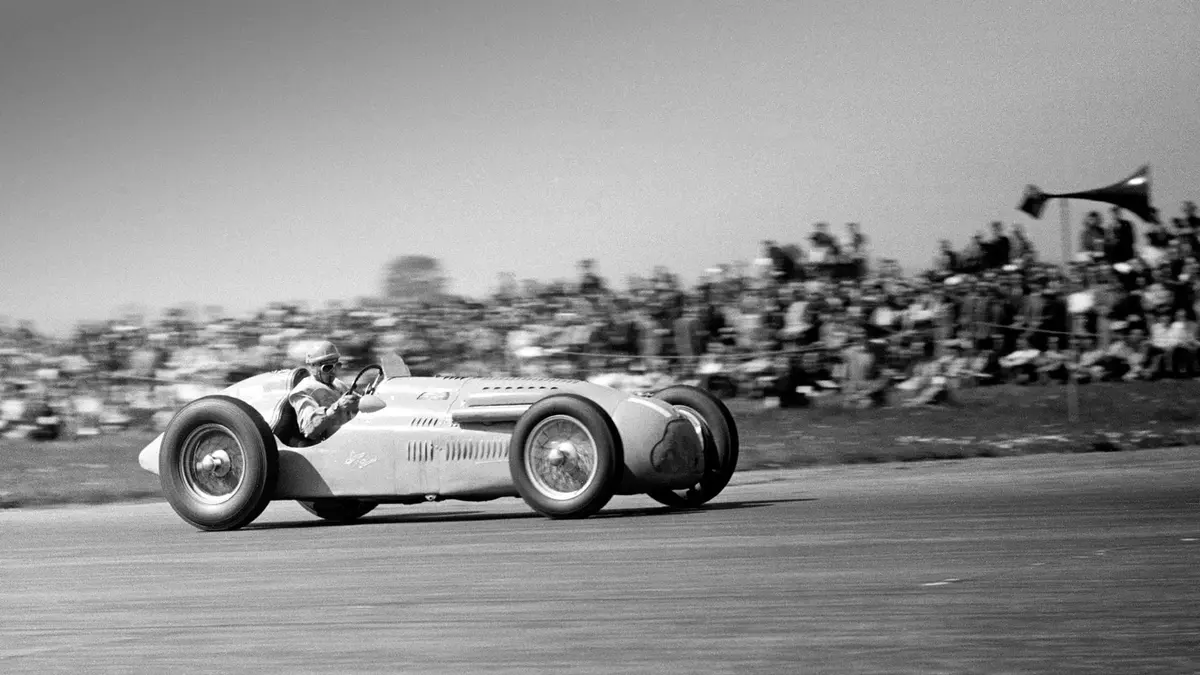
What Le Mans 1906 set was a pattern: factory teams from several countries on a closed road, a technical formula, a race of endurance and tyres, and a name, Grand Prix, that came to mean the top class of motor racing. The line from it runs through the Grands Prix of the 1920s and 1930s to the Formula One World Championship of 1950, and the roads near Le Mans, where the first race ran, were the setting of the 24 Hours of Le Mans from 1923.
What happened
- 1906
Scrutineering begins at Pont-de-Gennes on Sunday: the cars are examined and weighed against the limit of 1,000 kilograms, with seven kilograms more allowed for a magneto. One car, the single Vulpes, is found to be over the limit and is withdrawn; a Gregoire has crashed in practice and will not start either.
Pont-de-Gennes, near Le Mans: the start and finish, the grandstands, the pits and the weighing-in, beside the villageThe weighing goes on through Monday. Szisz's Renault is among the lightest of the field at 990 kilograms, with room to carry Michelin's heavy detachable rims on its rear wheels; most of the others are within a few kilograms of the limit and cannot. Special trains run between Paris and Le Mans all night.
Pont-de-Gennes, near Le Mans: the start and finish, the grandstands, the pits and the weighing-in, beside the villageOn the third lap Szisz takes the lead, with the two Brasiers behind him, while several rivals lose time in long tyre changes; he will not lose the lead again. At the end of the lap he is 31 seconds ahead of Barillier on elapsed time and about seven minutes ahead of Baras.
La Ferté-Bernard: the third corner of the triangle, where the cars turned back towards Le MansThe sun melts the tar laid on the roads and the cars throw it up into the drivers' faces. Edmond's goggles break and he is almost blinded; officials refuse him other goggles or another driver, and he gives up a few miles from the end of the fifth lap. Jenatzy and Lancia suffer in the same way.
La Ferté-Bernard: the third corner of the triangle, where the cars turned back towards Le MansPunctures, broken wheels and crashes thin the field: Villemain's Clement-Bayard retires with a wheel too dented to go on, and Florio's Mercedes, the Itala team and other cars are out as well. Only 17 of the 32 cars will complete the first day.
Cherré: a village on the northern leg of the circuit, between Vibraye and La Ferté-Bernard, behind board fencing- 5:00 a.m.
The roads of the circuit are closed to the public at five in the morning, with soldiers posted along them, and crowds fill the village of Pont-de-Gennes and the long grandstand. The morning starts misty and clear, and the day will turn into one of the hottest anyone can remember.
Pont-de-Gennes, near Le Mans: the start and finish, the grandstands, the pits and the weighing-in, beside the village - 6:00 a.m.
The first Grand Prix starts. Rene de Knyff, the former racing champion now working for the Automobile Club de France, sends away the first car, Gabriel's Lorraine-Dietrich, and the others follow one at a time every 90 seconds, Lancia's Fiat second and Szisz's Renault third, at 6:03.
Pont-de-Gennes, near Le Mans: the start and finish, the grandstands, the pits and the weighing-in, beside the village - 6:49 a.m.
The last car of the 32 starters, the Clement-Bayard of 'de la Touloubre', leaves at 6:49:30. Ten French makes, two Italian and one German have entered 34 cars; none came from Britain or America.
Pont-de-Gennes, near Le Mans: the start and finish, the grandstands, the pits and the weighing-in, beside the village - 6:58 a.m.
Paul Baras's Brasier completes the first lap in 52 minutes 25.4 seconds, an average of about 118 kilometres an hour, and takes the lead. It remains the fastest lap of the whole race. Baras leads again after the second lap, with Szisz about five minutes behind.
Pont-de-Gennes, near Le Mans: the start and finish, the grandstands, the pits and the weighing-in, beside the village - 11:48 a.m.
Szisz finishes the sixth lap, just before noon, in 5 hours 45 minutes 30.4 seconds, more than 26 minutes ahead of Albert Clement and 41 minutes ahead of Nazzaro. The 17 cars are pushed into a fenced and floodlit parc ferme guarded overnight, so that nobody can work on them until the next morning.
Pont-de-Gennes, near Le Mans: the start and finish, the grandstands, the pits and the weighing-in, beside the village Szisz drives straight to his depot and spends about twelve minutes on new tyres and on topping up fluids. Clement, who has no detachable rims and must change tyres by hand, still stops more quickly than Szisz at the start of this day; Nazzaro does not stop at all.
Pont-de-Gennes, near Le Mans: the start and finish, the grandstands, the pits and the weighing-in, beside the villageThe fight for second place is the only interest left. By the end of the tenth lap, at about 10:40 on the clock, Nazzaro's Fiat, on rims all round, has passed Clement's Clement-Bayard, with Szisz more than 40 minutes ahead of them both.
Pont-de-Gennes, near Le Mans: the start and finish, the grandstands, the pits and the weighing-in, beside the villageFelice Nazzaro finishes second, about half an hour behind Szisz, and Albert Clement third, a further three minutes back; Brasier's Barillier, Lancia in a Fiat, and the American George Heath in a Panhard follow. Only 11 cars finish, the last of them, a Mercedes, some four hours behind the winner.
Pont-de-Gennes, near Le Mans: the start and finish, the grandstands, the pits and the weighing-in, beside the villageThe three leaders are taken to the tribune of honour and applauded. The minister Louis Barthou congratulates Szisz, and the brothers Louis and Fernand Renault are presented to him, with their driver and his riding mechanic, Marteau.
Pont-de-Gennes, near Le Mans: the start and finish, the grandstands, the pits and the weighing-in, beside the villageAlbert Clement shakes hands with Szisz. He had refused the heavy rims against his father's wishes and lost about ten minutes at each tyre change; a car with the rims would probably have won the race.
Pont-de-Gennes, near Le Mans: the start and finish, the grandstands, the pits and the weighing-in, beside the village- 5:45 a.m.
On Wednesday the second day starts. The cars leave in the order of the day before and at the clock time of their first-day totals, so that Szisz is away at 5:45:30 and Clement at 6:11:40, and the order on the road is the order of the race. A horse tows each car from the parc ferme to the line, as no engine may be touched until the signal.
Pont-de-Gennes, near Le Mans: the start and finish, the grandstands, the pits and the weighing-in, beside the village - 11:02 a.m.
Szisz sets off on his last lap with a damaged rear suspension, having broken a spring, and drives it with care: the lap takes 1 hour 11 minutes 54 seconds, his slowest of the second day, but his lead is large enough.
Connerré: the village on the last stretch before the grandstands, with its bends and its Michelin boards - 12:14 p.m.
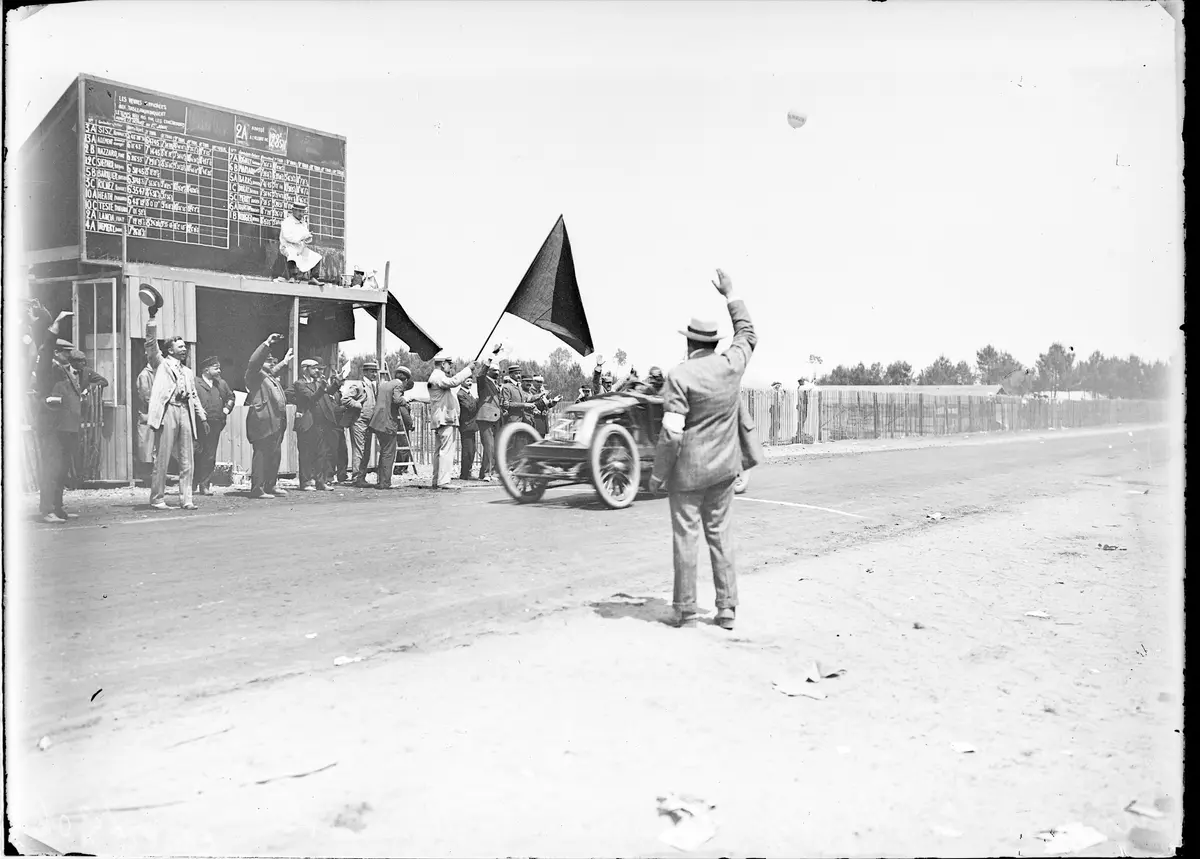
Ferenc Szisz crosses the line at 12:14:07 by the clock, the winner of the first Grand Prix, driving a Renault of about 13 litres that is one of the smaller cars of the race. He has changed 19 tyres on the way, and the grandstands are half empty because the result seemed clear the evening before.
Pont-de-Gennes, near Le Mans: the start and finish, the grandstands, the pits and the weighing-in, beside the village - 1907
Albert Clement, the third-place driver of Le Mans, is killed at the Dieppe circuit while practising for the 1907 Grand Prix; his car runs off the road at the bend at Saint-Martin-en-Campagne. The Clement-Bayard works then do not enter officially, and another driver, Marius Pin of Darracq, is killed in practice too.
Dieppe: the seaside town where the second Grand Prix was run on 2 July 1907- 6:00 a.m.
The second Grand Prix starts at Dieppe on Tuesday 2 July 1907, again at 6 a.m. The weight limit is gone, replaced by a limit on fuel (30 litres per 100 kilometres, with 231 litres issued per car), and the cars start one a minute. Nazzaro wins in a Fiat in 6 hours 46 minutes 33 seconds, with Szisz's Renault second.
Dieppe: the seaside town where the second Grand Prix was run on 2 July 1907