The microwave oven
“Raytheon's Percy Spencer patented microwave cooking in 1945; the Radarange reached restaurants in 1947 and homes in 1967. The melted-candy-bar story is a legend, and the first account says a peanut bar.”
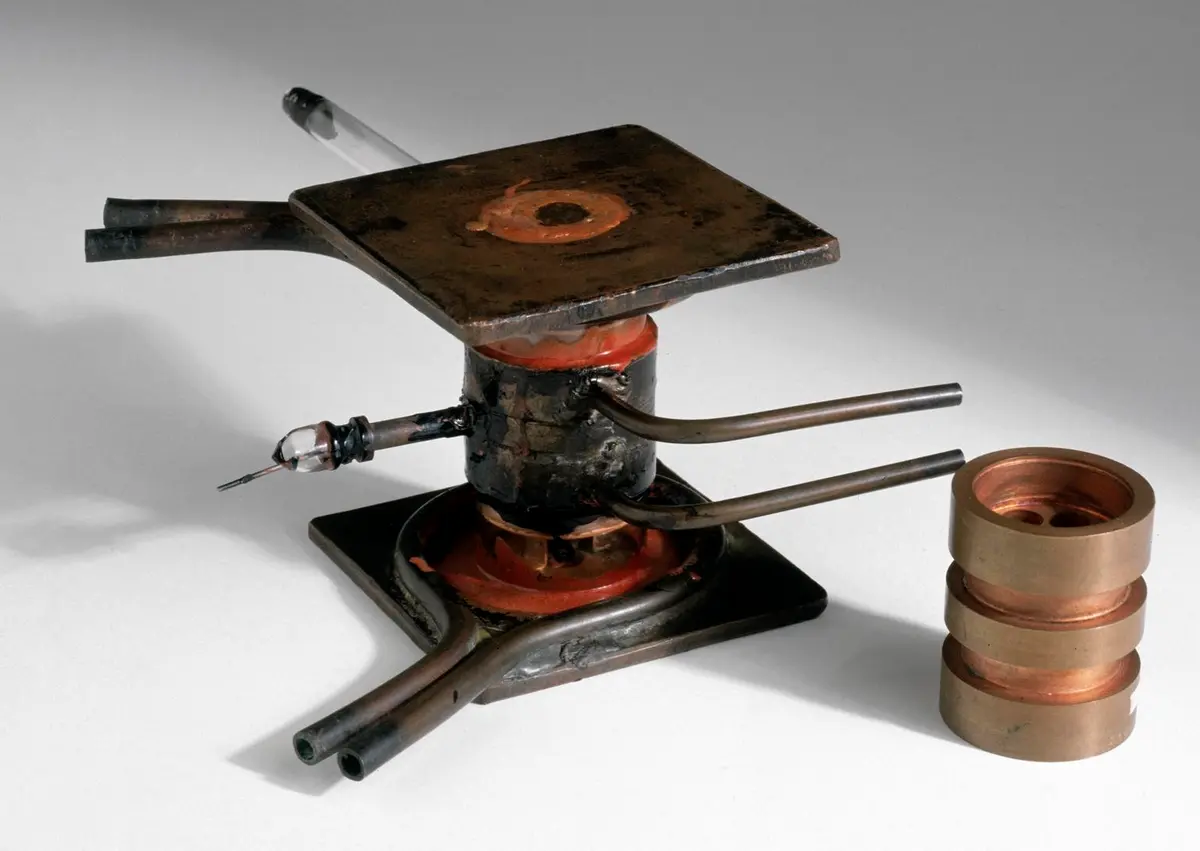
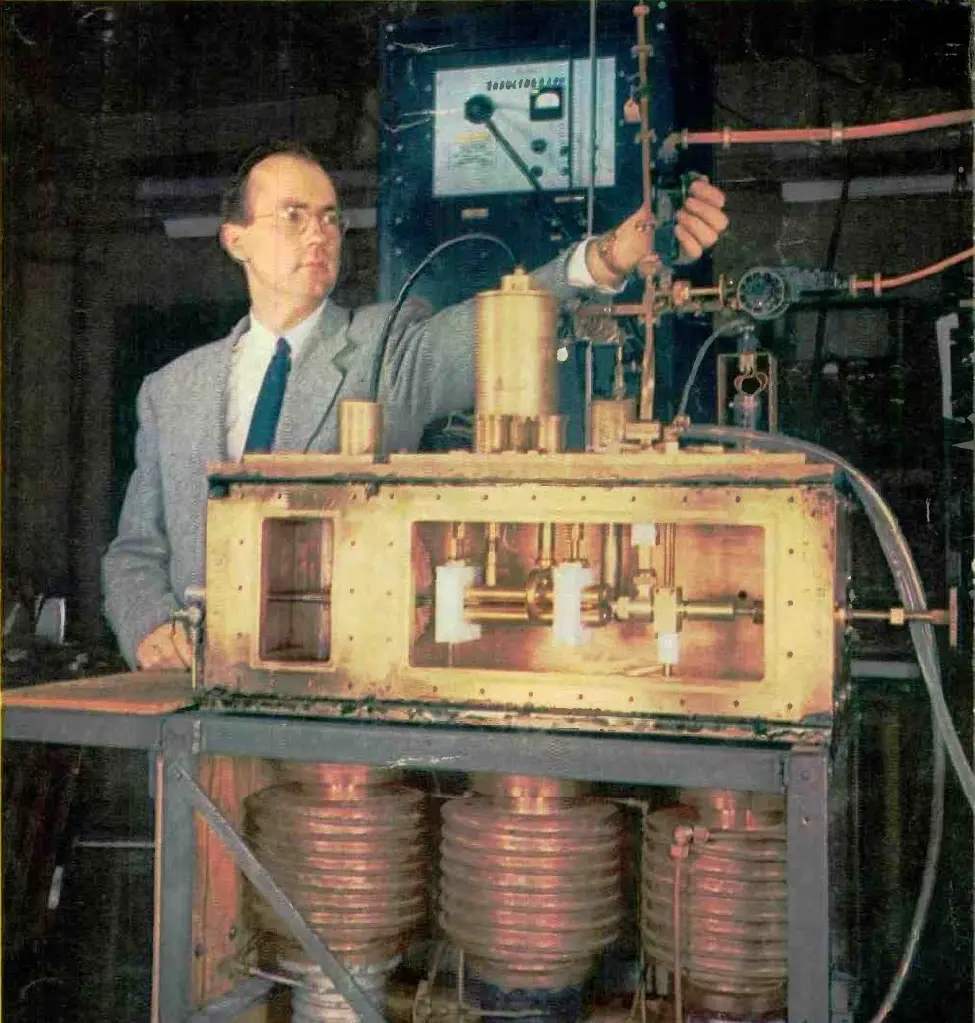
A microwave oven cooks by filling a metal box with radio waves about twelve centimetres long. Water and fat in the food soak up the waves and warm up from the inside, which is why a plate of leftovers can be hot in a minute while the plate stays cool. The idea grew out of radar. In the Second World War the Raytheon company of Massachusetts, which Time said made more than half of the search radar the Allies used, built magnetrons, the tubes that make such waves; the tube's own story, and how Britain handed it to America, is told in the entry on the cavity magnetron crossing the Atlantic. Percy Spencer, a self-taught engineer who had left school at twelve and ran Raytheon's power-tube work, was one of the people who noticed that the beam from a magnetron warms food.
The famous story says a chocolate bar melted in Spencer's pocket. What the sources support is smaller. The oldest account I could find is Reader's Digest, August 1958, which says that one day 'a dozen years ago' Spencer was visiting a laboratory where magnetrons were being tested and felt a 'peanut bar' start to cook in his pocket. It names no brand and says nothing about chocolate. He sent out for popcorn, which exploded all over the lab, and the next morning he put an egg in a kettle against a magnetron and a doubtful engineer who peeked in got a face full of egg. Raytheon's own John Osepchuk, who wrote the standard history of microwave heating in 1984, reports that Spencer's colleagues remembered a gradual process in which many people noticed warmth near the tubes and tried popcorn, and that Spencer's real contribution was to push the company to exploit it. The chocolate version comes from later retellings.
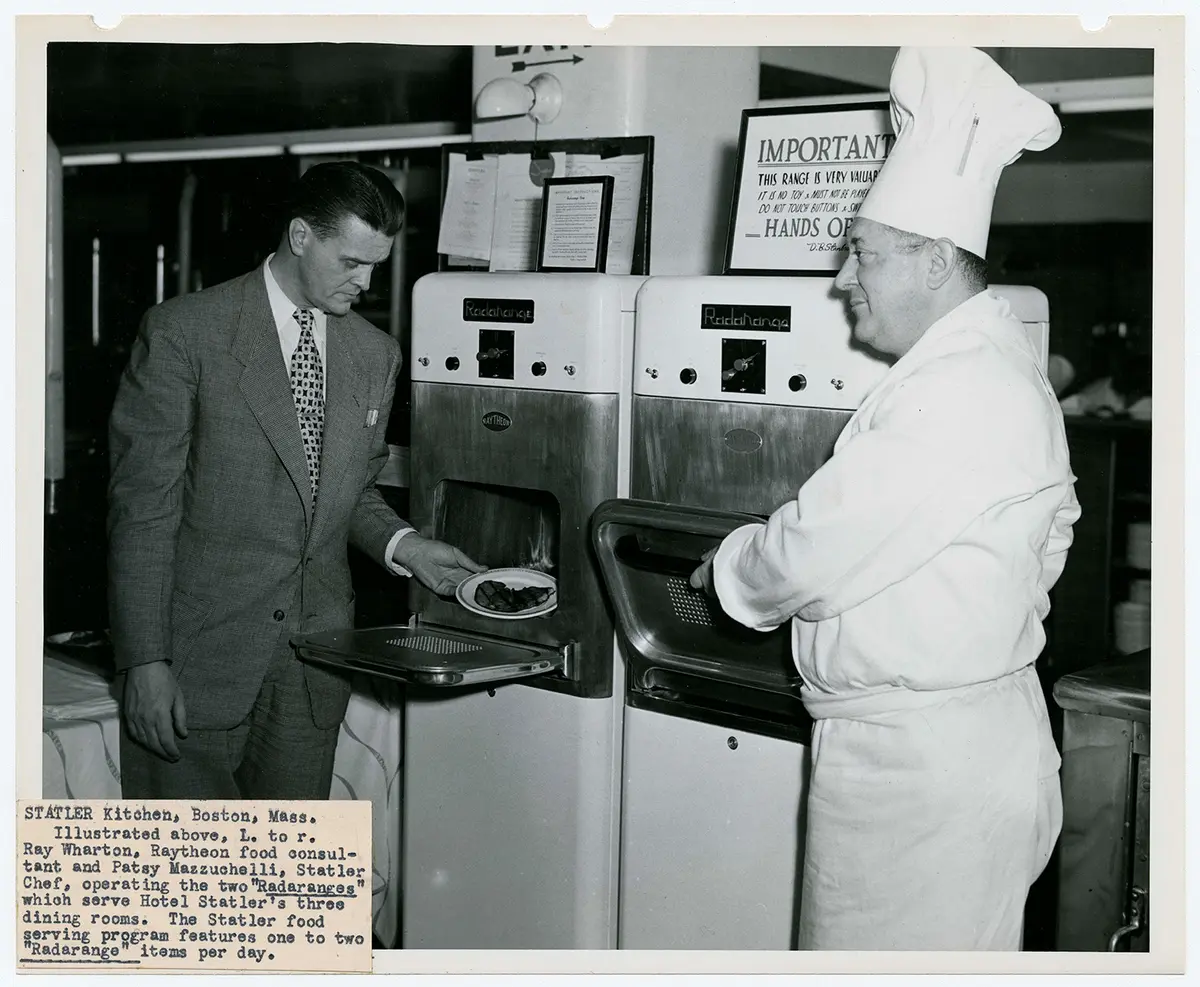
On 8 October 1945 Raytheon filed Spencer's first application, for 'Method of treating foodstuffs'. It was granted on 24 January 1950 as US patent 2,495,429. It does not show an oven: two magnetrons feed a waveguide and the food rides past on a conveyor belt, in waves of about ten centimetres. The patent claims that an egg can be hard-boiled with 2 kilowatt-seconds of energy against 36 the ordinary way, and a potato cooked with 240 against 72,000 in an electric oven. Applications in February and March 1947 show a box with a door and, in one, popcorn on the cob in a bag. Raytheon's first oven, the Radarange, was built by Marvin Bock: a 1.6-kilowatt, water-cooled magnetron in a white cabinet about five feet tall. The name came from a company contest. On 20 May 1947 the Hotel Statler in Boston served a whole 'first radar dinner' cooked in it. Raytheon leased early ovens to hotels and restaurants for about $150 a month, and meant them for trains and ships too; sources count 75 to 100 in use by early 1948, and give the price of one anywhere from $2,000 to $5,000.
Raytheon did not try to sell to families. It licensed Hotpoint, Westinghouse, Kelvinator, Whirlpool and Tappan, and Tappan's built-in oven of 1955, about 900 watts and about $1,200, sold in modest numbers; Osepchuk counts almost 10,000 ovens in American homes in 1966. The turn came when Raytheon bought Amana, the Iowa appliance maker, in 1965 and Amana launched a 115-volt countertop Radarange in 1967 for about $495, made possible by a cheaper air-cooled magnetron developed with Japan's New Japan Radio. Worries about leaking microwaves followed. Congress passed the Radiation Control for Health and Safety Act on 18 October 1968, and ovens made after 6 October 1971 had to obey a federal limit on leaking microwaves and carry two safety interlocks. By 1997 Amana said more than 90 percent of American homes owned one.
Spencer got no fortune from it and, in a biographical sketch he sent the University of Maine in 1961, did not mention the oven at all: he listed over a hundred patents, his Navy medal and the laboratory Raytheon named for him. He died on 8 September 1970. The cooking idea was not wholly his either: Westinghouse had cooked sandwiches between two metal plates connected to a short-wave transmitter at the 1933 Chicago World's Fair. What Spencer's Raytheon added was the microwave, the magnetron to make it cheaply, and the persistence to turn a curiosity into a product that, once it was small and cheap enough, changed how many people cook.
What happened
- 1945
Spencer, who runs Raytheon's power-tube work, finds that a magnetron's beam warms food. The legend says a candy bar melted in his pocket; the oldest account, in Reader's Digest in 1958, says a peanut bar, then popcorn that exploded across the lab and an egg that burst in a colleague's face. His colleagues later remembered a gradual discovery by many people. The year is only an upper limit: the patent below shows the cooking tests were done by October 1945.
Newton, Massachusetts: the town given for Raytheon Manufacturing Company and (West Newton) for Spencer in the 1945 patentRaytheon files Spencer's first application, serial 620,919, 'Method of treating foodstuffs': two magnetrons, a waveguide and a conveyor belt, waves of about ten centimetres. The egg is cooked with 2 kilowatt-seconds, against 36 the ordinary way.
Newton, Massachusetts: the town given for Raytheon Manufacturing Company and (West Newton) for Spencer in the 1945 patent- 1946
Raytheon is said to show two Radarange ovens to the press at the Waldorf-Astoria in New York, one for sandwich shops and one for cooking frozen meals for aircraft. The date is Wikipedia's, from New York Times and Brooklyn Eagle reports of 8 October 1946 that I could not read; IEEE Spectrum also dates the unveiling to 1946.
Waldorf-Astoria, New York: where Raytheon is said to have shown two Radaranges to the press on 7 October 1946- 1947
Raytheon files Spencer's 'High-frequency apparatus': a metal cooking cavity with a door, fed by two magnetrons through waveguides. This drawing, granted 15 April 1952 as patent 2,593,067, is the first that looks like an oven.
Newton, Massachusetts: the town given for Raytheon Manufacturing Company and (West Newton) for Spencer in the 1945 patentRaytheon files Spencer's patent on popcorn: an ear of corn in a bag, cooked in a metal cavity fed with radio-frequency energy. Granted 30 August 1949 as 2,480,679.
Newton, Massachusetts: the town given for Raytheon Manufacturing Company and (West Newton) for Spencer in the 1945 patentThe Federal Communications Commission, by order in Docket 6651, sets aside two radio bands for ovens and other industrial heating: 915 and 2,450 megahertz. Raytheon had asked for the higher one, General Electric for the lower. Wikipedia mentions an earlier approval of 2,450 megahertz on 30 December 1946, which I could not confirm.
A Hotel Statler luncheon menu in Boston already offers baked stuffed lobster 'out of the Statler Radarange', cooking time only 2 minutes 30 seconds. The Massachusetts Historical Society dates it 15 May, five days before the dinner it calls the hotel's debut of the oven, and the difference is not explained there.
Hotel Statler, Boston (now the Park Plaza): the 'first radar dinner', 20 May 1947The Hotel Statler in Boston serves 'The First Radar Dinner', a whole meal cooked in the Radarange, including coffee. The Boston Post of the next day says the hotel 'made epicurean history'.
Hotel Statler, Boston (now the Park Plaza): the 'first radar dinner', 20 May 1947- 1948
By early 1948 about 75 to 100 Radaranges are in use, mostly in hotels and restaurants, and Raytheon leases them for about $150 a month instead of selling them. The Statler's chef and a Raytheon food consultant stand beside two of them in the hotel's kitchen.
Hotel Statler, Boston (now the Park Plaza): the 'first radar dinner', 20 May 1947- 1950
The Patent Office grants Spencer patent 2,495,429, assigned to Raytheon, which, not Spencer, holds the rights.
Newton, Massachusetts: the town given for Raytheon Manufacturing Company and (West Newton) for Spencer in the 1945 patent- 1952
The liner United States sails on her maiden voyage with a Radarange in her kitchen: Time says the steaks served to the notables on board are cooked in it 'in half a minute'.
- 1955
Tappan of Mansfield, Ohio, one of Raytheon's licensees, brings out the first built-in microwave oven for homes, the RL-1: about 900 watts, 220 volts, about $1,200. Sales stay small.
Mansfield, Ohio: the Tappan Stove Company, which sold the first built-in microwave oven for homes - 1956
Westinghouse shows a microwave oven made jointly by Tappan, Raytheon and Westinghouse, one of several firms that sold Raytheon-licensed ovens under their own names. The museum's own label places it at a 1956 world's fair in Belgium, which is probably a mistake for Brussels in 1958.
- 1958
Reader's Digest publishes 'Percy Spencer and His Itch to Know'. It gives the peanut-bar story and says radar ranges, used 'for some time' in restaurants, Pullman diners and ocean liners, are 'now being produced for the home'. Later writers turned its peanut bar into chocolate.
- 1959
Raytheon dedicates the Spencer Laboratory in Burlington, Massachusetts, for microwave-tube research, and names it for Spencer, then manager of its Microwave and Power Tube Division and a senior vice president.
Burlington, Massachusetts: the Spencer Laboratory, dedicated by Raytheon on 27 July 1959- 1965
Raytheon buys Amana Refrigeration of Iowa to make and sell ovens for homes. It has already had a cheaper magnetron developed with New Japan Radio.
Amana, Iowa: Amana Refrigeration, which made the 1967 countertop Radarange - 1967
Amana launches the Radarange for homes: a 115-volt countertop oven at about $495, with two control knobs. It is launched in Chicago, where reporters and housewives are taken round houses and served coffee and popcorn, and shown to the press in Boston with Spencer, Raytheon's president Thomas Phillips and Amana's George Foerstner. Almost 10,000 ovens were in American homes the year before.
Amana, Iowa: Amana Refrigeration, which made the 1967 countertop Radarange - 1968
President Johnson signs the Radiation Control for Health and Safety Act (Public Law 90-602), the first federal law on radiation from electronic products, which gives the government power to set a standard for microwave ovens.
- 1970
Percy Spencer dies in Newton, Massachusetts, aged 76; the University of Maine's guide and Wikipedia say 8 September, Lemelson-MIT says 7 September. He is buried in Newton beside his first wife, Louise.
Howland, Maine: Spencer's birthplace, 9 July 1894 (his own sketch)- 1971
A federal standard takes effect for microwave ovens made after 6 October 1971: at most 1 milliwatt of leakage per square centimetre, 5 centimetres from the surface, when sold, and 5 afterwards; two safety interlocks that keep the oven from working while the cavity can be reached.
- 1997
Thirty years after the Amana launch, Amana says more than 90 percent of American households own a microwave oven.