Edward Wright
“The English mathematician (1561-1615) who published the mathematics of the Mercator projection in 1599, making Mercator's chart usable for navigation.”
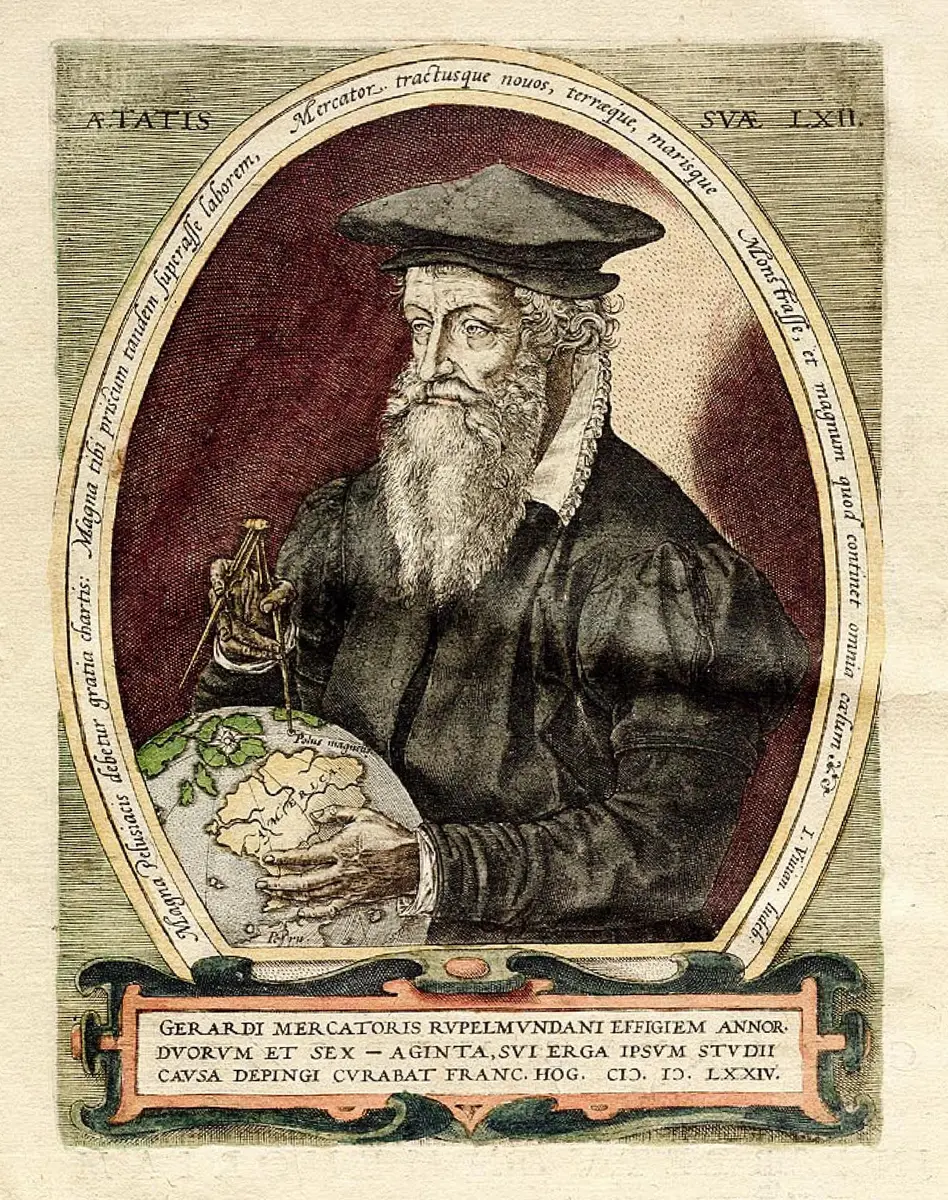
Edward Wright was an English mathematician from Norfolk who showed how to draw the Mercator chart. Gerardus Mercator's world map of 1569 let a navigator draw a ship's compass course as a straight line, but Mercator never said how he spaced the lines of latitude, so almost nobody could make such a chart. Wright worked out the rule and printed the numbers.
He was the younger son of a poor family, baptised at Garveston in 1561, and went to Gonville and Caius College, Cambridge, as a sizar, where he became a fellow in 1587. In 1589 Queen Elizabeth asked the college to let him sail with the Earl of Cumberland's fleet to the Azores. At sea he saw how badly the ordinary sea chart misplaced land, and that voyage turned a Cambridge mathematician into a practical navigator.
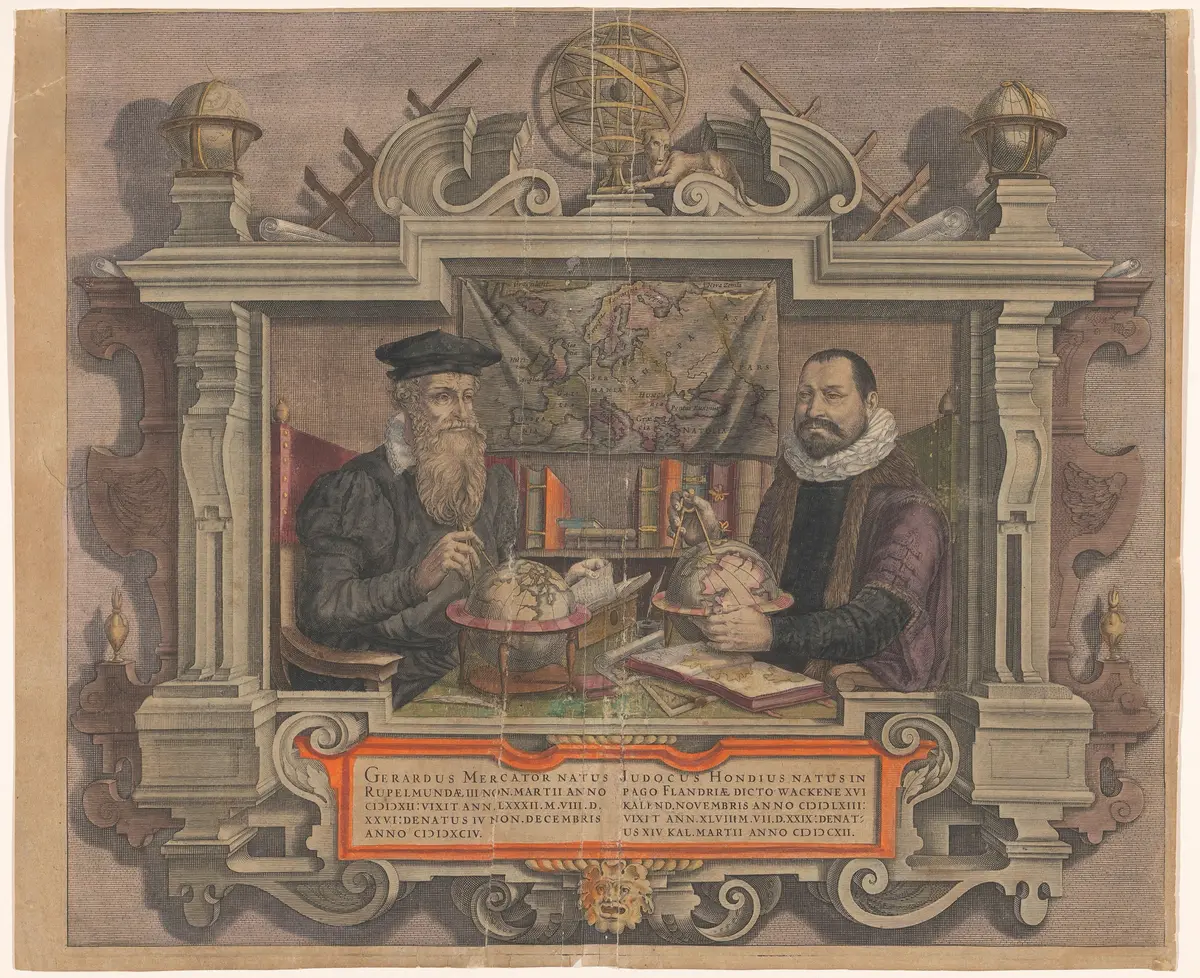
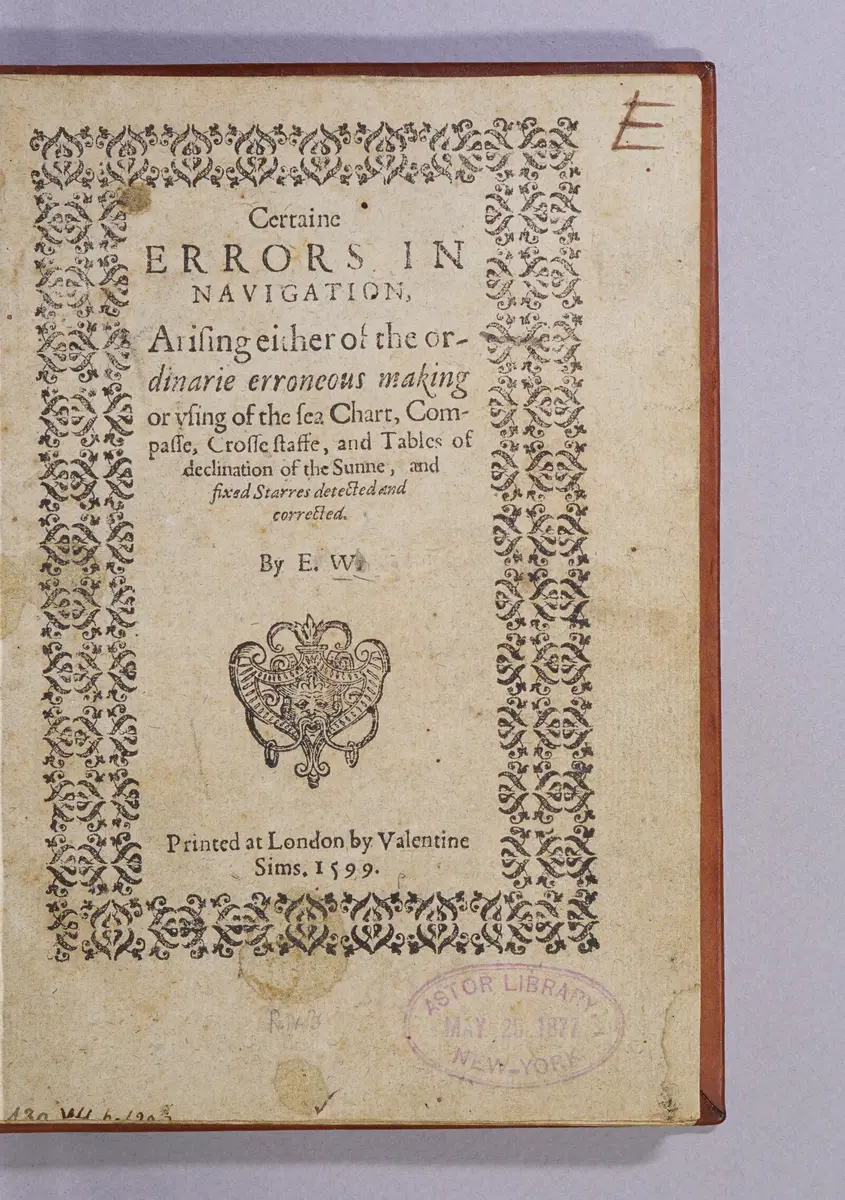
His method was simple: on a globe the parallels shrink towards the poles, so on a flat chart where they must all be as long as the equator, the gaps between them must grow in step. Wright added up the secants of the angles, minute by minute, to make a table. Friends and a rival borrowed it first: the Dutch engraver Jodocus Hondius used it without credit, which pushed Wright to print 'Certaine Errors in Navigation' in 1599, followed by a world chart in Hakluyt's collection and, in 1610, a fuller edition for Prince Henry.
Wright also made instruments, helped William Gilbert with his book on the magnet, lectured to merchant seamen, tutored the prince, helped survey the New River that brought water to London, and was translating John Napier's logarithms when he died in 1615. He died poor, with no known portrait. Later mapmakers, from Snellius to Joseph Moxon, used his table, and some called Mercator's chart 'Wright's chart'.
What happened
- 1561
Edward Wright is baptised in the village of Garveston in Norfolk, the younger son of Henry and Margaret Wright, a family of modest means. His birthday is not known.
Garveston, Norfolk: where he was baptised in 1561- 1576
He enters Gonville and Caius College, Cambridge, as a sizar, a poor scholar who earns part of his keep.
Gonville and Caius College, Cambridge: his college, student and fellow 1576-96- 1587
Wright becomes a fellow of Caius, on Lady Day, the same day as his friend John Fletcher; he holds the fellowship until 1596.
Gonville and Caius College, Cambridge: his college, student and fellow 1576-96- 1589
He sails from the Sound of Plymouth as navigator with the Earl of Cumberland's raiding fleet of four ships, bound for the Azores; Queen Elizabeth had asked Caius to give him leave.
The fleet comes back to the road of Fayal, the chief town of the island of Faial. On this voyage Wright sees that the sea chart puts land 50 leagues away that is in fact in sight: the error he later corrects.
Horta, Faial, in the Azores: the island and town of the 1589 voyageThe fleet limps into Falmouth, and Wright and the crew keep part of Christmas on English ground.
- 1590
Back at Cambridge, Wright starts the draft of Certaine Errors. He says Mercator's chart of 1569 set him thinking, but that he learned the method 'neither of Mercator, nor of any man els': he works it out by adding up secants.
Gonville and Caius College, Cambridge: his college, student and fellow 1576-96 - 1592
He gives the Earl of Cumberland a manuscript of the work. In the same years he helps the globe-maker Emery Molyneux, whose first English globes appear in 1592 or early 1593.
- 1594
A run of sun observations begins in London, made with the astronomer Christopher Heydon and ending in November 1597; the table of declinations in Certaine Errors rests on them. In the same year Thomas Blundeville prints Wright's table of meridional parts in his 'Exercises'.
- 1595
Wright marries Ursula Bernher in London; their son Samuel is born in 1596.
- 1596
He gives up his Cambridge fellowship and settles in London.
- 1597
The Dutch engraver Jodocus Hondius, who had seen Wright's manuscript, publishes the 'Christian Knight' world map on Mercator's projection without a word of credit. The map is dated 1596 or 1597.
- 1599
Certaine Errors in Navigation is printed in London. It lays out how to draw a Mercator chart, with a table of the distance of each parallel from the equator at every ten minutes of latitude, and it includes his account of the Azores voyage.
His world chart, drawn from Molyneux's globe, is printed in Richard Hakluyt's 'Principal Navigations'; his translation of Simon Stevin's 'Haven-finding Art' also appears this year.
- 1600
William Gilbert's 'De Magnete' is published in London. Wright is said to have written part of it, a chapter on finding the compass variation by the stars (Mark Ridley's claim).
- 1602
A three-page appendix by Wright on finding latitude from the dip of the needle, with a short table, appears in Blundeville's 'Theoriques of the Seven Planets'.
- 1608
About now, in 1608 or 1609, he becomes mathematics tutor to Henry, Prince of Wales, the heir to James I, and makes him instruments.
- 1609
He is surveyor for the New River, the channel that would bring fresh water from Hertfordshire to London over 40 miles, with a fall of only a few inches to the mile. From January 1612 another mathematician, Edward Pond, took over as surveyor.
New River Head, Islington: the end of the New River he surveyed, opened 1613 - 1610
The second edition of Certaine Errors, dedicated to Prince Henry, gives the full table at every minute of arc and a larger world chart engraved by William Kip.
The same edition adds a long table of the variation of the compass round the world, and new instruments for seamen such as the sea-ring.
- 1612
Prince Henry dies at 18. Wright had hoped to be the prince's librarian; he is named in the prince's will as 'a very poor man'.
- 1613
'The Description and Use of the Sphaere' is printed, describing the armillary sphere he made for Prince Henry.
On Michaelmas Day the New River is opened at New River Head in Islington, in front of the Lord Mayor; the water still serves London.
New River Head, Islington: the end of the New River he surveyed, opened 1613- 1614
The East India Company takes over the lectures on navigation for merchant seamen that Wright gives in London, at a salary of 50 pounds a year; he also prints a small book on sundials.
- 1615
Wright, who died in the last days of November while translating John Napier's book on logarithms, is buried in St Dionis Backchurch in the City of London. His son finishes the translation, which is printed in 1616.
St Dionis Backchurch, City of London (demolished 1878): where he was buried in 1615