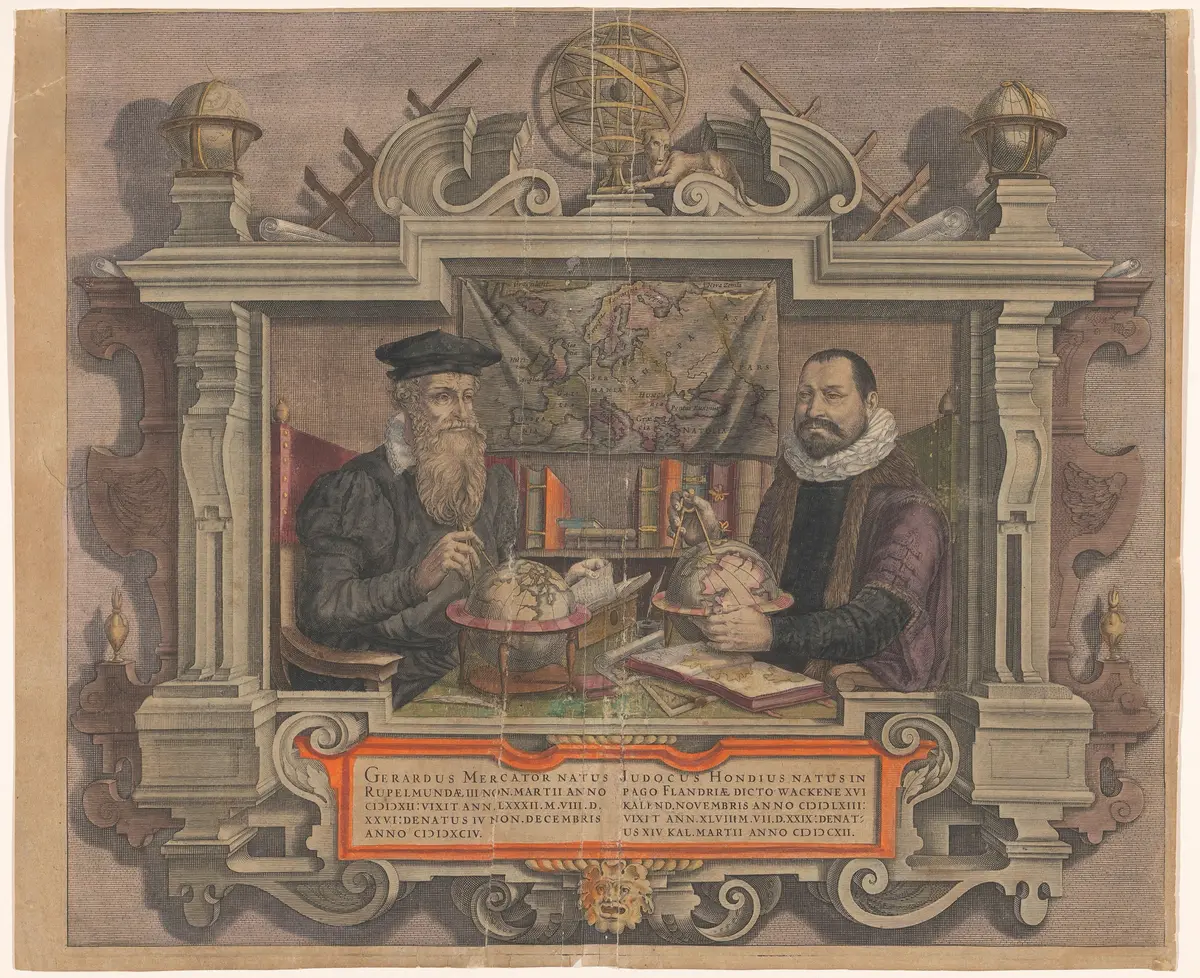
Jodocus Hondius
“The Flemish engraver (1563-1612) who published the enlarged Mercator Atlas in Amsterdam in 1606 and made Mercator the name on most 17th-century atlases.”
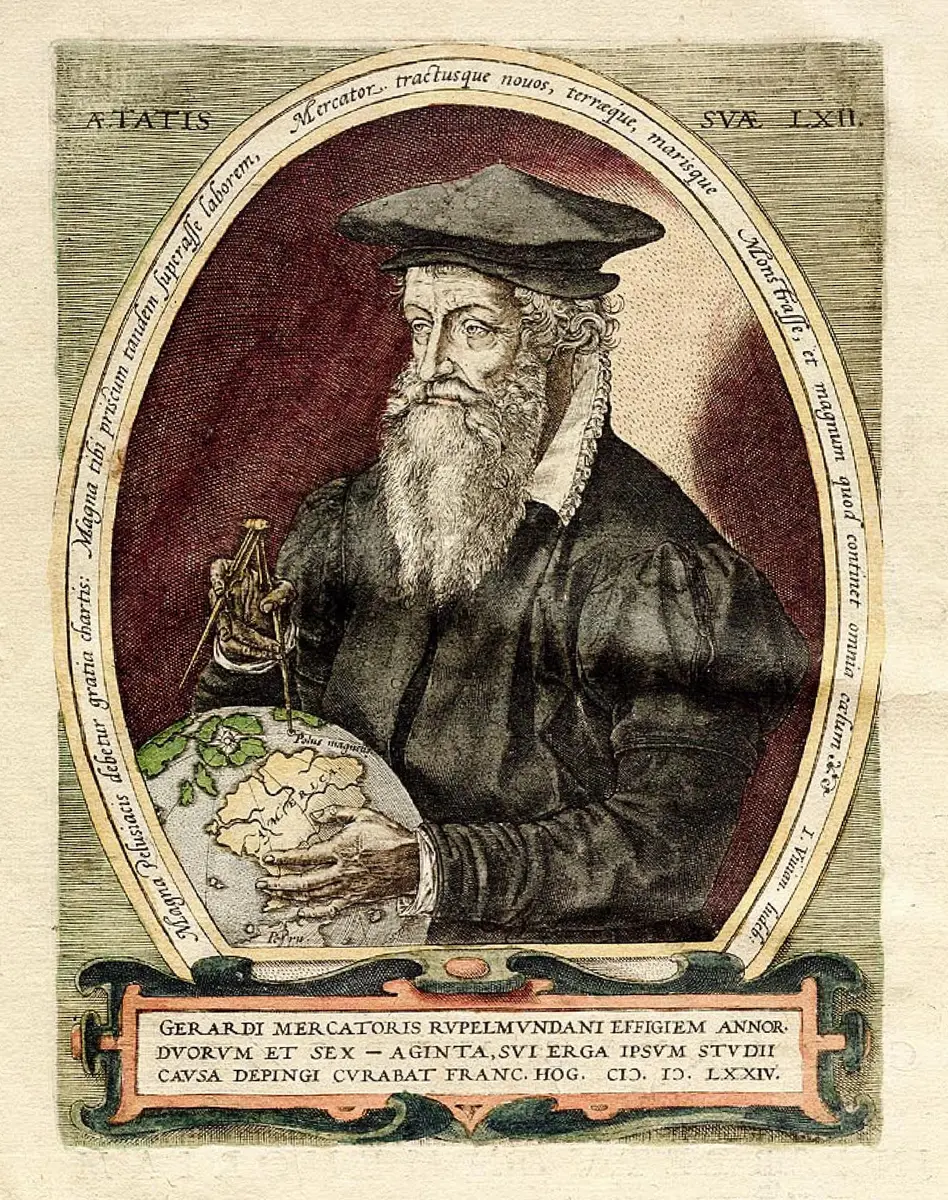
Jodocus Hondius (born Joost de Hondt) was a Flemish engraver and map publisher who made Amsterdam the place to buy a world atlas. He is best remembered for the 1606 Mercator-Hondius Atlas, which put Gerardus Mercator's maps back in print and added new ones. Without him, Mercator's work might have been forgotten.
He was born on 17 October 1563 in Wakken, in Flanders, and grew up in Ghent, where he learned engraving, drawing and calligraphy. When Spanish troops took Ghent in 1584 he left as a Protestant refugee for London. There he married Colette van den Keere in 1587, worked for publishers and writers such as Richard Hakluyt and Edward Wright, and met the men who sailed for England. He engraved the gores of Emery Molyneux's globes, the first made in England, in 1592. He also made a map of Francis Drake's voyage round the world, with insets of the places Drake stopped.
In 1593 the family moved to Amsterdam, where Hondius made globes and maps and, in 1602, went to Leiden University to study mathematics. In 1604 the copperplates of Mercator's atlas and his Ptolemy were sold out of the Mercator family's workshop in Duisburg. Hondius is the name usually given as the buyer. A Utrecht University historian argues that the buyer was probably the Amsterdam publisher Cornelis Claesz, and that the plates came to Hondius only after Claesz died in 1609.
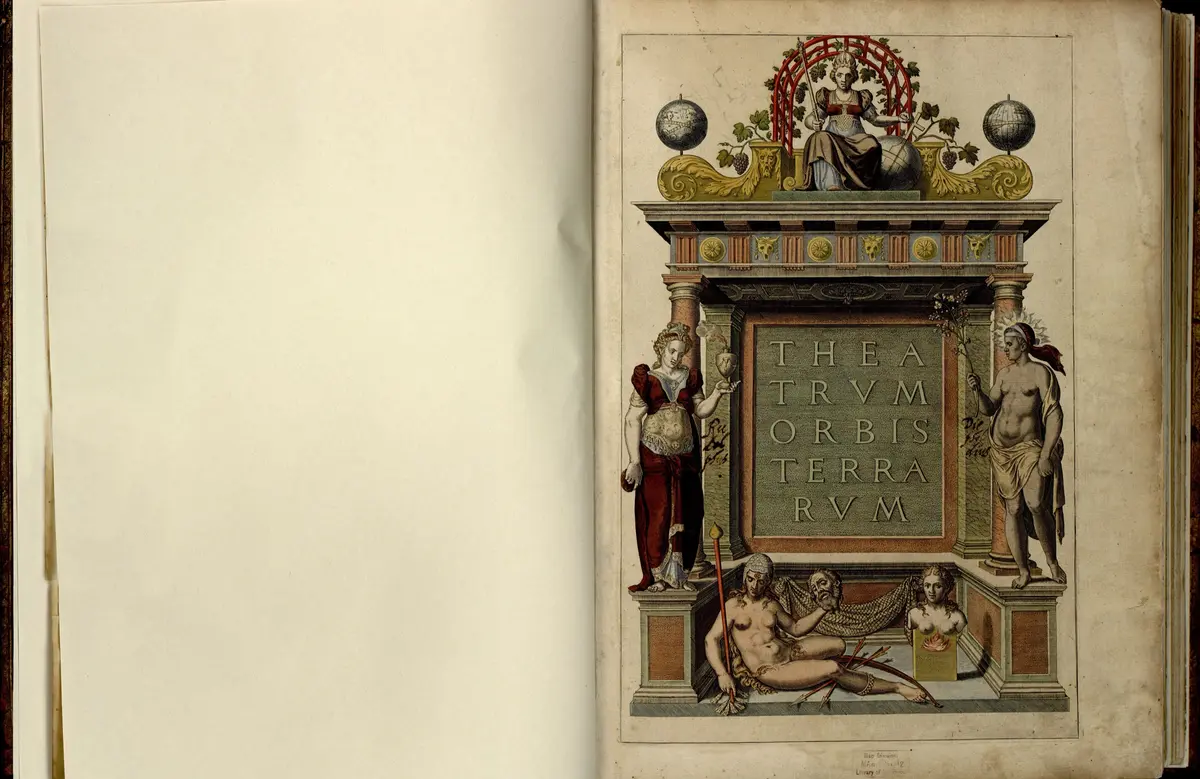
Either way, Hondius published the atlas in 1606 with Claesz's name beside his own on some title pages. It kept all 107 maps of the 1595 edition and added about 36 or 37 new ones, among them seven of Spain and Portugal and several of Asia and America. The book sold out within a year, and about fifty editions followed in the main European languages. Hondius also made a small Atlas Minor, engraved the plates for John Speed's atlas of Britain and printed the Leo Belgicus map in 1611. He credited the big atlas to Mercator and called himself only its publisher.
Hondius died in Amsterdam on 12 February 1612, aged 48. His widow and his sons Jodocus II and Henricus kept the atlas going, and after 1633 his son-in-law Jan Janssonius joined them. The notes below say where sources differ, above all on who bought the plates in 1604.
What happened
- 1563
Joost de Hondt, who will Latinise his name to Jodocus Hondius, is born in Wakken in Flanders, the son of Olivier de Hondt and Petronella van Havertuyn.
Wakken, Flanders: where he was born in 1563- 1565
When he is two his family moves to Ghent, where he learns engraving, drawing and calligraphy.
Ghent: where he grew up and learned engraving - 1584
After Spanish troops take Ghent, he leaves Flanders for London as a Protestant refugee.
London: his home from 1584 to 1593, where he made the Molyneux globe and the Drake map - 1587
In the Dutch Church of London he marries Colette van den Keere, from a family of engravers; her brother Pieter becomes his partner in map work.
London: his home from 1584 to 1593, where he made the Molyneux globe and the Drake map - 1588
Charts in the English edition of Waghenaer's sea atlas, 'The Mariners Mirrour', are engraved in London, Hondius among those named.
London: his home from 1584 to 1593, where he made the Molyneux globe and the Drake map - 1589
He draws a map of Drake's landing place on the California coast, 'Nova Albion', from the voyage accounts; where Drake really landed is still argued.
London: his home from 1584 to 1593, where he made the Molyneux globe and the Drake map - 1592
He engraves the gores of Emery Molyneux's globes, the first globes made in England.
London: his home from 1584 to 1593, where he made the Molyneux globe and the Drake map - 1593
He moves with his family to Amsterdam and sets up as a publisher of maps, globes and instruments.
Amsterdam: his workshop from 1593, where he published the Mercator-Hondius Atlas and died - 1595
He publishes his world map of Drake's and Cavendish's voyages, with insets of California, Java and the Moluccas; sources date it 1593 to about 1595.
- 1597
He publishes the 'Christian Knight' map of the world, which uses Edward Wright's mathematical method without crediting him.
- 1602
At 39 he enrols at Leiden University to study mathematics, encouraged by his wife's half-brother, the scholar Petrus Bertius.
Leiden: where he studied mathematics from 1602 - 1604
The copperplates of Mercator's atlas and Ptolemy leave Duisburg for Amsterdam; Encyclopedia.com gives Hondius as buyer on 12 July, while Utrecht says the buyer was probably Cornelis Claesz, with the plates reaching Hondius after Claesz died in 1609.
Amsterdam: his workshop from 1593, where he published the Mercator-Hondius Atlas and diedHondius buys a house in Amsterdam, which he names 'In de Wackere Hondt' (the Watchful Dog), after his birthplace, and sets up his printing business there.
Amsterdam: his workshop from 1593, where he published the Mercator-Hondius Atlas and died- 1605
With Claesz he publishes Ptolemy's Geographia, Latin and Greek, the first book with Greek text printed in Amsterdam.
Amsterdam: his workshop from 1593, where he published the Mercator-Hondius Atlas and died - 1606
He publishes the Mercator Atlas, with all 107 maps of 1595 and new maps, among them seven of Spain and Portugal; the first large Amsterdam world atlas sells out within about a year.
Amsterdam: his workshop from 1593, where he published the Mercator-Hondius Atlas and died - 1607
He issues the pocket Atlas Minor, which includes 'Designatio orbis christiani', a world map of religions.
Amsterdam: his workshop from 1593, where he published the Mercator-Hondius Atlas and died - 1608
He publishes a world map on Mercator's projection, studied in a 1927 memoir for the Royal Geographical Society.
Amsterdam: his workshop from 1593, where he published the Mercator-Hondius Atlas and died - 1610
He engraves the plates for John Speed's county maps of Britain, published as the Theatre of the Empire of Great Britaine in 1611-12.
Amsterdam: his workshop from 1593, where he published the Mercator-Hondius Atlas and died - 1611
He prints 'Leo Belgicus', the Low Countries drawn as a lion, one of his last maps.
Amsterdam: his workshop from 1593, where he published the Mercator-Hondius Atlas and died - 1612
Jodocus Hondius dies in Amsterdam aged 48.
Amsterdam: his workshop from 1593, where he published the Mercator-Hondius Atlas and diedHis widow and sons Jodocus II and Henricus carry on the atlas, and later his son-in-law Jan Janssonius; his globe gores are still being reissued in 1615.
Amsterdam: his workshop from 1593, where he published the Mercator-Hondius Atlas and died