Lauda's Nürburgring crash and Hunt's title
“On 1 August 1976 Niki Lauda's Ferrari burned at the Nürburgring; he was back at Monza 42 days later but quit in the rain at Fuji, and James Hunt won the title by one point, 69 to 68.”
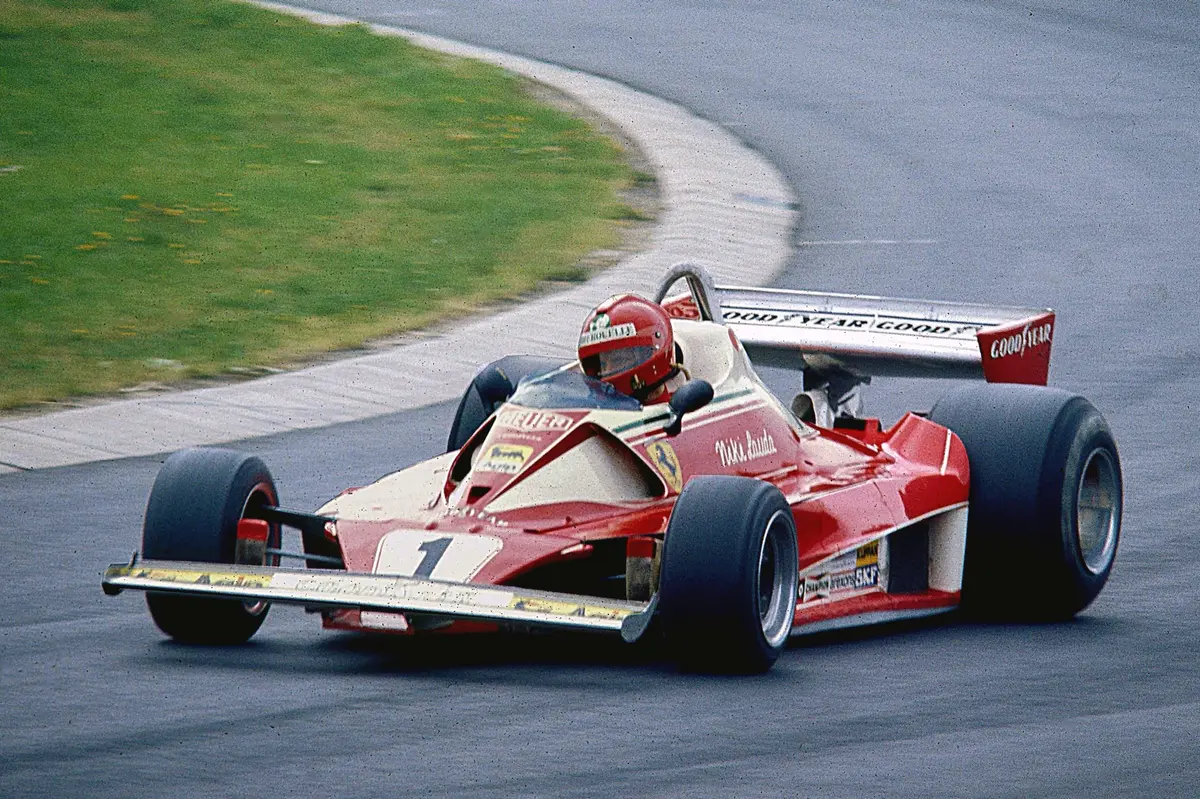
In 1976 two men fought for the Formula One world championship, and the fight is remembered for a fire and for one point. Niki Lauda, an Austrian driving for Ferrari, was the reigning champion, precise and unemotional. James Hunt, an Englishman, had lost his Hesketh seat when that team closed at the end of 1975 and joined McLaren when Emerson Fittipaldi left it. Lauda won the first race at Interlagos and three of the next five, and by the end of May he led Hunt by a wide margin.
The turning point was the German Grand Prix on Sunday 1 August 1976 at the Nürburgring, on the 22.8 km Nordschleife, a lap with more than 170 corners. Lauda had argued that the circuit was too dangerous for Formula One, and the drivers had voted to race anyway, by one vote according to Autosport. On the second lap his Ferrari left the road on a fast left-hand curve before the Bergwerk corner, hit an earth bank and came back across the track in flames. Brett Lunger's Surtees and Harald Ertl's Hesketh hit it, Guy Edwards got past, and Lunger, Ertl, Edwards and Arturo Merzario stopped to pull Lauda out; Merzario reached into the cockpit to undo his belts. His helmet had come off. He had burns on his head and hands, and the fumes had damaged his lungs. A priest gave him the last rites. The race was restarted and Hunt won it.
Lauda missed the Austrian and Dutch Grands Prix, in which Hunt scored 12 points. He was back for the Italian Grand Prix at Monza on 12 September, 42 days after the crash, qualified fifth and finished fourth with blood showing through his bandages. By then the season had also become a quarrel about rules. Hunt won the Spanish Grand Prix in May but was excluded because his McLaren was 1.8 cm too wide, then reinstated on appeal in Paris on 5 July. He won the British Grand Prix in July after a first-lap crash and a restart that Ferrari said was illegal, and in September a tribunal in Paris agreed with Ferrari and moved Lauda up to first. Hunt then won in Canada and at Watkins Glen, and went to the last race, in Japan, trailing Lauda by 68 points to 65.
At Fuji on 24 October 1976 it rained so hard that Hunt and Lauda, both members of the drivers' association, tried to stop the race. The organisers started it after a delay, and Lauda, whose burns had damaged his eyelids, drove two laps and pulled into the pits. Hunt, in the lead for much of the race, lost it when his tyres wore through; he stopped on lap 68 for new ones and then passed two cars in the last laps to finish third. Third place gave him four points, and the title by 69 to 68. Mario Andretti won the race.
The story still matters for two reasons. It was the last Formula One race on the old Nordschleife, and it began the argument about driver safety that ended Grands Prix there for good; the sport returned to the Nürburgring only on a new, shorter track in 1984. And it is the best-known title decided by a single point. The 2013 film Rush made the rivalry famous, but it is a drama, not a record, and nothing in this entry is taken from it.
What happened
- 1976
The season opens at Interlagos in Brazil. Lauda, the reigning champion, wins for Ferrari. Hunt, in his first race for McLaren, takes pole by two hundredths of a second over Lauda, but throttle and engine trouble hold him back and he crashes while heading for second.
At Kyalami in South Africa Lauda wins again and Hunt, from pole, finishes second for his first points of the year.
At Long Beach Clay Regazzoni wins for Ferrari with Lauda second; Hunt retires after three laps.
At Jarama Hunt wins from pole, 31 seconds ahead of Lauda, who is racing a few days after a tractor accident that broke several ribs. Half an hour after the finish the stewards find Hunt's McLaren 1.8 cm wider than the rules allow and exclude him, and Jacques Laffite's Ligier as well. Lauda is declared the winner, and McLaren appeals.
Jarama, near Madrid: the Spanish Grand Prix of 2 May 1976, where Hunt won and was excludedLauda wins the Belgian Grand Prix at Zolder.
Lauda wins at Monaco. Hunt, who started 14th, retires with a blown engine. With the Spanish result against him, Lauda leads Hunt by 51 points to 6.
By now the drivers have already voted on whether to race at the Nürburgring. Lauda, who wanted a boycott, tells Autosport, in an interview published on 25 July, that 'we voted, and the vote was to go'; Autosport and Bonhams reports put the margin at one vote. The meeting's date is not known.
Hunt wins the French Grand Prix at Paul Ricard from pole, after his team has moved the oil coolers to cure a loss of form. Lauda retires with a mechanical failure.
The FIA's appeal court in Paris hears McLaren's case about Jarama, and the decision restores Hunt's win in Spain. McLaren and Ligier are fined $3000 instead. Hunt gains nine points and Lauda loses three.
Paris: the seat of the FIA's appeal bodies, which reinstated Hunt on 5 July and disqualified him from the British Grand Prix in September 1976At the British Grand Prix at Brands Hatch Clay Regazzoni touches Lauda at the first corner and spins, and Hunt is caught up in the crash. The red flag stops the race. Hunt leaves his damaged car on a back road and takes the spare car; rivals say he should not restart. The crowd chants for him and throws bottles and cans, and the stewards let him go. He passes Lauda and wins. Ferrari, Tyrrell and Fittipaldi's team protest, and the stewards at first reject the protest.
Brands Hatch, Kent: the British Grand Prix of 18 July 1976, won on the road by Hunt and awarded to Lauda in SeptemberFriday qualifying at the Nürburgring decides the grid. Hunt takes pole in 7 minutes 6.5 seconds, Lauda is second at 7:07.4 and Laffite sixth.
The Nürburgring Nordschleife, Germany: the 22.8 km 'Green Hell' lap in the Eifel on which Formula One raced for the last time on 1 August 1976Saturday's practice is a one-hour session without timing, followed by rain, so the grid stays as Friday's times left it.
The Nürburgring start-and-finish complex, with the pits and grandstands from which the 1976 German Grand Prix was started and restarted (the 1984 Grand Prix circuit now fills the same area)The German Grand Prix is due to start at 1:30 p.m. A 15-minute delay stretches on, rain is reported on the far side of the circuit, and shortly after two o'clock the cars leave on wet tyres, Jochen Mass's McLaren on slicks. At the end of the first lap the track is drying and almost the whole field, Lauda among them, pits for slicks.
The Nürburgring start-and-finish complex, with the pits and grandstands from which the 1976 German Grand Prix was started and restarted (the 1984 Grand Prix circuit now fills the same area)On the second lap Lauda's Ferrari leaves the road at a fast left-hand curve before Bergwerk, goes through the fences and into an earth bank, and bounces back across the track burning. A fuel tank has split and the catch-fencing has pulled off his helmet. Edwards gets past; Lunger's Surtees and Ertl's Hesketh hit the wreck. No source found gives a clock time for the crash.
Bergwerk, on the Nordschleife: the corner where Lauda's Ferrari crashed on lap two on 1 August 1976Lunger, Ertl, Edwards and Merzario stop and run to the car. Merzario reaches in and undoes the harness and Lunger drags Lauda out; AP Archive says it took 43 seconds, Motor Sport almost a minute. Lauda stands at first. He is taken to Adenau hospital and then by helicopter to a specialist burns hospital, in Mannheim or Ludwigshafen according to the source.
Adenau, the town beside the circuit, whose hospital Lauda was taken to first- 3:10 p.m.
The race is restarted about ten minutes after three o'clock for the full 14 laps, with about twenty cars. Hunt leads from the start, Peterson crashes at the Flugplatz on the first lap, and Hunt wins by 27.7 seconds from Scheckter with Mass third. It is the last Formula One race on the Nordschleife.
The Nürburgring start-and-finish complex, with the pits and grandstands from which the 1976 German Grand Prix was started and restarted (the 1984 Grand Prix circuit now fills the same area) On the Tuesday after the crash Lauda is struggling to breathe and his blood oxygen is dangerously low; he is given the last rites.
Lauda misses the Austrian Grand Prix; John Watson wins in a Penske and Hunt is fourth.
Hunt wins the Dutch Grand Prix at Zandvoort, with Regazzoni second. Lauda, still recovering, is not there.
Zandvoort, Netherlands: Hunt's win in the Dutch Grand Prix of 29 August 1976, which Lauda missedAt Monza, six weeks after the crash, Lauda makes the fifth fastest time in practice, still recovering from burns to his face and hands and damage to his lungs.
Monza, Italy: Lauda's return on 11 and 12 September 1976, fourth in the Italian Grand PrixLauda finishes fourth in the Italian Grand Prix, 19.4 seconds behind Peterson, with blood showing through his bandages, 42 days after the crash. Hunt retires on lap 11.
Monza, Italy: Lauda's return on 11 and 12 September 1976, fourth in the Italian Grand PrixThe FIA's tribunal in Paris, hearing Ferrari's appeal, decides that Hunt's mechanics pushed his car before the red flag and disqualifies him from the British Grand Prix. Lauda is promoted to the win; Hunt loses nine points and Lauda gains three. The day of the ruling is from Wikipedia citing The Times of 25 September.
Paris: the seat of the FIA's appeal bodies, which reinstated Hunt on 5 July and disqualified him from the British Grand Prix in September 1976Hunt wins the Canadian Grand Prix at Mosport from pole. Lauda, in the shadow of the burns, finishes eighth.
Mosport, Ontario: Hunt's win in the Canadian Grand Prix of 3 October 1976Hunt wins the United States Grand Prix at Watkins Glen with Lauda third. With one race left Lauda leads the championship by 68 points to 65.
Watkins Glen, New York: Hunt's win in the United States Grand Prix of 10 October 1976, cutting Lauda's lead to three pointsAt Fuji, under Mount Fuji, rain falls in streams and visibility is about a hundred yards. Hunt and Lauda, both members of the drivers' association, try to have the race stopped; a drivers' meeting votes that the circuit is too dangerous, but Ecclestone and McLaren's team manager Alastair Caldwell argue for racing, and the pits are opened after a long delay.
Fuji Speedway, Shizuoka, Japan: the last race of 1976, held in torrential rain on 24 October 1976Lauda pulls into the pits after two laps and retires, judging the conditions far too dangerous. Mario Andretti wins the race in a Lotus.
Fuji Speedway, Shizuoka, Japan: the last race of 1976, held in torrential rain on 24 October 1976Hunt runs near the front for most of the race, then both left-hand tyres wear through. On lap 68 he stops for new wheels at the pit, rejoins fifth with only a few laps left, passes Alan Jones and Regazzoni and finishes third, behind Andretti and Depailler. He does not know that third place, worth four points, makes him champion by 69 points to 68.
Fuji Speedway, Shizuoka, Japan: the last race of 1976, held in torrential rain on 24 October 1976