The Imola weekend
“On the San Marino Grand Prix weekend of 1994 Ratzenberger died in qualifying and Senna in the race; F1 rebuilt Imola, slowed the cars, revived the drivers' union and set up a safety group.”
Over three days, from Friday 29 April to Sunday 1 May 1994, the San Marino Grand Prix at the Autodromo Enzo e Dino Ferrari in Imola, Italy, became the weekend Formula One has never forgotten. On the Friday Rubens Barrichello's Jordan was launched over a kerb at the Variante Bassa and he survived with a broken nose. On the Saturday the Austrian Roland Ratzenberger, a rookie with the small Simtek team, hit a wall at the Villeneuve curve in qualifying and died. On the Sunday, after a collision at the start that injured spectators and a long safety-car period, the three-time world champion Ayrton Senna left the track at the Tamburello corner on lap 7 and died of head injuries. He was 34.
There is no single agreed cause for Senna's crash. The Italian courts found that the steering column of his Williams had broken and that it had been badly modified; Williams argued that it broke when the car hit the wall. Other explanations were offered: that the slow laps behind the safety car had cooled his tyres, that debris had punctured a tyre, and that he simply made a mistake. The weekend also showed how little room for error the circuit allowed: a flat-out left-hander with a concrete wall just beyond the grass, and, later that afternoon, a loose wheel in a crowded pit lane that injured four mechanics.
What followed came quickly. At Monaco two weeks later the front of the grid was left empty in the colours of Brazil and Austria and a pit-lane speed limit was introduced. After Karl Wendlinger's heavy crash there, Max Mosley set up an Expert Advisory Group under Professor Sid Watkins, the Formula One doctor who had treated all three drivers at Imola, and ordered changes to slow the cars. The drivers, led by Niki Lauda, Michael Schumacher and Gerhard Berger, re-formed their own Grand Prix Drivers' Association. Imola itself was rebuilt for 1995, with chicanes at Tamburello and before the Villeneuve curve.
In Brazil the response was that of a state. President Itamar Franco decreed three days of official mourning and gave Senna the Grand Cross of the National Order of Merit. His body lay in state at the Legislative Assembly in São Paulo and he was buried at the Morumbi Cemetery on 5 May; the coffin was carried by rival drivers, and hundreds of thousands, by some counts millions, lined the streets. Ratzenberger, much less remembered, was buried in Salzburg two days later.
The law took thirteen years. Patrick Head and Adrian Newey of Williams were tried for manslaughter; they were acquitted in 1997 and again on appeal in 1999, the Supreme Court sent the case back in 2003, in 2005 Newey was found innocent and Head's case was closed because the time limit had run out, and in April 2007 the Supreme Court refused Head's appeal to be fully cleared, upholding the finding that the steering-column modification was poorly designed and executed. The court held Head responsible but the time limit meant no sentence was served. The weekend is remembered in the sport as the turning point in its attitude to safety.
What happened
- 1994
In the first of two qualifying sessions on the Friday, Rubens Barrichello's Jordan runs over a steep kerb at the Variante Bassa at about 140 mph, is launched over a tyre barrier and lands upside down. He is unconscious; Professor Sid Watkins clears his airway and he recovers on the way to the medical centre. He has a broken nose (accounts differ on his arm) and takes no further part in the weekend. Senna is at his bedside before the team owner arrives.
The Variante Bassa, Imola: the chicane before the pits where Barrichello's Jordan left the ground on April 29, 1994About twenty minutes into the Saturday qualifying session Roland Ratzenberger, a 33-year-old Austrian rookie with the Simtek team, damages his front wing on a kerb at the Acque Minerali chicane and drives on. At the Villeneuve curve the wing breaks away; the car goes straight on at about 195 mph and hits the wall head-on. Professor Watkins reaches him within half a minute and he is flown to Bologna. The session is stopped and, after a long pause, resumed.
The Villeneuve curve, Imola: the kink after Tamburello where Ratzenberger's Simtek hit the wall during qualifying on April 30, 1994- 2:15 p.m.
Roland Ratzenberger is pronounced dead at the Maggiore Hospital in Bologna; the announcement is made at the circuit at about 14:15. He is the first driver to die at a Grand Prix weekend in twelve years. Senna, who has gone to the crash scene and talked with Watkins, stays out of the rest of the session, and his Friday time stands as pole position.
The Maggiore Hospital, Bologna: where Ratzenberger and Senna were taken by helicopter and where both deaths were announced - 2:00 p.m.
The race starts at 14:00 in dry, sunny weather. JJ Lehto stalls his Benetton on the grid and Pedro Lamy, starting from the back, cannot avoid it; a wheel and debris fly over the fence and a policeman and eight spectators are slightly injured. Neither driver is hurt. The safety car, an Opel Vectra, leads the field for five laps while the track is cleared.
The Autodromo Enzo e Dino Ferrari, Imola: the circuit of the San Marino Grand Prix, as drawn in OpenStreetMap today; the pit lane, the grid and the three corners of the weekend lie inside it - 2:17 p.m.
On lap 7, at about 14:17, Senna's Williams, leading from Michael Schumacher, goes off at the Tamburello left-hander at about 190 mph and hits the concrete wall at about 130 mph. The race is stopped within about a minute. Watkins's team reaches him in about a minute and treats him at the scene; a helicopter lands on the track and takes him to the Maggiore Hospital in Bologna.
Tamburello, Imola: the fast left-hander where Senna's Williams left the track on lap 7 on May 1, 1994; it was rebuilt as a chicane for 1995 and the Senna statue stands beside it - 2:55 p.m.
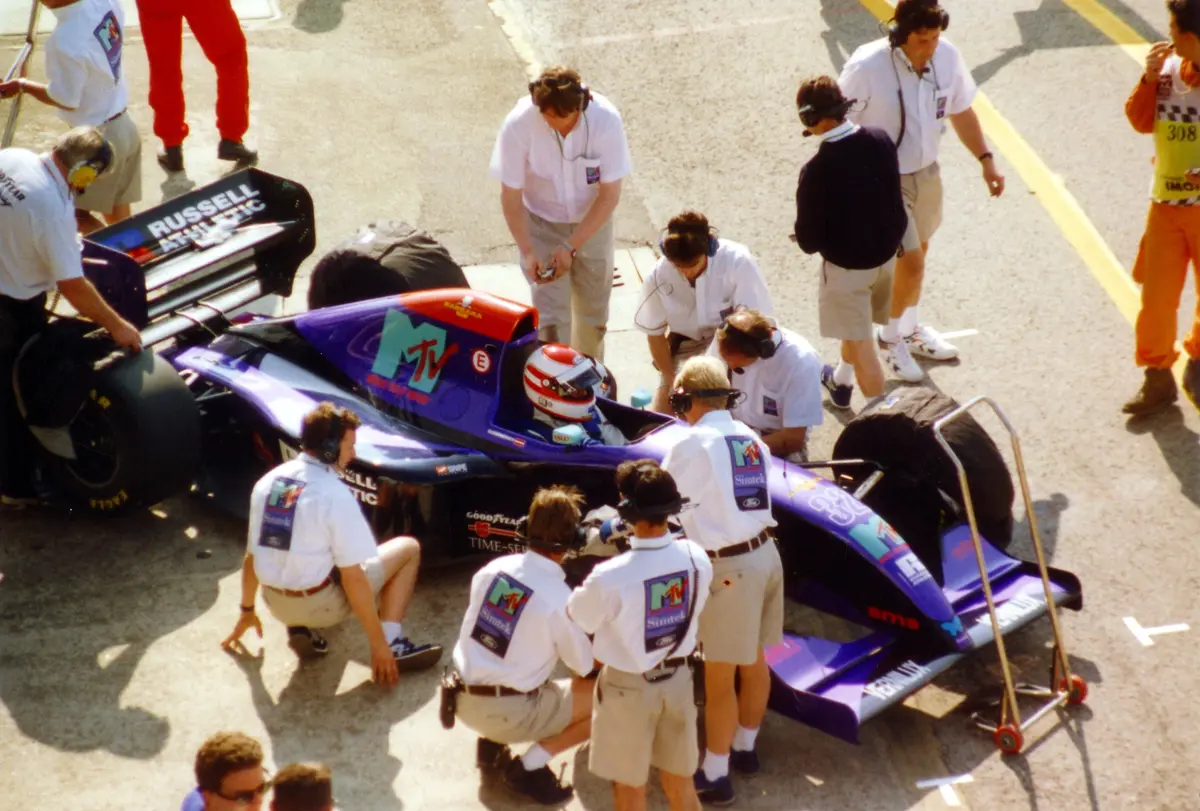
The race is restarted after about 37 minutes and run over the remaining laps, which are counted from the first lap after the safety car. On lap 48 or 49 a rear wheel comes off Michele Alboreto's Minardi as it leaves the pit lane and injures four mechanics, two Ferrari and two Lotus, who are treated in hospital. Michael Schumacher wins from Nicola Larini and Mika Hakkinen.
The Autodromo Enzo e Dino Ferrari, Imola: the circuit of the San Marino Grand Prix, as drawn in OpenStreetMap today; the pit lane, the grid and the three corners of the weekend lie inside it - 6:40 p.m.
At about 18:40 the hospital's doctor announces that Ayrton Senna, aged 34, is dead. Under Italian law his time of death is recorded as 14:17, the moment of the crash not the time of the announcement. Two drivers are dead and a third, Barrichello, is hurt.
The Maggiore Hospital, Bologna: where Ratzenberger and Senna were taken by helicopter and where both deaths were announced In Brasilia President Itamar Franco signs two decrees: one admits Senna after death to the National Order of Merit with the Grand Cross; the other declares three days of official mourning across Brazil.
Senna's body is flown home in the passenger cabin of a Varig aircraft and taken to the Legislative Assembly in Sao Paulo, where it lies in state for about a day.
The Legislative Assembly of Sao Paulo (Palacio 9 de Julho), Ibirapuera: where Senna lay in state on May 4 and 5, 1994Senna's funeral is held in Sao Paulo. President Franco and Governor Fleury attend the wake; the coffin is carried by Alain Prost, Jackie Stewart, Emerson and Christian Fittipaldi, Gerhard Berger, Derek Warwick, Thierry Boutsen, Michele Alboreto, Rubens Barrichello and Roberto Moreno. Hundreds of thousands line the route to the Morumbi Cemetery, where he is buried; estimates of the crowd range from about 250,000 to several million.
The Morumbi Cemetery, Sao Paulo: where Senna was buried on May 5, 1994Ratzenberger is buried in Salzburg. Max Mosley, the president of the FIA, attends his funeral rather than Senna's.
At the Monaco Grand Prix, in the Thursday morning practice session, Karl Wendlinger crashes his Sauber at the Nouvelle Chicane, is unconscious and lies in a coma for weeks; Sauber withdraws from the race. He recovers.
The Circuit de Monaco: Wendlinger's crash on May 12, the empty front of the grid on May 15, 1994, the pit-lane speed limit, and the meeting at which the drivers' association was re-formedMax Mosley announces an Expert Advisory Group on safety, to be chaired by Professor Sid Watkins, about a day after Wendlinger's crash, and announces changes to slow the cars. At Monaco the drivers meet on the Friday under Martin Brundle and re-form the Grand Prix Drivers' Association; Schumacher, Berger and Christian Fittipaldi are named its representatives and Niki Lauda its spokesman for the year.
The Circuit de Monaco: Wendlinger's crash on May 12, the empty front of the grid on May 15, 1994, the pit-lane speed limit, and the meeting at which the drivers' association was re-formedAt Monaco the first two places on the grid are left empty, painted in the colours of Brazil and Austria, in memory of Senna and Ratzenberger; an 80 km/h speed limit applies in the pit lane for the first time, with tight corners at its entrance and exit.
The Circuit de Monaco: Wendlinger's crash on May 12, the empty front of the grid on May 15, 1994, the pit-lane speed limit, and the meeting at which the drivers' association was re-formedStepped undersides, which cut downforce, are ordered for the cars from the German Grand Prix in July, a change that had been planned for 1995; smaller changes to front wings and diffusers follow earlier in the summer.
- 1995
Imola is rebuilt for the next San Marino Grand Prix at the end of April 1995: a chicane on the inside at Tamburello (the outer wall cannot move because a river lies behind it), a new chicane before the Villeneuve curve, the Acque Minerali chicane replaced by two right-hand corners, the first part of the chicane before the pits (Barrichello's) removed, and more run-off at Rivazza.
Tamburello, Imola: the fast left-hander where Senna's Williams left the track on lap 7 on May 1, 1994; it was rebuilt as a chicane for 1995 and the Senna statue stands beside it- 1996
After a technical report, the Imola magistrate Maurizio Passarini charges Williams's technical director Patrick Head and chief designer Adrian Newey with manslaughter, arguing that a poorly modified steering column broke; he asks for one-year suspended sentences. Frank Williams and the race officials are among the others tried.
The Autodromo Enzo e Dino Ferrari, Imola: the circuit of the San Marino Grand Prix, as drawn in OpenStreetMap today; the pit lane, the grid and the three corners of the weekend lie inside it- 1997
A court at Imola acquits all six defendants. The judge finds that the steering column broke but that there is not enough proof to blame the defendants; the prosecutors appeal.
- 1999
The appeal court in Bologna upholds the acquittals of Head and Newey: 'no crime took place', it says, citing the car's speed, tyre wear and the uneven track among several factors. The prosecution can still appeal.
- 2003
Italy's Supreme Court annuls the appeal court's verdict for 'material errors' on the prosecutor's petition and orders the appeal to be heard again.
- 2005
At the retrial in Bologna, which opened on May 11 with the prosecutor asking to close the case because the time limit had run out, the court finds Adrian Newey innocent of manslaughter; the case against Patrick Head is dropped because of the statute of limitations.
- 2007
Italy's Supreme Court rejects Patrick Head's appeal to be fully cleared, saying there are no new grounds to rule that he was not responsible for the modification to Senna's steering column, which it describes as poorly designed and poorly executed; the time limit means he is not punished. It is the end of the case.