The Lumière brothers screen the first films
“On 28 December 1895 the Lumière family charged one franc a head to show ten fifty-second films in a Paris café basement: others had projected films before, but this is the show remembered as the birth of cinema.”
The birth of cinema is usually dated to 28 December 1895. That evening a few dozen Parisians paid one franc each to go down to the Salon Indien, a room under the Grand Café on the Boulevard des Capucines, and watched ten films of about fifty seconds each: workers leaving a factory, a gardener soaked by a boy with a hose, a baby at breakfast, people bathing in the sea. The show was run by Antoine Lumière, the father; his sons Auguste and Louis, who had built the machine, were not the ones on stage.
The machine was an answer to Edison. Antoine, a portrait photographer turned manufacturer, saw Edison's Kinetoscope in Paris in 1894: a wooden cabinet where one person at a time peeped at a short film, the first parlour of which had opened in New York on 14 April 1894. Back in Lyon, in the family's plate factory at Monplaisir, Louis and Auguste set out to make something better. With the engineers Charles Moisson and Jules Carpentier they built a single light box that filmed, printed and projected, pulling the perforated film down frame by frame with a small fork, much like the needle of a sewing machine. They patented it on 13 February 1895.
The first showings were private. On 22 March 1895 Louis showed one film, workers leaving the Lyon factory, to the Société d'encouragement pour l'industrie nationale in Paris, at the end of a talk about photographic plates; the guests asked to see it again. In June it was shown at a photographers' congress in Lyon. The Grand Café show of 28 December was the first time anyone could simply buy a ticket for the Lumière films, and within days there were queues along the pavement and takings of up to 2,500 francs a day.
The Lumières were not alone, and 'first' depends on what you count. Edison's Kinetoscope came earlier but was a peep-show. In New York the Latham family's Eidoloscope projected films to paying customers from 20 May 1895. In Berlin Max and Emil Skladanowsky showed their Bioscop to a paying audience at the Wintergarten from 1 November 1895, eight weeks before the Lumières; their booking at the Folies Bergère in Paris was cancelled after the Lumière show. Edison answered in April 1896 with the Vitascope, a projector invented by Thomas Armat and sold under Edison's name. The Lumière show is the one remembered because their machine was lighter, cheaper and could film as well as project, and because the family sent trained operators round the world.
Among the first guests was the Paris magician Georges Méliès, who offered to buy a machine and was refused; he bought a projector in London instead and became cinema's first great storyteller. By 1905 the Lumières had left the film business, after some 1,400 short films, and turned to colour photography. One famous story is false: that the audience of 1895 ran from the film of a train arriving at La Ciotat. That film was not in the first programme, and the version we know was shot in 1897.
What happened
- 1894
The first Kinetoscope parlour opens at 1155 Broadway, New York: customers pay to look into Edison's cabinets one at a time. It is a commercial success, but it is a peep-show, not a screen.
1155 Broadway, New York: the first Kinetoscope parlour, opened 14 April 1894A Lyon newspaper reports that the Lumière brothers are building a new 'cinetograph' no less remarkable than Edison's. Antoine Lumière had seen the Kinetoscope in Paris earlier that year and brought his sons a strip of its film.
Lumière factory, Monplaisir, Lyon: where Louis filmed Sortie d'usine and L'Arroseur arrosé in 1895; the site of the Institut Lumière and the Hangar du Premier-Film- 1895
Auguste and Louis Lumière file French patent no. 245,032 for 'an apparatus for obtaining and viewing chronophotographic prints': one machine to film, print and project, with a claw that moves perforated film frame by frame. Additions follow on 30 March and 6 May 1895.
Lumière factory, Monplaisir, Lyon: where Louis filmed Sortie d'usine and L'Arroseur arrosé in 1895; the site of the Institut Lumière and the Hangar du Premier-FilmLouis films workers leaving the Lumière factory in Lyon, in the street beside the works at Monplaisir (the date is presumed). This first version is lost; the oldest copy that survives was made in May 1895.
Lumière factory, Monplaisir, Lyon: where Louis filmed Sortie d'usine and L'Arroseur arrosé in 1895; the site of the Institut Lumière and the Hangar du Premier-FilmAt the Société d'encouragement pour l'industrie nationale in Paris, Louis Lumière gives a talk on the making of photographic plates and ends it with one short film. The guests, a small invited audience, ask to see it again: probably the first projection of a film before an audience in France.
Société d'encouragement pour l'industrie nationale, 44 rue de Rennes at the time (today 4 place Saint-Germain-des-Prés), Paris: Louis Lumière's first private screening, 22 March 1895In New York the Latham family's Eidoloscope shows boxing films to a paying public, a month after a press show on 21 April: the first paid screening of projected film in the United States, and earlier than the Lumières' public show.
At a congress of French photographic societies in Lyon, Louis shows the workers-leaving-the-factory film and the comedy L'Arroseur arrosé, which he had filmed in the garden of the family house with the family's gardener and a boy.
Lumière factory, Monplaisir, Lyon: where Louis filmed Sortie d'usine and L'Arroseur arrosé in 1895; the site of the Institut Lumière and the Hangar du Premier-FilmOn the congress's boat excursion up the Saône, Louis films the members stepping ashore at Neuville-sur-Saône. Shown to the same audience the next day, it is often called the first newsreel.
Quai Pasteur, Neuville-sur-Saône: where Louis filmed the photographers' congress stepping ashore on 11 June 1895The congress closes in the salons Monnier on the place Bellecour in Lyon, and the new landing film is shown at the end of the session. The astronomer Jules Janssen, speaking at the congress, notes that the picture flickers.
Place Bellecour, Lyon: the salons Monnier on the square, where the congress closed and the Neuville film was shown on 12 June 1895Max and Emil Skladanowsky open a show of their Bioscop, a projector with two lenses and two film strips, at the Wintergarten variety theatre in Berlin. It runs through November, 23 screenings of films of a few seconds each among the theatre's other acts: by Ian Christie's count the first film show for a paying audience in Europe.
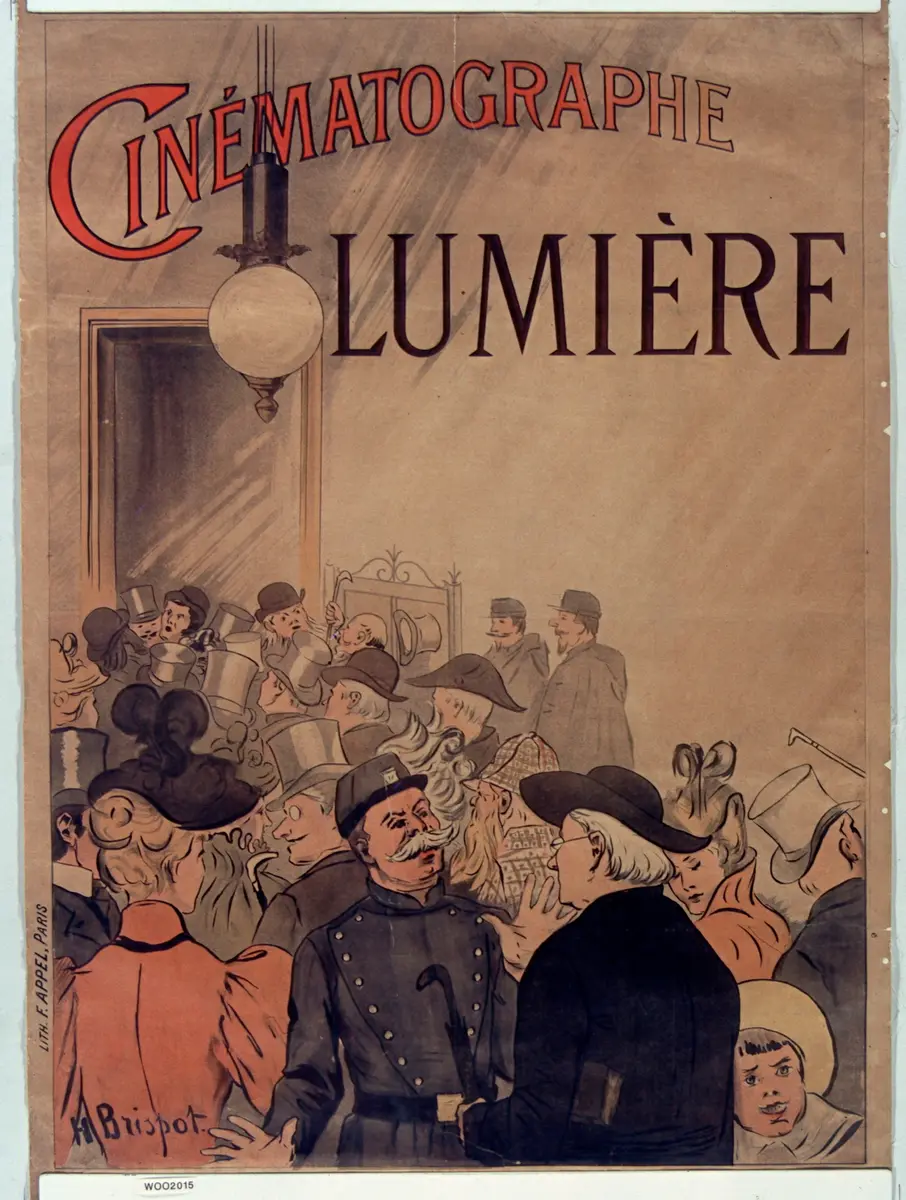
Wintergarten in the Central-Hotel, Friedrichstraße, Berlin: where the Skladanowskys' Bioscop was shown to a paying audience from 1 November 1895; destroyed in the Second World WarIn the Salon Indien under the Grand Café, Antoine Lumière presents the first paid Lumière show: ten films of about fifty seconds, from Sortie d'usine to La Mer, for one franc a ticket. Charles Moisson, the machine's builder, supervises the projection; Louis and Jules Carpentier are not there. The posters outside draw in passers-by.
Salon Indien du Grand Café, 14 boulevard des Capucines, Paris: the basement room where the first paid Lumière show was given on 28 December 1895; the building is now the Hôtel Scribe and carries a plaqueInvited guests include theatre owners. At least three offer to buy the machine, for between 10,000 and 50,000 francs, and are refused; the Lumières mean to run the business themselves. One of them is the Paris magician Georges Méliès, who will go to London for a projector instead.
Salon Indien du Grand Café, 14 boulevard des Capucines, Paris: the basement room where the first paid Lumière show was given on 28 December 1895; the building is now the Hôtel Scribe and carries a plaqueMax Skladanowsky, in Paris for a booking at the Folies Bergère, is taken to see the Lumière show; the engagement is cancelled, though the brothers are paid in full.
- 1896
In London the Lumière agent Félicien Trewey gives a press show of the Cinématographe at the Royal Polytechnic Institution, Regent Street. The first public show follows the next day.
Royal Polytechnic Institution, 309 Regent Street, London: the first Lumière shows in Britain, 20 and 21 February 1896; today the University of WestminsterAt Koster and Bial's Music Hall in New York, Edison's Vitascope shows films on a screen. The projector was invented by Thomas Armat and is sold under Edison's name: Edison, who had favoured the peep-show, now shows his films on a screen like the Lumières.