Kodak puts the camera in everyone's hands
“In 1888 George Eastman's Kodak, a $25 box loaded with a hundred exposures and sent back to Rochester for developing ('You press the button, we do the rest'), made photography something anyone could do.”
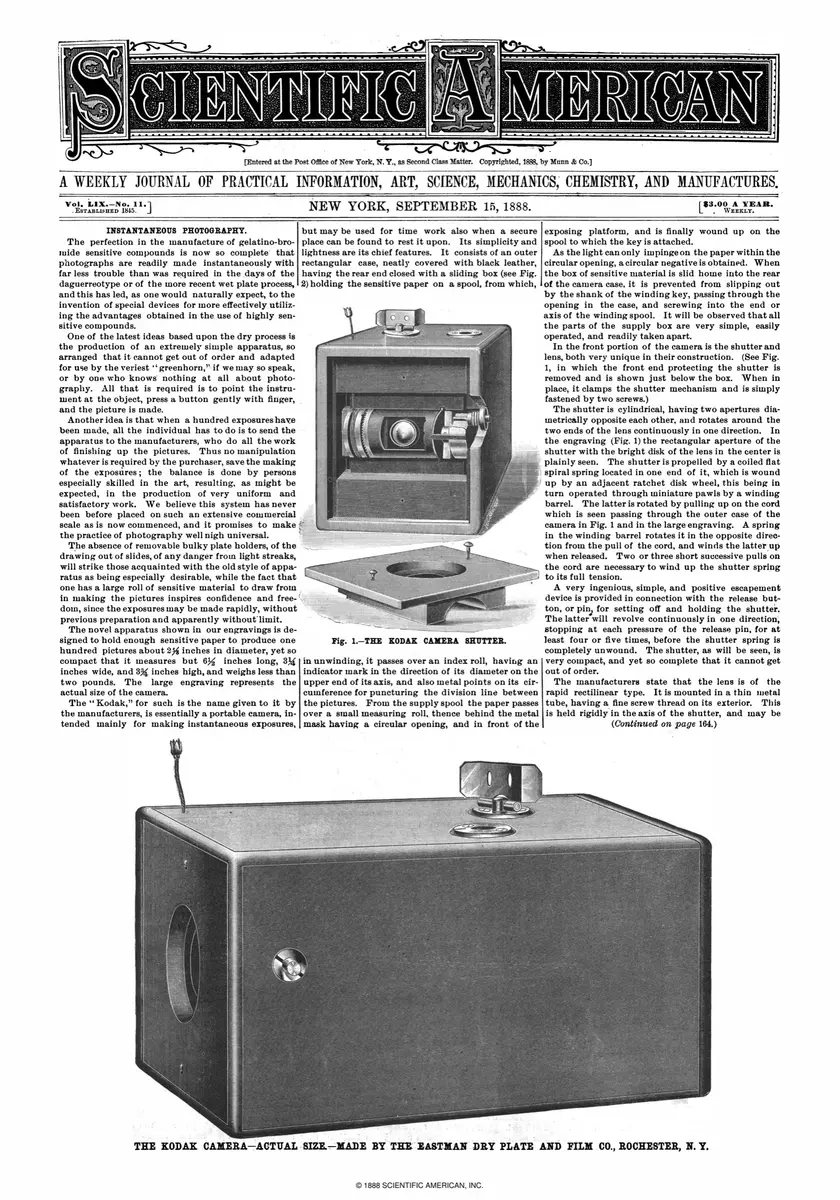
Before 1888 taking a photograph was a craft. You carried a heavy camera, a tripod and glass plates, and you needed a dark room and a set of chemicals to turn the plates into pictures. In September 1888 a company in Rochester, New York, started selling something very different: a black leather box about 16 centimetres long and under two pounds in weight, called the Kodak. It held a roll of sensitive paper long enough for one hundred round pictures, each about 6 centimetres across. The owner pointed the box, pulled a cord to set the shutter, pressed a button, and turned a key to wind on the roll. When the hundred exposures were used up, he sent the whole camera back to the factory.
At the factory the roll was taken out, developed and printed, a fresh roll was put in, and the camera went back to its owner with the pictures. Eastman's own company catalogue of 1895 still lists the original No. 1 Kodak at $25 loaded with a hundred exposures, and $10 for reloading, developing and printing a hundred pictures. The slogan that went with it, 'You press the button, we do the rest', said the whole idea in seven words. Amateurs who did not want to learn chemistry could now take photographs, and the maker earned its money from the film and the finishing, which every owner had to buy again.
George Eastman, a bank clerk who had turned to photography, had spent a decade getting there. In 1881 he and Henry Strong started a dry-plate company in Rochester, which became the Eastman Dry Plate and Film Company in October 1884. That year he applied for a patent on a flexible gelatine film on paper, and in 1885 he and William Walker patented a roll holder that let an ordinary plate camera take many exposures on a roll. For the Kodak he asked for a new patent on 30 March 1888. The Patent Office passed it for issue on 13 July and granted it on 4 September, and on 15 September 1888 Scientific American put the camera on its front page, calling it a system that 'promises to make the practice of photography well nigh universal'.
The Kodak was an instant success, though not yet a cheap one. In 1889 Eastman added a larger No. 2 model and, with his chemist Henry Reichenbach, a transparent roll film; Kodak Park, a large new works for making film, was begun in 1890; and in 1892 the firm became the Eastman Kodak Company. Prices fell and cameras shrank until, in February 1900, the Brownie arrived at one dollar, aimed at children. Photography had stopped being something done by a few specialists. It had become what ordinary families did on holidays and at birthdays, and the word 'snapshot' came to mean the pictures people took of their own lives.
What happened
- 1884
George Eastman applies for a patent on a flexible light-sensitive film: gelatine coated on a paper support that can be rolled, the first step away from glass plates.
343 State Street, Rochester: the Eastman factory and office where the Kodak was made and the film was developed (Kodak Tower stands there now)The Eastman Dry Plate Company is re-incorporated as the Eastman Dry Plate and Film Company, in Rochester.
343 State Street, Rochester: the Eastman factory and office where the Kodak was made and the film was developed (Kodak Tower stands there now)Eastman and William H. Walker are granted US patent 306,470 for a gelatine film on paper with a coat of gelatine on the back to stop it from curling, assigned to the company.
- 1885
Walker and Eastman are granted US patent 317,049 for a roller holder, a case that lets an ordinary plate camera take a long series of exposures on a roll of film. It is the Kodak's mechanism in an earlier form.
343 State Street, Rochester: the Eastman factory and office where the Kodak was made and the film was developed (Kodak Tower stands there now)- 1886
The company's illustrated catalogue gives its factory and office as 343, 345, 347 and 349 State Street, Rochester, with a branch office at 13 Soho Square, London, and offers plates, American film, bromide paper and roll holders.
343 State Street, Rochester: the Eastman factory and office where the Kodak was made and the film was developed (Kodak Tower stands there now) - 1888
Eastman files his application for a patent on a 'Camera': a leather-covered box with a lens, a shutter and a roll of film, which he calls a detective camera.
The Patent Office, Washington: where the Kodak patent was examined, passed for issue on 13 July 1888 and granted on 4 SeptemberThe Patent Office examiners pass the Kodak patent for issue, a date written on the National Archives' file copy of the drawing.
The Patent Office, Washington: where the Kodak patent was examined, passed for issue on 13 July 1888 and granted on 4 SeptemberBy mid-September 1888 the Kodak is on sale, as a camera loaded with film for a hundred pictures, with the slogan 'You press the button, we do the rest'. It costs $25, and $10 more buys development, printing and a fresh roll when the camera is sent back to Rochester.
343 State Street, Rochester: the Eastman factory and office where the Kodak was made and the film was developed (Kodak Tower stands there now)US patent 388,850 is granted to George Eastman of Rochester for the camera.
The Patent Office, Washington: where the Kodak patent was examined, passed for issue on 13 July 1888 and granted on 4 SeptemberScientific American puts the Kodak on its front page: a camera about 6.5 inches long that holds sensitive paper for 100 round pictures. The owner presses a button, and when the roll is used he sends the camera to the makers, who develop the negatives, print the pictures and return it reloaded.
343 State Street, Rochester: the Eastman factory and office where the Kodak was made and the film was developed (Kodak Tower stands there now)- 1889
Kodak grows: a larger No. 2 Kodak takes round pictures 3.5 inches across, and Eastman and the chemist Henry Reichenbach patent a transparent roll film that is like celluloid, replacing the paper film.
343 State Street, Rochester: the Eastman factory and office where the Kodak was made and the film was developed (Kodak Tower stands there now) - 1890
The company begins building Kodak Park on the edge of Rochester, a works for making film, paper and plates. By 1895 it covers fourteen acres.
Kodak Park, Rochester: the works begun in 1890 to make Kodak film, paper and plates - 1892
The company is incorporated as the Eastman Kodak Company.
343 State Street, Rochester: the Eastman factory and office where the Kodak was made and the film was developed (Kodak Tower stands there now)- 1895
Kodak's own catalogue calls the No. 1 Kodak 'the original Kodak' and still lists it at $25 with a hundred exposures; its executive offices on State Street carry the slogan on the wall, and the camera works, a six-storey factory, make the Kodaks.
343 State Street, Rochester: the Eastman factory and office where the Kodak was made and the film was developed (Kodak Tower stands there now) - 1900
Kodak releases the Brownie, a cardboard-and-leatherette box camera for one dollar, designed by Frank A. Brownell and aimed at children, and it sells in the hundreds of thousands.
343 State Street, Rochester: the Eastman factory and office where the Kodak was made and the film was developed (Kodak Tower stands there now)