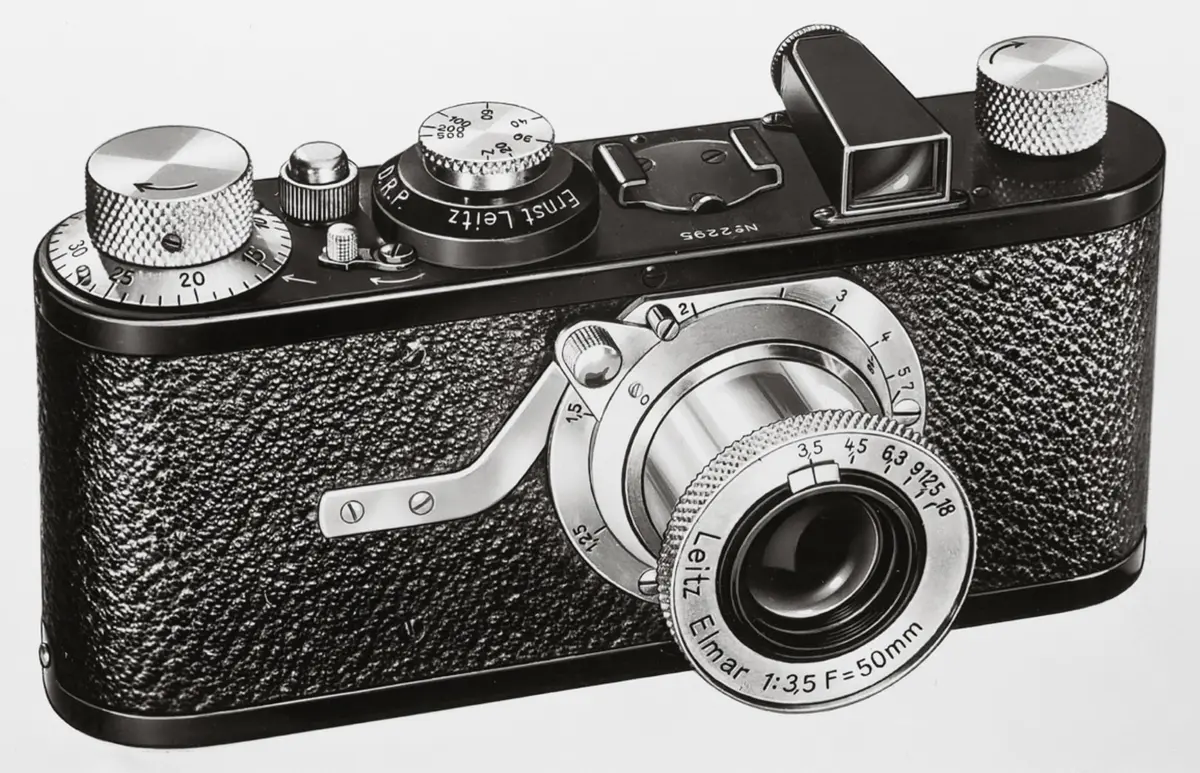
The Leica and 35mm photography
“Oskar Barnack's Ur-Leica of 1913/14 turned cinema film sideways into the 24x36 mm 35mm still frame, and the Leica I, shown at Leipzig in March 1925, made it a camera for everyone.”
Until the 1920s serious photography meant a heavy camera, glass plates or sheet film, and often a tripod. The Leica I changed that. It was shown at the Leipzig Spring Fair in March 1925 by Ernst Leitz of Wetzlar, a firm known until then for microscopes and binoculars: a small metal camera that fits in a coat pocket, with a lens that folds in and a focal-plane shutter. It uses 35 mm cinema film, a roll about 1.6 metres long that holds thirty-six pictures, so a photographer can shoot quickly without reloading.
The idea was Oskar Barnack's. Born in 1879 in the Brandenburg village of Lynow, he was a precision mechanic who came to Leitz in 1911 and became head of development for cinema and measuring equipment. He loved photography, but his asthma made carrying a plate camera hard. About 1913-14 he took cinema film, which runs vertically in a movie camera, and ran it sideways, so each frame was 24 by 36 millimetres instead of the cine 18 by 24: the 3:2 shape that digital 'full frame' still copies. His small prototype, the Ur-Leica, took its first pictures in Wetzlar in 1914. Because the negatives were tiny and had to be enlarged, the lens had to be very sharp, and Leitz's optician Max Berek designed a new 50 mm f/3.5 one, the Elmar.
The First World War delayed the camera for ten years, and after it came hunger and hyperinflation. Barnack went on taking pictures, such as the flood in Wetzlar in 1920. In 1923 Leitz made a small test series of cameras, and in 1924 the owner, Ernst Leitz II, decided against the advice of many of his managers to make the camera in numbers: 'I hereby decide: we will take the risk.' The first serial Leica I, whose name is short for Leitz Camera, left the works at the end of 1924.
It sold. Around 57,000 were made by 1930; lenses became interchangeable in 1930, a rangefinder came with the Leica II in 1932 and slow speeds with the Leica III in 1933. Zeiss Ikon answered with the Contax in 1932, and in 1934 Kodak made a 135 cassette that fit both, which made 35 mm film a standard. Photographers such as Henri Cartier-Bresson and Robert Capa used the Leica to take unposed pictures of streets and events, and picture reporting in magazines grew with it. Barnack died in January 1936, aged 56.
The Leica's story in Germany has a darker side. From 1933 until the borders closed in September 1939, Ernst Leitz II helped Jewish workers and friends to leave by 'assigning' them to Leitz offices overseas, giving many of them a Leica to take along; the effort, later called the Leica Freedom Train, stayed unknown for decades. The camera's legacy is the 24 by 36 mm frame, still the reference size for serious cameras, and the habit of carrying a camera everywhere. Leica still has its home in Wetzlar.
What happened
- 1911
Oskar Barnack, a precision mechanic born in 1879, joins the Leitz works in Wetzlar and soon becomes head of development for cinema and measuring equipment. He is an enthusiastic amateur photographer with asthma, and the plate cameras of the day are too heavy for him to carry.
The Leitz works, Ernst-Leitz-Strasse, Wetzlar: where Barnack built the Ur-Leica and the Leica was made until 1986 - 1913
Working at Leitz about 1913, Barnack turns the 35 mm film used in cinema cameras on its side, so each picture is 24 by 36 millimetres, twice the size of a cine frame. In a small metal body he builds the Ur-Leica, which he calls 'Liliput'. Leica dates it 1913/14; Barnack's 1914 first pictures are the earliest dated proof.
The Leitz works, Ernst-Leitz-Strasse, Wetzlar: where Barnack built the Ur-Leica and the Leica was made until 1986 - 1914
Barnack tests the Ur-Leica in the old town of Wetzlar and takes the Eisenmarkt as his first picture. The small negative, when enlarged, gives a print good enough to show.
Eisenmarkt, Wetzlar: where Barnack took the first picture with the Ur-Leica in 1914Just before the First World War Ernst Leitz II sails to New York with a prototype and photographs the streets of Manhattan. Without Barnack, a man who is no photographer finds out how easily the camera works. The war then holds up the project for about ten years.
New York: Ernst Leitz II's street pictures with the Ur-Leica in 1914- 1920
The River Lahn floods Wetzlar. Barnack walks out with the Ur-Leica and photographs the water in the streets, among the first news pictures made on 35 mm film. In the same year Ernst Leitz I dies and his son Ernst Leitz II becomes the sole owner of the firm.
The Leitz works, Ernst-Leitz-Strasse, Wetzlar: where Barnack built the Ur-Leica and the Leica was made until 1986 - 1922
The firm Ernst Leitz files a German patent application for a roll-film camera (DE 384071, 'Rollfilmkamera'); the patent is published on 3 November 1923. The Leica's early cameras carry the letters D.R.P., for German Reich Patent.
The Leitz works, Ernst-Leitz-Strasse, Wetzlar: where Barnack built the Ur-Leica and the Leica was made until 1986- 1923
Leitz builds a small test series of the camera, the 'zero series', and gives the cameras to photographers, employees and experts to try in real life. Barnack's own camera, no. 105, was sold in 2022 for 14.4 million euros; the usual count is about thirty cameras, but sources differ.
The Leitz works, Ernst-Leitz-Strasse, Wetzlar: where Barnack built the Ur-Leica and the Leica was made until 1986 - 1924
Many managers and engineers at Leitz doubt that anyone will buy such a camera. Ernst Leitz II ends the debate with the words 'I hereby decide: we will take the risk.'
The Leitz works, Ernst-Leitz-Strasse, Wetzlar: where Barnack built the Ur-Leica and the Leica was made until 1986The first serial Leica I goes into production at the end of 1924. Camera no. 126, sold to a customer in Brazil, is officially the first; it is back in Leica's own collection. Leica is short for Leitz Camera.
The Leitz works, Ernst-Leitz-Strasse, Wetzlar: where Barnack built the Ur-Leica and the Leica was made until 1986- 1925
The Leica I is shown to the public at the Leipzig Spring Fair, which opens on 1 March and runs to 7 March 1925. It has a 50 mm Elmar lens designed by Max Berek and a focal-plane shutter with speeds from 1/20 to 1/500 of a second.
Leipzig: the Spring Fair of 1-7 March 1925, where the Leica I was first shown- 1930
After about 57,000 cameras in five years, the Leica I (C) gets a screw thread so that lenses can be changed; a 35 mm wide-angle lens and a 135 mm telephoto are offered with the 50 mm.
The Leitz works, Ernst-Leitz-Strasse, Wetzlar: where Barnack built the Ur-Leica and the Leica was made until 1986 - 1932
The Leica II is the first with a built-in rangefinder, which couples to the focus. Zeiss Ikon, in the same year, brings out the Contax, a camera built to beat it. Henri Cartier-Bresson buys a Leica in these years and says that taking a photograph means putting 'head, eye and heart in the same line of sight'.
The Leitz works, Ernst-Leitz-Strasse, Wetzlar: where Barnack built the Ur-Leica and the Leica was made until 1986 - 1933
The Leica III adds slow shutter speeds. After Hitler takes power, Ernst Leitz II begins to help Jewish workers and friends leave Germany by 'assigning' them to Leitz offices abroad, mostly in New York, where each new arrival is given a Leica. It later becomes known as the Leica Freedom Train.
The Leitz works, Ernst-Leitz-Strasse, Wetzlar: where Barnack built the Ur-Leica and the Leica was made until 1986 - 1934
Kodak introduces the 135 cassette, a daylight-loading magazine of 35 mm film for still cameras that fits both the Leica and the Contax, together with its own Retina camera. 35 mm film now has a standard of its own.
- 1936
Oskar Barnack dies in Bad Nauheim at the age of 56. The Leica IIIa of 1935, with its top shutter speed of 1/1000 of a second, is the last model for which he was fully responsible.
Bad Nauheim, Hesse: where Barnack died on 16 January 1936- 1937
At Lakehurst, New Jersey, the airship Hindenburg burns. Press photographers use large Speed Graphic cameras; two spectators, Arthur Cofod Jr. and sixteen-year-old Foo Chu, take pictures with Leicas.
- 1938
Henri Cartier-Bresson photographs people picnicking on the banks of the Marne, a picture of ordinary life as unposed as the Leica allows.
After the Kristallnacht pogrom of 9-10 November, Leitz's effort to bring Jewish workers out of Germany grows. Groups of refugees arrive in New York every few weeks in 1938 and early 1939.
The Leitz works, Ernst-Leitz-Strasse, Wetzlar: where Barnack built the Ur-Leica and the Leica was made until 1986- 1939
Germany invades Poland and closes its borders, and the Leica Freedom Train ends. Leitz had by then trained and placed many refugees through its overseas offices; the Leica III now goes to war with the photographers.
The Leitz works, Ernst-Leitz-Strasse, Wetzlar: where Barnack built the Ur-Leica and the Leica was made until 1986