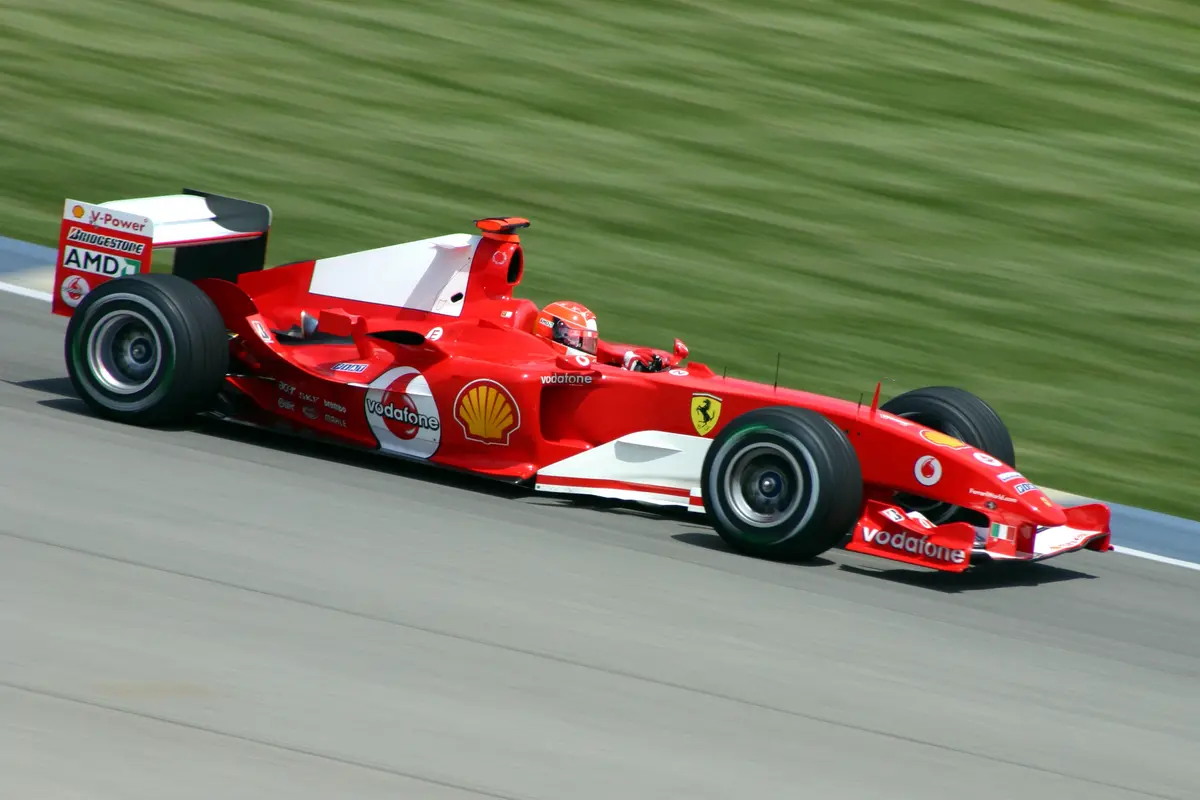
Michael Schumacher
“The German who won seven Formula One titles, two at Benetton and five in a row at Ferrari, 91 Grands Prix, and came back with Mercedes; since a skiing accident in December 2013 his family has kept his condition private.”
Michael Schumacher is a German racing driver who won the Formula One world championship seven times: twice with Benetton (1994 and 1995) and five times in a row with Ferrari (2000 to 2004). When he stopped for the first time, at the end of 2006, he had won 91 Grands Prix, a record that stood until Lewis Hamilton passed it, and his seven titles were two more than Juan Manuel Fangio's five, a mark that stood for nearly fifty years. Hamilton equalled the seven titles as well, so the numbers are no longer his alone; what the record books still show is how long he was on top.
He was born on 3 January 1969 in Hürth-Hermülheim, near Cologne. His father, a bricklayer, ran the kart track at nearby Kerpen and his mother ran its canteen, so he grew up at a racetrack. He was German junior kart champion in 1984 and 1985, German and European kart champion in 1987, German Formula Three champion in 1990, and drove sports cars for Mercedes. In August 1991 he took the place of the jailed Bertrand Gachot at Jordan for the Belgian Grand Prix, his clutch failed on the first lap, and Benetton signed him before the next race. At Spa a year later he won his first Grand Prix.
His two Benetton titles were both close and both disputed. In 1994 he was disqualified at Silverstone for ignoring a black flag, excluded from a win at Spa for a worn skid block and banned for two races, yet he reached the last round at Adelaide one point ahead of Damon Hill. There, on 13 November, the two cars collided on lap 36 and both retired, so he won by 92 points to 91. In 1995 he won nine races and took the title with two races to spare. He left for Ferrari in 1996, a team that had not won the drivers' title since 1979. The car was not the fastest, but in 1996 he won three races, including the Spanish Grand Prix in the rain, and in 1997 he finished second in the championship, a result that was later removed.
The 1997 season ended at Jerez on 26 October, when he turned in on Jacques Villeneuve, who was trying to pass, and ended up in the gravel. The FIA found the move deliberate and on 11 November took away his second place in the championship, though his five race wins stand. After a broken leg at Silverstone in 1999, which kept him out for six races, he won the 2000 title at Suzuka for Ferrari's first drivers' championship in 21 years. With Jean Todt as team principal, he then won four more: 2001, 2002, 2003 and 2004, when he won 13 of the 18 races. He retired after the Italian Grand Prix of 10 September 2006, finished second in the championship to Fernando Alonso and went on to work for Ferrari as an adviser.
In December 2009 he agreed to return with Mercedes, led by Ross Brawn, and raced from 2010 to 2012. He won no race, took one podium (third in Valencia in 2012) and retired again at the end of 2012. On 29 December 2013 he fell while skiing off-piste in Méribel, in the French Alps, hit his head on a rock and suffered a serious brain injury; he was kept in an induced coma until June 2014 and went home in September 2014. Since then his family and manager have shared almost nothing about his condition, and this entry states only what was said publicly at the time. In 2020, when Lewis Hamilton equalled the 91 wins, Schumacher's son Mick gave him one of his father's helmets.
What happened
- 1969
Michael Schumacher is born in Hürth-Hermülheim, near Cologne, in West Germany. His father, a bricklayer, runs the kart track at nearby Kerpen and his mother runs its canteen; his brother Ralf is born six years later and also becomes a Formula One driver.
Hürth-Hermülheim, near Cologne: Michael Schumacher was born here on 3 January 1969 (Britannica gives the place as Hürth-Hermülheim)- 1987
By 1987 he is German and European kart champion (he had been German junior kart champion in 1984 and 1985). He has left school and works as an apprentice car mechanic before becoming a full-time racing driver.
Kerpen: the town where his father ran the kart track and where he grew up racing; on 24 July 1995, at the kart track where he began, he said he was talking to Ferrari - 1990
He wins the German Formula Three championship and is hired by Mercedes to drive sports cars.
- 1991
Formula One debut in the Belgian Grand Prix at Spa, in a Jordan that he is given because Bertrand Gachot is in prison in London. He qualifies seventh and his clutch fails within a few hundred metres of the start.
Spa-Francorchamps, Belgium: his first Grand Prix (25 August 1991), his first win (30 August 1992) and the place where he clinched his seventh title (29 August 2004)In his first race for Benetton, which signed him straight after Spa, he finishes fifth at Monza, one place ahead of his three-time champion team-mate Nelson Piquet.
Monza, Italy: his first race for Benetton (8 September 1991) and the place where he announced his retirement on 10 September 2006- 1992
His first Formula One win, in the wet at Spa in a Benetton, from third on the grid, exactly a year and five days after his debut there.
Spa-Francorchamps, Belgium: his first Grand Prix (25 August 1991), his first win (30 August 1992) and the place where he clinched his seventh title (29 August 2004)- 1994
Benetton launches its B194 car at the team's factory at Enstone with Schumacher and J. J. Lehto in the overalls and Jos Verstappen in the cockpit.
Schumacher wins the San Marino Grand Prix at Imola, from second on the grid, on the weekend on which Ayrton Senna died; it is his third win in a row at the start of the season.
At the British Grand Prix he overtakes pole-sitter Damon Hill on the parade lap, is given a five-second stop-and-go penalty, ignores the black flag that follows and is later disqualified from second place and banned for two races.
He wins the Belgian Grand Prix at Spa but the Benetton is excluded after the wooden skid block under the car is found worn beyond the limit; he is also banned for two races (the Italian and Portuguese Grands Prix), and the ban stands after an appeal.
Spa-Francorchamps, Belgium: his first Grand Prix (25 August 1991), his first win (30 August 1992) and the place where he clinched his seventh title (29 August 2004)In the last race of the season, at Adelaide, he leads Hill by a point. On lap 36 the two collide at East Terrace; both retire, the stewards call it a racing incident and Schumacher is champion by 92 points to 91.
Adelaide Street Circuit, Australia: the last race of 1994, where he and Damon Hill collided on 13 November 1994 and he won his first title- 1995
At Silverstone Hill, on fresher tyres, tries to pass him at Priory and the two collide and go out; Hill calls it a racing accident, Schumacher blames Hill, and Johnny Herbert wins the race for Benetton. Sources give lap 45 or 46.
At the kart track where he began to race, he tells reporters that his manager is negotiating with Ferrari and that he will decide his 1996 team by October, though Ferrari has not spoken to him directly.
Kerpen: the town where his father ran the kart track and where he grew up racing; on 24 July 1995, at the kart track where he began, he said he was talking to FerrariHe wins the Belgian Grand Prix at Spa from sixteenth on the grid.
Spa-Francorchamps, Belgium: his first Grand Prix (25 August 1991), his first win (30 August 1992) and the place where he clinched his seventh title (29 August 2004)Schumacher wins the Pacific Grand Prix at Aida, which clinches his second title, with two races to go; he finishes the year with 102 points to Hill's 69.
- 1996
In his first year at Ferrari he and the young Jacques Villeneuve run together in practice at Imola.
His first win for Ferrari, in heavy rain at Barcelona in the Spanish Grand Prix, 45 seconds clear of Jean Alesi, in a car that was not the fastest of the year; he wins three races in 1996.
- 1997
At Jerez, in the last race of the season, Villeneuve dives up the inside of Schumacher on lap 48. Schumacher turns in, the cars collide, Schumacher stops in the gravel and Villeneuve finishes third, enough to win the title.
Jerez circuit, Spain: where he and Jacques Villeneuve collided in the European Grand Prix of 26 October 1997After a hearing in Paris the FIA's World Motor Sport Council removes Schumacher's second place from the 1997 standings (78 points and five wins stand as race results; Ferrari keeps its constructors' points). It finds the collision deliberate, though not premeditated.
- 1999
On the first lap at Silverstone his car goes off at Stowe at high speed and hits the barrier; he breaks his right leg, the only injury of his career, and misses six races. Sources differ on the cause (brake failure is the usual account).
He returns at the first Malaysian Grand Prix, takes pole position and then holds back so that Ferrari team-mate Eddie Irvine, still in the title fight, can win; Schumacher finishes second.
- 2000
He wins the Japanese Grand Prix at Suzuka, 1.8 seconds ahead of Mika Häkkinen, and takes Ferrari's first drivers' title for 21 years, since Jody Scheckter in 1979.
- 2001
He wins in Hungary with four races left, which makes him champion for the fourth time (94 points to David Coulthard's 51).
- 2002
He wins at Magny-Cours, which gives him a fifth title with six races to go (96 points to Pablo Montoya's 34); that year he is on the podium in all 17 races and wins 11.
- 2003
At the last race, at Suzuka, he finishes eighth from 14th on the grid and wins his sixth title by two points from Kimi Raikkonen, which beats Juan Manuel Fangio's record of five.
- 2004
He wins the British Grand Prix, one of the 13 wins in 18 races that season.
His second place at Spa, behind Raikkonen, is enough for a seventh title, at the circuit where he made his debut in 1991; four races remain.
Spa-Francorchamps, Belgium: his first Grand Prix (25 August 1991), his first win (30 August 1992) and the place where he clinched his seventh title (29 August 2004)- 2006
After winning the Italian Grand Prix at Monza he announces at a press conference that he will retire from racing at the end of the year.
Monza, Italy: his first race for Benetton (8 September 1991) and the place where he announced his retirement on 10 September 2006He wins the Chinese Grand Prix from sixth on the grid, his 91st and last win.
His last race of the first career, at Interlagos: he starts tenth, finishes fourth and loses the title to Fernando Alonso, 134 points to 121.
- 2009
Mercedes announces that he will return to Formula One in 2010 on a three-year contract.
- 2010
His first race back, the Bahrain Grand Prix: he finishes sixth.
- 2012
He sets the fastest lap in qualifying at Monaco, but a grid penalty puts him sixth on the grid; he retires on 27 May with a fuel-pressure problem.
He finishes third in the European Grand Prix at Valencia from 12th on the grid, his only podium of the comeback and his last.
At Suzuka, with Ross Brawn and Norbert Haug beside him, he says he will retire at the end of the season; Lewis Hamilton has been announced as his replacement at Mercedes.
His last Grand Prix, the Brazilian Grand Prix at Interlagos: seventh. He has 91 wins, 68 poles and seven titles.
- 2013
While skiing off-piste with his family at Méribel in the French Alps, he falls and hits his head on a rock. He is wearing a helmet but suffers a serious brain injury; he is taken by helicopter to a hospital in Moutiers and then to the hospital in Grenoble, where he is operated on and put into an induced coma.
Méribel, French Alps: the ski resort where he fell on 29 December 2013- 2014
The doctors end the induced coma (Britannica: he was kept in it until June 2014).
After months in intensive care in Grenoble and a stay in a hospital at Lausanne, he goes home in early September 2014. His family and manager have since kept his condition private.
- 2020
At the Eifel Grand Prix at the Nürburgring, Lewis Hamilton wins for the 91st time, equalling Schumacher's record; his son Mick Schumacher gives him one of his father's race-worn helmets from 2012. Hamilton later passes the record.