Ayrton Senna
“The Brazilian who won three world championships (1988, 1990, 1991), fought Alain Prost at Suzuka, and died at Imola on 1 May 1994.”
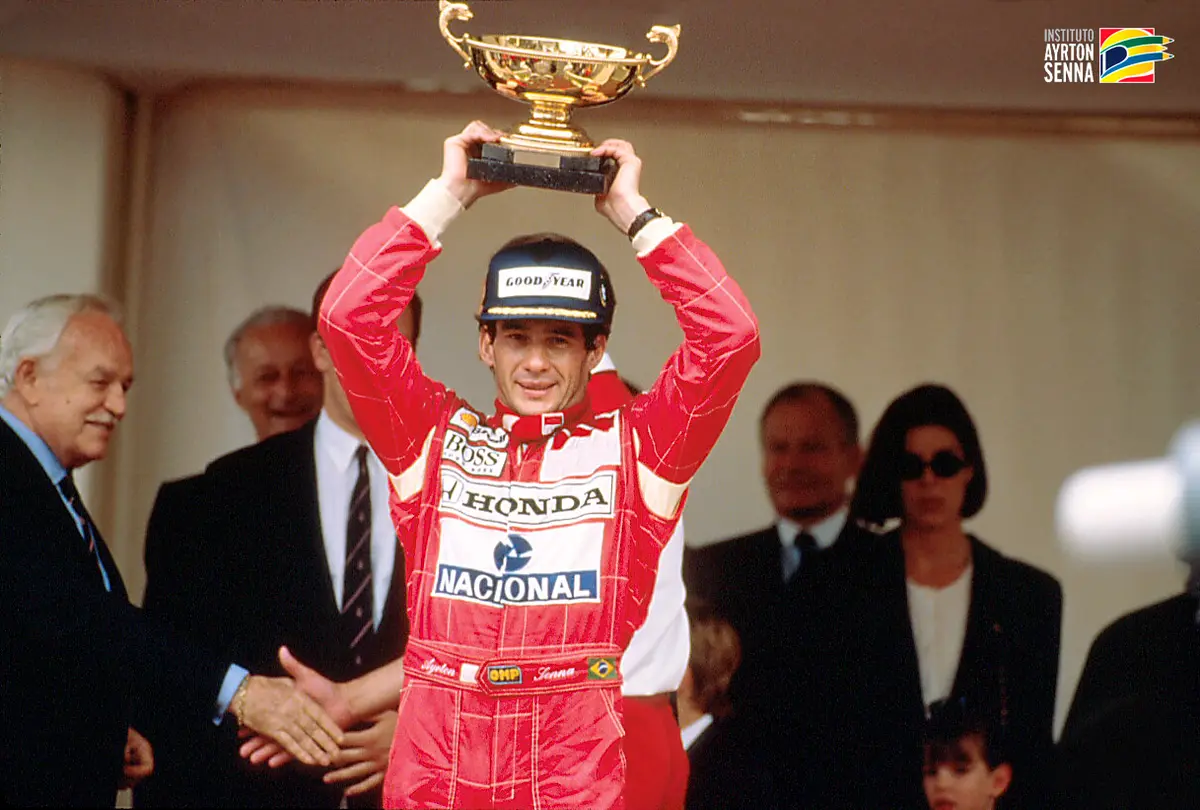
Ayrton Senna da Silva was a Brazilian racing driver who won the Formula One world championship three times, in 1988, 1990 and 1991, and won 41 Grands Prix. He took 65 pole positions, a record when he died, and won at Monaco six times. People remember him for his speed over one lap, his driving in the rain and the all-or-nothing way he raced, and for his feud with his McLaren team-mate Alain Prost, which was settled twice at the Suzuka circuit in Japan. He was 34 when he died after a crash at Imola on 1 May 1994, during a Grand Prix.
He was born on 21 March 1960 in São Paulo into a wealthy family, and as a small boy he was given a kart by his father. He was allowed to enter official kart races at 13 and, by the accounts, won straight away. He was runner-up in the Karting World Championship in 1979 and 1980. In 1981 he moved to England: he won the British Formula Ford 1600 titles that year, both Formula Ford 2000 titles in 1982 and the British Formula 3 championship in 1983 after a season-long fight with Martin Brundle, then the Macau Grand Prix. In 1984 he started Formula One with the small Toleman team and in the rain at Monaco climbed from 13th on the grid to second, closing on Prost when the race was stopped early.
In 1985 he left Toleman for Lotus and won his first Grand Prix in the pouring rain at Estoril in Portugal. At Lotus he took pole positions in bunches but his cars often broke, and he finished fourth in the championship in 1985 and 1986 and third in 1987, the year of his first Monaco win. For 1988 he moved to McLaren to partner Prost, with Honda engines. The team won 15 of 16 races that year, Senna took eight to Prost's seven, and he won his first title at Suzuka after stalling on the grid. In 1989 their rivalry turned bitter, from the broken agreement at Imola to the collision at the Suzuka chicane, where Senna won on the road but was disqualified and Prost took the title. In 1990 Senna won the title at the first corner at Suzuka by driving into Prost's Ferrari, as he admitted a year later; and in 1991 he won a third title, after an emotional first win at his home race in São Paulo with only sixth gear left in the car.
The Williams-Renault of Nigel Mansell and then Prost had the better car in 1992 and 1993, but Senna still won at Monaco in 1992 by 0.215 seconds after a chase by Mansell, and in 1993 in a McLaren with a customer Ford engine he won five races, among them the wet European Grand Prix at Donington Park, where he passed four cars on the first lap. He won the last race of the year in Adelaide, his 41st and last victory, and left McLaren for Williams, the fastest team of the time, for 1994.
That year went wrong from the start. The new Williams FW16 was hard to drive; Senna took pole in the first three races but retired from the first two, so that Michael Schumacher's Benetton led the championship with 20 points to his none. At Imola, on Sunday 1 May 1994, after a weekend in which Roland Ratzenberger had died in qualifying, Senna led from pole position when his car went straight on at the Tamburello bend on the seventh lap and hit an unprotected concrete wall; he died in Bologna that evening. After years of trial the Italian courts found that a steering column that had been modified failed. Brazil declared national mourning, a state funeral was held in São Paulo and a million or more people lined the streets; his family founded the Ayrton Senna Institute that year to support education in Brazil. The weekend led to many changes to circuits and cars, which are told in their own entry; the circuit at Imola itself was changed so that Tamburello became a chicane.
What happened
- 1960
Ayrton Senna da Silva is born in São Paulo, into a wealthy business family; he has an older sister, Viviane, and a younger brother, Leonardo.
São Paulo: where Senna was born on 21 March 1960, grew up, and was buried after the funeral of May 1994- 1973
Too young for official races until 13, he enters the Winter Tournament at Interlagos in a kart and wins at once. The accounts of this very first race differ on the place and the day (see qa.uncertain).
Autódromo José Carlos Pace, Interlagos: his home circuit, where he raced his first official kart race in 1973 (by the fan sources) and won the Brazilian Grand Prix in 1991 and 1993- 1979
He is runner-up in the Karting World Championship at Estoril, and again in 1980 at Nivelles in Belgium; he later named his team-mate Terry Fullerton, the Englishman, as his greatest rival.
- 1981
He moves to England and drives a works Van Diemen in Formula Ford 1600: twelve wins, the RAC and Townsend Thoresen titles, and then a holiday home in Brazil instead of the end-of-season festival.
- 1982
In Formula Ford 2000 for Rushen Green Racing he wins 22 times and takes both the EFDA Euroseries and the British Pace series with races to spare.
At Thruxton he makes his Formula 3 debut in the West Surrey Racing Ralt-Toyota, in a non-championship race: pole position by 0.75 seconds, then a win by 13 seconds.
- 1983
At the last round at Thruxton, Senna wins from pole position and takes the British Formula 3 title from Martin Brundle, after Senna had won the first nine races of the season and Brundle had then taken the lead in the points.
He wins the Macau Grand Prix in the Ralt RT3-Toyota, from pole position, a month after the British title.
- 1984
His Formula One debut, for Toleman in the Brazilian Grand Prix at Rio de Janeiro, ends after eight laps. He had tested for Williams and McLaren and then signed a three-year contract with Toleman.
At Kyalami in South Africa he finishes sixth, his first championship point.
In the rain on the newly opened Nürburgring Grand Prix circuit he wins the Mercedes-Benz 'Race of Champions', in identical 190 E saloons, ahead of Niki Lauda, with Prost starting from pole; on the way he forces Prost off the track.
Starting 13th in torrential rain at Monaco, he climbs to second and is catching Prost's McLaren fast when the race is stopped after 31 laps; he finishes 7.446 seconds behind. It is the result that makes his name.
Circuit de Monaco: the street circuit where he finished second in 1984 and won six times (1987, 1989 to 1993), where he crashed in 1988 and where he lived- 1985
Driving a Lotus for the first time in a Grand Prix season, he takes pole at Estoril and wins his first Grand Prix in heavy rain.
Third at Zandvoort in the Dutch Grand Prix, on a podium with Lauda (winner) and Prost; it was the last Formula One race there until 2021.
- 1986
At Jerez in Spain he beats Nigel Mansell's Williams by 0.014 seconds, from pole position.
- 1987
Driving a Honda-engined Lotus, he wins at Monaco for the first time, on his fourth attempt, 30 seconds ahead of Piquet; three weeks later he also wins in Detroit.
Circuit de Monaco: the street circuit where he finished second in 1984 and won six times (1987, 1989 to 1993), where he crashed in 1988 and where he livedAt the Italian Grand Prix weekend it is announced that Senna will join McLaren, with Honda engines, for 1988, to drive beside Prost.
- 1988
McLaren-Honda wins 15 of the 16 races; Senna takes eight to Prost's seven and is on pole 13 times.
He is almost a minute ahead of Prost at Monaco when, on lap 67 of 78, his nose fin touches the wall at Portier and the car hits the barrier. He walks back to his apartment and does not go back to the pits.
Circuit de Monaco: the street circuit where he finished second in 1984 and won six times (1987, 1989 to 1993), where he crashed in 1988 and where he livedAt Suzuka, Senna stalls on pole, is push-started down the slope and comes through the field, passes Prost on lap 28 at the first turn, wins in light rain and, with his eighth win of the year, is world champion for the first time.
Suzuka Circuit: where his first title was won in 1988, where the Prost collisions of 1989 and 1990 happened, and where he won the third title in 1991- 1989
At the restart of the San Marino Grand Prix at Imola, after Gerhard Berger's fiery crash at Tamburello, Senna passes Prost at the Tosa. They had agreed that whoever led after the first start would be left alone into the first corners; Senna later said the red flag cancelled the deal.
Imola circuit (Autodromo Enzo e Dino Ferrari): the San Marino Grand Prix of 1989, where he passed Prost at the Tosa, and of 1994At Suzuka Senna needs to win to stay in the title fight. On lap 47 of 53 he dives inside Prost at the chicane and the two McLarens tangle; Prost walks away, Senna is push-started, cuts back in, passes Nannini and wins on the road. He is disqualified for missing the chicane, which hands Prost the title.
Suzuka Circuit: where his first title was won in 1988, where the Prost collisions of 1989 and 1990 happened, and where he won the third title in 1991- 1990
At Suzuka, with Prost now at Ferrari, Senna is on pole but his request to start on the cleaner side of the grid is refused; at the first corner he drives into Prost's Ferrari, both cars are out and Senna is champion for the second time. He admitted the next year that it was deliberate.
Suzuka Circuit: where his first title was won in 1988, where the Prost collisions of 1989 and 1990 happened, and where he won the third title in 1991- 1991
Senna opens the season by winning from pole at Phoenix; he wins the first four races of 1991.
At Interlagos he finally wins his home Grand Prix, at the eighth attempt, with only sixth gear left in his car, three seconds ahead of Patrese; he is too spent to lift the trophy.
Autódromo José Carlos Pace, Interlagos: his home circuit, where he raced his first official kart race in 1973 (by the fan sources) and won the Brazilian Grand Prix in 1991 and 1993On the last lap of the British Grand Prix at Silverstone his McLaren runs out of fuel; Nigel Mansell, who has won, stops and gives him a lift back to the pits on the side of his Williams.
Third world title at Suzuka: Mansell goes off at turn 2 on lap 10, which makes Senna champion, and on the last lap he lets his team-mate Berger go by to win the race, finishing 0.344 seconds behind.
Suzuka Circuit: where his first title was won in 1988, where the Prost collisions of 1989 and 1990 happened, and where he won the third title in 1991- 1992
Monaco: Mansell's Williams has led all race but stops for tyres with seven laps to go. Senna takes the lead, Mansell catches him and for three laps cannot find a way past; Senna wins by 0.215 seconds, his fifth Monaco win.
Circuit de Monaco: the street circuit where he finished second in 1984 and won six times (1987, 1989 to 1993), where he crashed in 1988 and where he lived- 1993
In the rain at Donington Park Senna starts fourth, loses a place at the start, then passes Schumacher, Wendlinger, Hill and Prost on the first lap and leads by six tenths; he finishes more than a minute ahead of Hill and a lap ahead of Prost.
Donington Park: the wet European Grand Prix of 11 April 1993 and its first lapAt Adelaide in his last race for McLaren he wins, the 41st and last win of his career.
- 1994
His first race for Williams, in Brazil, ends in a spin after 55 laps; Schumacher's Benetton wins.
At the Pacific Grand Prix at Aida in Japan he is hit at the first corner by Häkkinen and then by Larini and is out after a few seconds; he has no championship points after two races.
- 2:17 p.m.
After Ratzenberger's death in qualifying the day before, Senna starts from pole and leads. On the seventh lap, the second racing lap after the safety car, his Williams goes off the road in Tamburello at about 211 km/h and hits a concrete wall; a part of the front suspension strikes his helmet. The race is red-flagged.
Tamburello bend, Imola: where his Williams left the track on 1 May 1994; the bronze memorial statue stands in the park beside it - 6:40 p.m.
He is flown to the Maggiore Hospital in Bologna, where his death is announced at 18:40; the official time of death was later given as 14:17, and some accounts give 18:37. He is 34.
Ospedale Maggiore, Bologna: the hospital where he was flown by helicopter and where his death was announced that evening